Posts

Showing posts with the label microfossil

Phytolith mystery!

Image
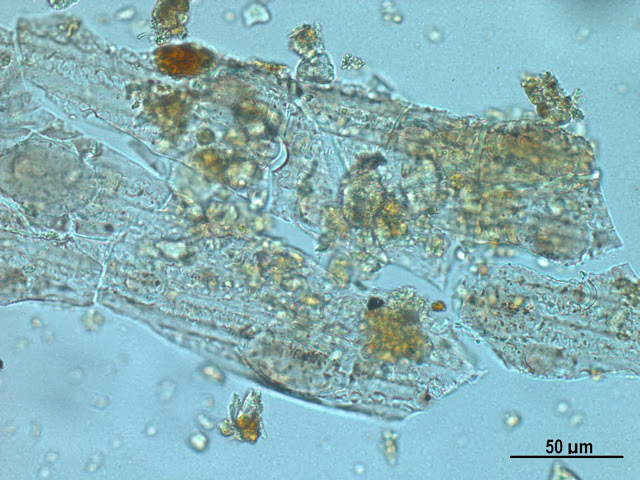
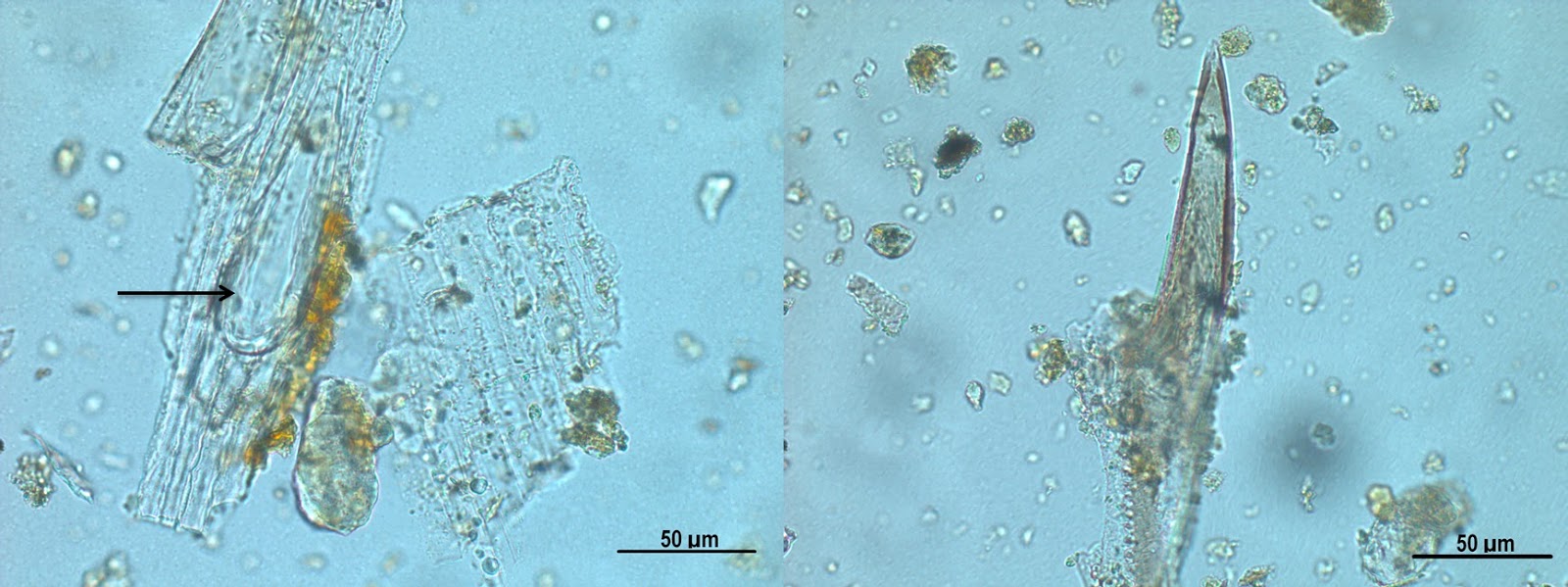
One of the nicest things about my job is hearing about the successes of past students. It makes me genuinely happy to see students with enthusiasm and passion for environmental archaeology go on to build successful careers. I taught my first postgraduate students during my time at Edinburgh back in  2013, and they are all doing so well. One recently finished a PhD and gained a great postdoctoral position, another is on track to finish their PhD very soon and has recently published their first paper, and another has a fantastic job as a research technician in a top environmental archaeology lab. I had an email from the latter recently regarding the identification of some unknown phytoliths. They appear to be generic grass long cells, but have odd striations that I have never seen before. The striations are all in the same direction - could this be an artefact of processing or is it surface decoration? I am not sure about surface decoration, it looks a bit too regular. has anyone see...

Training in Belize!

Image
2016 - the year where the exciting news just keeps on coming! I found out recently that I've been selected to take part in a NERC training course, Fieldwork Skills in the Tropics, run by the Royal Botanic Gardens Edinburgh , as part of their MSc in Biodiversity and Taxonomy of Plants . The course runs over two weeks next year, in Belize! It's been over a decade since I first left the UK on my first fieldwork abroad, but the thought of travelling somewhere new is still as exciting now as it was then. Probably even more so as I have some idea what I'm doing now. This course covers vegetation survey, monitoring and plant identification, with some GIS. Part of the application process involved a statement of why you would like to attend, with priority given to those with NERC funding, ECRs and students. Whilst I now work as an archaeologist, my background is in geosciences/geography, and I've always maintained that perspective in my research and teaching. My long term aim is...

Micrograph: Unusual archaeobotany

Image
As a micromorphologist something that you begin to notice quite quickly is that plant remains come in a huge variety of forms. Whilst at the macroscale we usually think about charred remains - wood charcoal, burnt seeds and grains - at the microscale there is a whole world of other plant remains. Phytoliths and other microfossils are something I talk about quite a lot in this blog, and these are becoming a standard form of 'plant evidence' alongside plant macros. More unusual are pseudomorphic voids, plant remains that are no longer there! I have talked about these a lot in previous posts , basically they are 'impressions' of plants that have since decayed. The micrographs below show something a bit in between. The plants haven't fully decayed, as they were partially desiccated. The orange colour you can see is where the organic matter from the plant has stained the calcareous aggregate (probably some sort of architectural material). In the voids you can see remains...

Microfossil of the Month: Discus diatoms

Image
Almost forgot to post a microfossil for November! That would be sad as I've managed to do the monthly micrograph then microfossil posts every month for almost two years now. I've just been so busy with teaching, and the lack of microscope camera makes taking pictures a bit more of an effort than it used to be. Good news is that we do have a new set of microscopes and cameras for the archaeology lab here at Newcastle, hurray! The lab however is located in a different building to my office, so photograph acquisition still requires a bit more planning than it used to. As it is almost the end of 2015 (yikes), I am thinking of a new monthly blog feature, perhaps a thin section of the month, where I show you exciting pictures of whole thin section slides! But for now, here is something very pretty. Like the sponge spicules I posted earlier in the year , these little creatures are not my specific area of expertise, but they occasionally show up in my phytolith slides. They are littl...

Microfossil of the Month: Which Wood?

Image
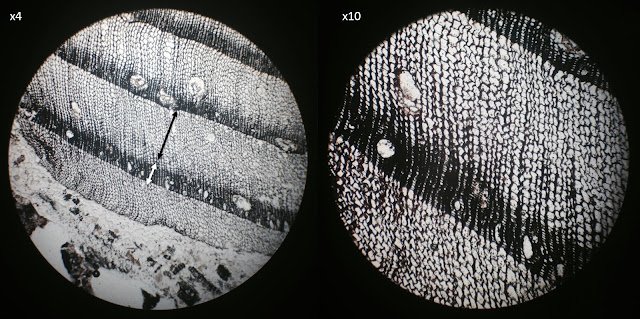
Something a little bit different for October. This fits in nicely with what I've been up to this week, preparing teaching materials on wood charcoal analysis in archaeology. Although I am not technically a wood specialist, I am wondering if I should pick up a new skill set, as it would actually be very useful as a thin section micromorphologist. This image shows a cross section through an unidentified fragment of wood charcoal in a thin section of sediments from the tower at Cesis Castle, Latvia . There are layers within the sediment that are full of tiny wood charcoal fragments, and actually we see bits of wood a lot when looking at thin sections of ash samples, unsurprisingly. You can see the annual rings quite clearly in this fragment, and it can be identified as a soft wood species (coniferous) due to the lack of pores. Soft woods are a bit more difficult to identify than hard woods (from deciduous trees), as their structure is more simple and less distinctive. In this example ...

Microfossil of the Month - Globigerina Ooze

Image
A bit of a geoscience themed iPhone micrograph for September (I am getting quite good at this iPhone down the eyepiece photo taking thing). Yes, there really is a sediment called ooze... Globigerina  ooze! Archaeologists are probably aware that much of our global scale climate reconstructions come from the isotopic analysis of deep sea sediment cores, and  Globigerina ooze is one of these sediments. Huge areas of the ocean floor are covered in this stuff, which consists largely of the shells of various foraminifera, of which the species Globigerina bulloides is the most common. The shells of these little creatures are composed of calcium carbonate (CaCO 3 ) and it is the oxygen component of this that is used for oxygen isotope analysis in the  reconstruction of  temperature in the past. The name  Globigerina  ooze was first used to describe the sediment during planning and construction of the earliest transatlantic telegraph cables. They are ve...

Microfossil of the Month: Fragile phytoliths

Image
I promise brand new images will be coming soon, but for now here is a micrograph from my old files, this time from my work with the Central Zagros Archaeological Project back in 2010, and is from ashy deposits in an external area at the Neolithic site of Sheik e Abad in Iran. This is a great example of a conjoined phytolith that is not particularly well silicified and/or has suffered erosion. The pattern of the cells is not very distinct, and quite 'faint', though you can just about make out the wave pattern of the long cells in places. For comparison, see this example of well-silicifed wheat phytoliths from Catalhoyuk, and this reference specimen of Setaria italica , both of which have very distinctive and well defined cell morphologies. The reason I chose this micrograph is that it is a very good example of how fragile phytoliths are. Despite being composed of silica, which is pretty resistant to decay, phytoliths are physically quite fragile. Think of it like glass - it i...

Microfossil of the Month: Setaria italica tissue phytoliths

Image
Last month I thought that I would be unable to post any new micrographs for a while, however with a stroke of luck, and digging out of an old hard drive, I came across all the files from my PhD thesis! A stark reminder of the importance of proper archiving of digital image files, I must have hundreds of images that have not been catalogued properly...I'll add that to the to do list! Here we have a micrograph of a reference specimen of Setaria italica, more commonly known as foxtail millet. In this image you can see that this is a very well silicified bit of plant tissue, with all the individual cells being clearly defined. This is a leaf fragment and you can see the spikey hair phytoliths, which are also called trichomes. the little 'dumb-bell' shaped short cells are known as bilobes or bilobate cells. These bilobes are typically found in plants with C4 photosynthesis, and can give an indication of the broad type of environment. C4 refers to the biochemical mechanism that ...

Microfossil of the Month: Multi-celled Sedges

Image
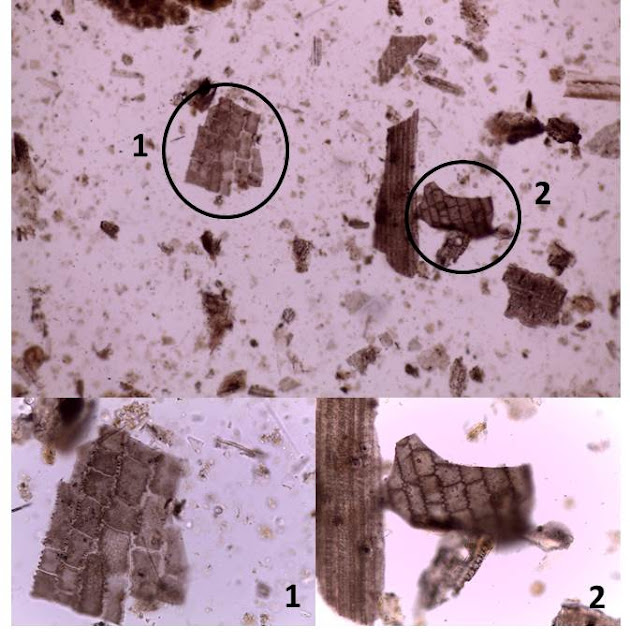
Yikes, I can't believe it's already June, and time for a new microfossil! This month we have firstly a general view of a phytolith slide from the site of Boncuklu in Turkey , at x100. This just gives you a taste of how chock full of microfossils these slides are! I have highlighted two particular phytoliths here shown at x400, both are conjoined phytoliths from sedge. Sedges, or Cyperaceae, are monocots which are similar to reeds, and are associated with wetlands. Though significantly, it should be noted that they can be found in other types of environment as well. At Boncuklu we know from other environmental work that a local wetland habitat was quite likely, and we also see a lot of reed phytoliths in these samples. The blocky square pattern is typical of sedge phytoliths, though it is difficult to say anything about which species they might be from. This sample is from an ashy layer in a midden deposit, and it could be that the sedges were burnt alongside reeds, either delib...

Microfossil of the Month: Wheat husk phytoliths

Image
This month's microfossil is a classic, at least within near eastern archaeology. The beautiful little structure you are looking at here is a phytolith from the husk of wheat. A huge area of research in phytolith studies is focused on cereals, and whether cereal phytoliths can be used to identify the genus or even species of cereals, and whether we can distinguish cultivated cereals from wild grasses. This obviously has very significant potentials in studying the origins and development of agriculture. This particular phytolith is from the middle Neolithic levels at Catalhoyuk , Turkey. At this point we have definitive evidence for agriculture from other lines of evidence, such as charred cereal grain stores within buildings. This phytolith was recovered from a midden, and is interesting because of its size. There is a positive correlation between the size of conjoined phytoliths and the availability of water during the growth of the plant. you can see that this phytolith is very la...

Microfossil of the Month: Jigsaw phytoliths

Image
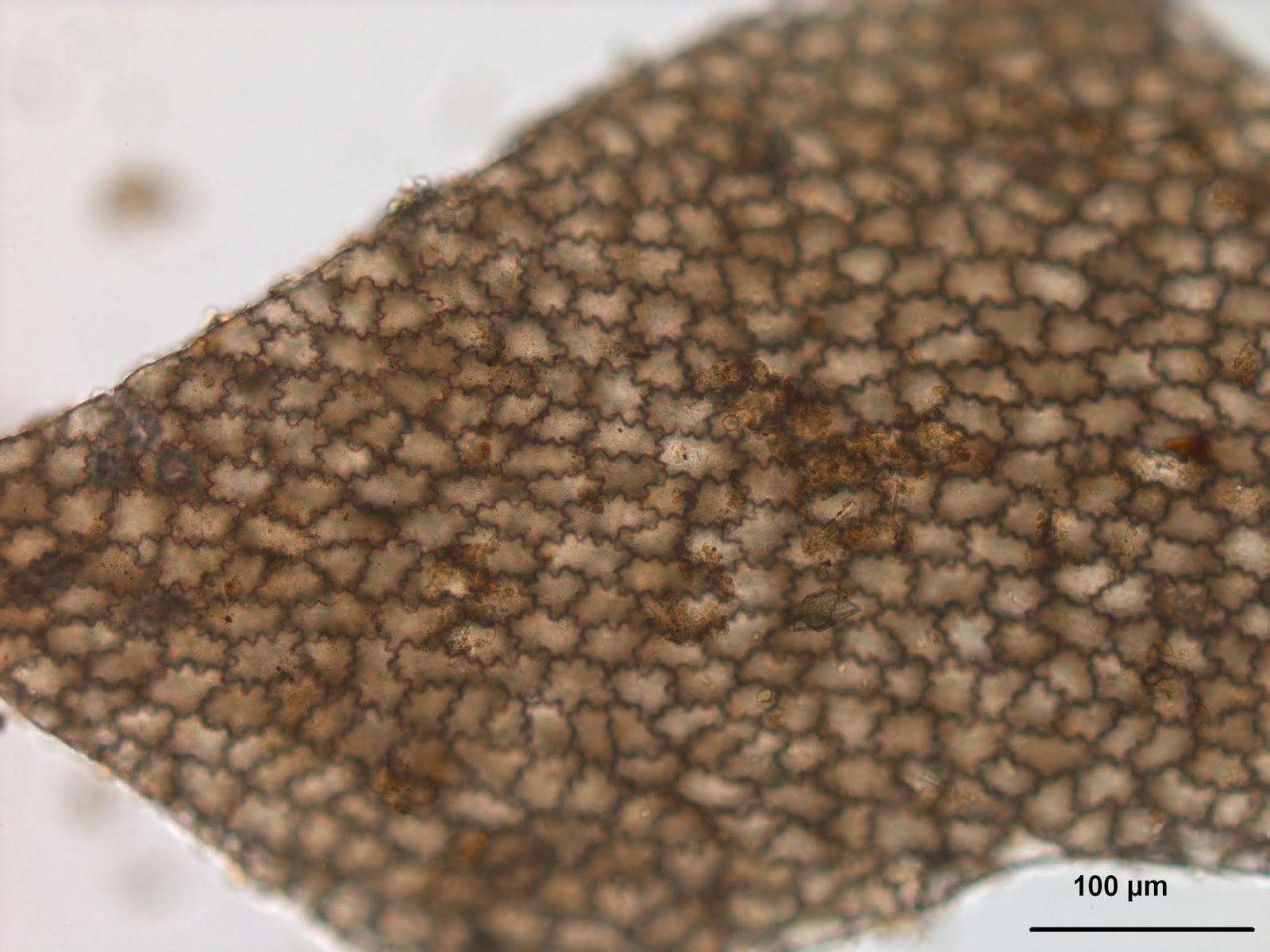
This month's microfossil is a 'jigsaw' phytolith, or rather phytoliths, as it is actually a tissue fragment consisting of multiple conjoined silicified cells. These jigsaw types are associated with the epidermis of woody dicotyledonous plants, though they are also found in herbaceous plants. The two images show the same phytolith in two different focal planes. The uppermost image being the upper epidermis, and the lowermost image showing the underlying layer of 'regular' shaped cells, or the palisade mesophyll layer. The sample this was extracted from is from Sheik e-Abad in Iran, an early pre-pottery Neolithic site, though in terms of food, the plant remains suggest the people were relying to a large extent on non-domestic resources. What makes this sample particularly interesting is the context, within a layer of dark grey calcitic ash, as identified through thin section micromorphology. Dicot phytoliths account for 10% of whole assemblage, which is a lot conside...

Microfossil of the Month: Awn phytoliths

Image
These micrographs show grass awn phytoliths, on the left the spiky hair part is still attached to the rest of the awn, the one on the right shows a hair that has become detached. Awns are hair or bristle type structure which are particularly common on grasses. In some species, such as emmer wheat, the awns contribute to seed dispersal, by hooking into the soil. Changes in humidity cause the awns to expand and contract, acting like a ratchet to propel the seed into the ground. Not to be confused with trichomes, which are another 'hair-like' structure, but a much finer growth of hairs on the surface of the epidermis, and can also produce distinctive phytoliths. Both of these examples are from the same sample, extracted from ashy deposits in an external area at Sheik-e Abad, an early pre-pottery Neolithic site in Iran. The site was excavated as part of the Central Zagros Archaeological Project . I worked there for 2 months after submitting my PhD in 2008, one of the most fascinat...

Microfossil of the Month: Sponge Spicule

Image
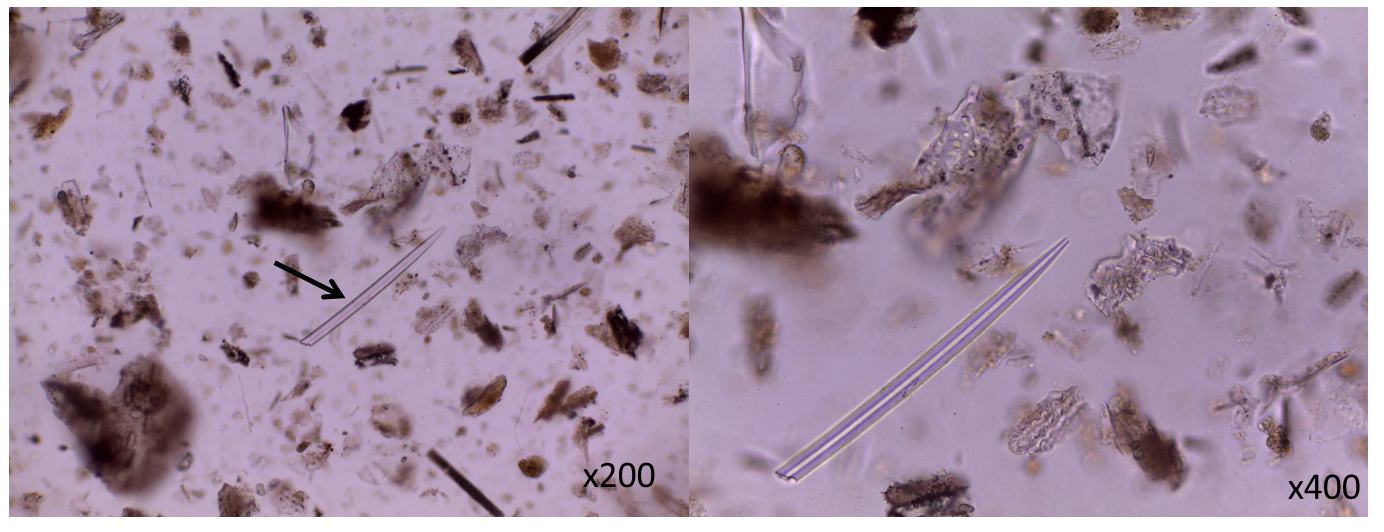
Something a little bit different - this month I have an image of a siliceous sponge spicule! This show up occasionally in my phytolith slides, and are very distinctive. Sponges, or poriferans to give them their scientific name, are characterised by an unusual feeding system that involves drawing water in through little pores in the outer walls, and filtering food from the water as it moves around their bodies, before being pumped back out again. This flow of water occurs in one direction and is driven by beating flagella. Sponge spicules provide structural support and protection from predators. They come in all sorts of shapes each with a different name - the single spike shape that you can see looks like a monaxon, though it is also possible that is has broken off a larger 'polyaxon' type. The formation of spicules seems to be better understand than that of my other favourite siliceous microfossil, the phytolith, and is controlled largely genetically, but with environmental c...

Microfossil of the Month: Plant Stomata

Image
For 2015 I have decided to replace my Micrograph of the Month feature with Microfossil of the Month. I will likely return to the thin section micrographs at some point, but as I am going to be working on phytolith and ash samples for most of this year, I figured it would make sense to feature some of these on the blog! Who knows how long I will be able to keep it up - from past experience of the sites I am working on, I may be limited in the range of examples that I will find! As a refresher (and for those of you new to the blog), microfossils are any fossil remains that are too small to see easily with the naked eye, but can be identified under the microscope. I work on plant microfossils, specifically silica phytoliths, which are 3D 'impressions' of plant cells and tissue. When the plant is alive, it takes up silica from the ground, which is then deposited inside and between the cells, forming 3D replicas of the cells that preserve when the organic part of the plant decays. T...