Posts

Showing posts with the label landscape

Human-environment interactions in the Hadrian's Wall Landscape

Image
You wait a whole year for a blog post, then two come along at once etc. Following the existential musings of the previous post, I figured I'd better post some fun geoarchaeological stuff. I have been working with a number of colleagues on various projects for the past couple of years, that are loosely related, and fall under the general banner of Human-environment interactions in the Hadrian's Wall Landscape. Regular blog readers will remember in 2021 I talked about the new  excavations at Birdoswald . These have been progressing nicely, and we have uncovered all sorts of amazing finds and environmental material. I have also been working with Dr Eline Van Asperen, and Masters student Damian Rudge, looking at long term changes in the environment, and whether these relate to Roman or earlier activities such as lead mining. In 2022 we were awarded a small grant from the Royal Archaeological Institute  to collect some peat cores with the aid of local volunteer groups. Eline a...
Stonehenge is in the news again

Stonehenge is in the news again. This time, because the plans to deal with the traffic situation have finally gone ahead, and it has been decided that the problem will be solved by digging a tunnel and re-routing the problematic road away from the monument. This is a plan that has been considered and debated for many years now, and in fact one of my most read blog posts was a reflection, back in 2014, in response to the tunnel plan about what we mean by the 'landscape of Stonehenge' . My thought is that there is no such thing as a pristine landscape, and the area has so much more history than just the Neolithic. But I am very sympathetic to the traffic issues, and realise that there are multiple considerations when it comes to heritage management.  For clarity, I am not strongly for or against the tunnel. Dr Tess Machling has posted some very insightful threads on this , and I think my feeling is generally in line with hers. I don't believe the tunnel to be the best solutio...

New project: TerraSAgE: Terraces as Sustainable Agricultural Environments.

Image
I am excited to announce a new AHRC research project starting at Newcastle  in January,   TerraSAgE: Terraces as Sustainable Agricultural Environments .The project is led by PI Prof. Sam Turner, and I am one of the project coIs, overseeing the geoarchaeological aspects of the project. Sam and his team have been doing pilot studies for this project for a while now, developing a new OSL dating method to understand the chronology and formation of agricultural terraces from prehistory to historic periods. I became involved in the project last year to advise on geoarchaeological and soil science approaches to the analysis of archaeological and historic terraces. The major aims of the project are to understand how and when terraces were constructed and how they were maintained and managed, and how this varies in different geographic regions, and in different time periods. We also want to understand why terracing developed, and conversely, why it was abandoned in some places but not...

Teaching Geoarchaeology Field Skills

Image
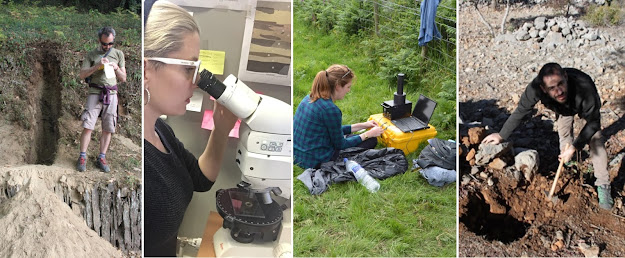
As part of a postgraduate module I am co-convening, Landscape Archaeology: Theory and Practice, I will be taking a group of Masters students into the field in a few weeks time to teach them the joys of soil transect surveys. We've even bought a brand new shiny hand auger kit. I am quite pleased with how the handbook and plan have turned out. We're lucky to have the amazing landscape of Northumberland to work with, and the area we are looking at, Milfield Basin, has had extensive archaeological and geoarchaeological analysis so there is plenty of background material for the students to refer to. Preparing this exercise has been strange in some ways and almost nostalgic, as this was one of my first experiences as a geoarchaeologist. As part of my MSc Geoarchaeology, we were tasked with doing a borehole survey and writing it up like a professional commercial report. I remember distinctly the terror of being sent out with a hand auger, and being left to get on with it. There is not...

First NERC project meeting in Oregon

Image
The NERC project officially started on the 1st November. Since then we've held interviews for the first PDRA post, and last week I traveled to Oregon for the first project meeting with partners Dr Dennis Jenkins and Dr Tom Stafford, at the Oregon Museum of Natural and Cultural History . It felt very surreal, finally having got the grant that we talked about for so long, and to be honest, did not quite expect to get! Not that we all don't think it's an amazing and worthwhile project, but getting funding for archaeological science is pretty difficult, and the success rate for NERC is really low ( 11% for the standard grants, new investigator scheme in 2015 ). I've made this journey many times, as I have family in central Oregon, but I must be getting old or something as the jet lag really kicked in this time. Still, many coffees later we had a productive meeting, going over the schedule for the next three years, planning the first session of fieldwork in the Spring, and g...

Conferences and famous trees

Image
One of the main reasons I started my blog was in an effort to promote the first conference I organised, back in 2012 . After the stress and time it took  I told myself I was going to take a break from organizing big events. But now I've had a few years off I'm going to do something even bigger and better (hopefully!) for the 7th Developing International Geoarchaeology conference, which I'm pleased to say we will be hosting at Newcastle University in September 2017 . The call for papers is likely to be issued towards the end of this year, so follow us on Twitter and/or Facebook for updates. DIG is one of the first conferences I went to as a PhD student, and I am pleased to be focusing more on specialized events at the moment, after a few years doing the SAA and EAA . Those huge conferences are great for catching up across a wide range of research areas, but I find them very exhausting and not so good for networking. I'm much better at interacting with people in a mo...

Landscape

Image
Rolling hills and jagged peaks, bubbling brooks and flowing creeks, Vast swathes of trees turn green to gold, with hues that shift in ebbs and flows, Ten thousand bricks in reds and browns, transforming clays from cliffs to towns; And here between the sea and land, the speckled straw expanse of sand, Gleaming towers, slate grey tiles and tarmac trails extend for miles, Twinkling stars and harbour lights, to sodium glare transforming nights, Shades and dancing shadows bright, creating shifting city sights; And there beyond the winding road, stand stones with tales from long ago, What tales perhaps we’ll never know, symbolic meanings come and go, In landscape then and now align, a layered view of place and time.

From the microscale to landscape

Image
A nice bit of good news for the end of the year - I was recently appointed as assistant editor and social media editor for Landscape Research , the academic journal of the Landscape Research Group , which is published by Routledge. This means that in addition to normal editorial duties (assessing manuscripts, assigning reviewers, encouraging a quality and speedy publication process), I am also responsible for developing the social media profile of the journal. In particular, I hope to build the audience in the archaeological community, and encourage collaborative, interdisciplinary approaches to researching and understanding landscapes. I blogged recently about how I jump in between disciplinary pigeon-holes , and the study of landscape is an area that falls into many categories. The individual elements of a landscape are from the past and present, the natural and the cultural, the tangible and the intangible. In order to understand the landscape as a whole, we need to investigate th...

The landscape of Stonehenge?

Image
Stonehenge c. 1885. Wikipedia. 10th battalion CEF marching past Stonehenge1914–15 Wikipedia It was announced earlier today that the A303 road which currently runs past Stonehenge will be re-routed through a tunnel, to remove it from view of the monument. This follows the closing of the A344 earlier last year. Although this is being done for the benefit of visitors who apparently complain about the road, I myself have mixed feelings about it. Which is odd, as I am the sort of person who generally prefers landscapes of trees and 'nature' to one of city skylines and roads. I guess the major thing that bothers me is the definition of a landscape as somehow belonging to Stonehenge. I am assuming we are trying to revert to what the landscape may have been like at the time Stonehenge was in use, by Neolithic people.  A303 road in 1930 from Stonehenge: a history in photographs Even if we could provide a truly accurate picture of what the landscape was like at this time,...