Posts

Showing posts with the label GC/MS

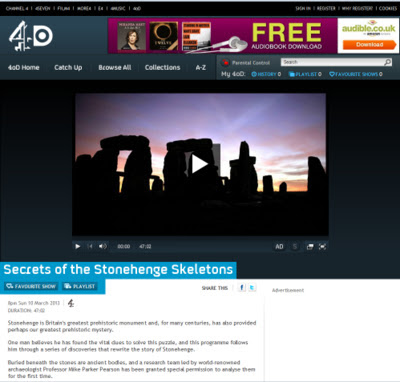
Secrets of the Stonehenge Skeletons
Image
My postdoc work on the pottery residues for the Feeding Stonehenge project was featured on the Channel 4 documentary last night Secrets of the Stonehenge Skeletons. The organic residues PI, Dr Oliver Craig did a great job of explaining the methods we have been using, with a few hints at our results - full details won't be available until we publish the research towards the end of the year (and complete our statistical analysis to confirm our interpretations!). The work is also featured as one of this week's main news stories on the University of York website here and the Department of Archaeology news page here . http://www.channel4.com/programmes/secrets-of-the-stonehenge-skeletons/4od As Ol explains, this is one of the largest studies of pottery residues from a single site (over 300 individual pots were analysed), and by designing a sampling strategy with GIS and other specialists, we have been able to investigate spatial differences in pottery use across the site, be...

Mass Spec Maintainance and Visual Media

Image
Today was spent mostly taking apart complicated bits of kit and putting them back together again. We had a training course in GC/MS maintainance, including such delightful topics as cleaning the ion source (quite pretty and shiny I think), and troubleshooting for low sensitivity. It's really interesting getting to learn more about how this sort of equipment is put together. Reading the theory of how it all works isn't the same as seeing all the bits for yourself, and working out how it all goes together. Something that looks incredibly complex to begin with gradually becomes less scary and more familiar. I took photos of various stages of the cleaning process to remind myself what to do in future. This particular image reminded me of the USS Enterprise. Don't you think? See the door in the background, and the entrance to the Jefferies tube in the floor. No? Following the maintainance course I went to this weeks' Heritage Research seminar over in King's Manor,...

Feeding Stonehenge - food residues in Neolithic pots

Image
Lab day today, finishing off the last batch (for now) of pottery samples from Durrington Walls . Bit of background - my main research project at the moment is to investigate patterns of food consumption at Durrington Walls, the Neolithic settlement associated with Stonehenge. This involves selecting pottery from different parts of the site, extracting food remains, and seeing if there are differences across the site. Fatty food residues survive suprisingly well in prehistoric pottery (well, some of it, depending on the preservation conditions and other factors). They can be extracted quite easily in the lab by grinding up a small portion of the pottery and shaking it with solvent. The fatty residues dissolve into the solvent, and can then be identified by injecting the solvent into a GC/MS. In basic terms, the GC/MS seperates out all of the different parts of the food residue so we can identify the different components, and the result is something like this. Each of the peaks is a diff...