Posts

Showing posts with the label Cesis

Microfossil of the Month: Which Wood?
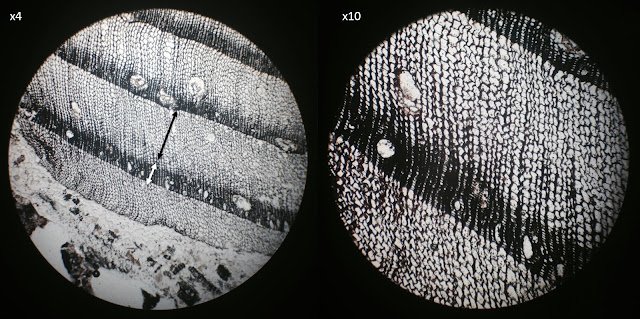
Image
Something a little bit different for October. This fits in nicely with what I've been up to this week, preparing teaching materials on wood charcoal analysis in archaeology. Although I am not technically a wood specialist, I am wondering if I should pick up a new skill set, as it would actually be very useful as a thin section micromorphologist. This image shows a cross section through an unidentified fragment of wood charcoal in a thin section of sediments from the tower at Cesis Castle, Latvia . There are layers within the sediment that are full of tiny wood charcoal fragments, and actually we see bits of wood a lot when looking at thin sections of ash samples, unsurprisingly. You can see the annual rings quite clearly in this fragment, and it can be identified as a soft wood species (coniferous) due to the lack of pores. Soft woods are a bit more difficult to identify than hard woods (from deciduous trees), as their structure is more simple and less distinctive. In this example ...

Micrograph of the Month: Modern roots

Image
In your sediments, post-depositionally disturbing your stratigraphy. Here we have examples of roots from modern plants that have grown into the archaeological deposits. They are easily distinguishable from archaeological plant remains as the tissue is fresh, organic and well preserved. Photo A shows a root that has grown into soft, ashy, compact midden at Boncuklu, Turkey. You can see clearly the void that has been created from the root's growth, which is the same shape as the root itself (3). We can also see a fragment of shell (1) and some small crushed bone fragments (2) embedded in the deposits. Photos B and C show close ups of modern root from Cesis Hillfort, Latvia. In B you can see where the root is divided into two rootlets whilst C shows the cell structure very clearly. Each of those 'jigsaw' shapes is an individual cell - it is cells like this that become infilled with silica during the growth of the plant, to produce phytoliths. This example of 'jigsaw' s...

Quo vadis? Cesis!

Image
Back in the lab after a week in the field in Latvia, taking micromorphology samples for the Ecology of Crusading project at Cesis Castle . As I was only there for the week I missed all the fun of actually excavating the trench and uncovering exciting stuff like the fully articulated horse skeleton (hence the nickname 'horse trench'!), and horse related paraphernalia including bridle bosses, spurs and stirrups. Wet muddy trench of doom This did mean that I had a nice fully exposed section to work with, which makes it much easier to work out the best locations for taking micromorphology blocks - in this case to identify the surface residues on the floor and test the hypothesis that this was stable. The benefit of this however was perhaps outweighed by the fact the trench was filling up with water as I collected the samples, and the presence of a huge waterlogged beam conveniently located right where I needed to stand, making it a rather muddy business with some preca...