Posts

Showing posts with the label fuel

Experiential experiments

Image
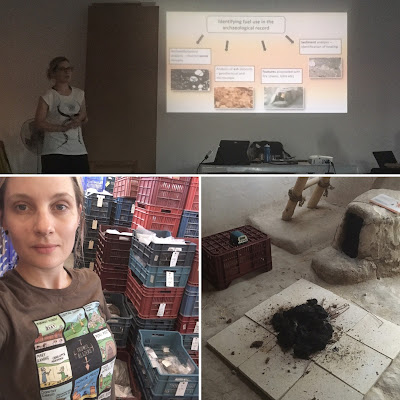
We've spent the past couple of days doing burning experiments in the reconstructed mudbrick house at Catalhoyuk, as part of our Wellcome Trust project. The aim of the experiments is to collect some pilot data relating to smoke emissions when ovens and hearths are in use. We don't have time in the pilot study to conduct a detailed series of controlled experiments - there are a lot of different variables that could be adjusted to test different scenarios - but we do hope to get some basic comparisons of different fuel types and how emissions change over a few hours of burning. I think the most useful part of doing this pilot work has been the practical side of things, the experience of having to find the materials for fuel, finding out how much fuel works best (and at what point there's too much fuel and you get smoked out of the house), observing how different people react differently to smoke levels. We tried using animal dung but it smouldered really badly, which we reali...
Catalhoyuk - Wellcome project

Image
After yesterday's musings I figured I should post about some of the fun archaeological stuff I've been up to at Catalhoyuk this week. The reason we are here this year (we being myself and project postdoc Helen Mackay ), is that we were lucky enough to be awarded a grant from the Wellcome Trust. We are collecting archive samples to export for analysis, doing some burning experiments in the reconstructed mudbrick house, and general networking and scouting for collaborators for when we (hopefully!) do the full sale research project. The focus of the Wellcome project is to investigate the potential relationships between 'biofuel' use and respiratory health in the archaeological record. The materials that people used for fuel in the Neolithic (wood, dung, reeds etc) are being promoted today as sustainable alternatives to fossil fuels, however there has been a lot of research showing that these fuels are actually just as bad for respiratory health as fossil fuels. Biomass ...

Ladies of the Midden Kiln

Image
Back in March I mentioned that I was involved in a sciart collaboration, where artists and scientists come together to work on collaborative art projects, inspired by scientific research. I love this idea. I was always really into both art and science growing up (and took Art as an A Level subject!), and although I choose to go down the 'science' route for my career, I have maintained a keen interest in art, and particularly how we can use artistic expression to communicate scientific research. The artist I have been working with is Molly McEwan , an Edinburgh based artist and graduate of Duncan of Jordanstone College of Art and talented ceramicist.  The photos to the left are a sneak preview from Molly's exhibition at Wednesday's Girl, a free exhibition showcasing the work of female artists from Scotland, held at Space Club and supported by Somewhere To , an organisation provides spaces and venues for young people across the UK. Molly's solo exhibition , ...

Power from Poo! And, should archaeology strive for modern day relevance?

Image
I had one of those moments this morning when I realised how odd my career sounds to those outside academia, as I found myself Googling 'Newcastle poo blog' in an attempt to find a blog I came across a few weeks ago, when I posted a fab cartoon called ' A Day in the Life of Poo '. Are there many people out there who talk about poo on a semi-regular basis? Parents of small children perhaps. My own work on poo has been on the fossilised variety, known as coprolites, but I also follow research on modern faecal analysis, particularly biofuel research and waste water analysis, as both are related to my work and interests. My research on the use of animal dung and reeds as fuel in prehistory for example draws heavily on studies of the modern use of such fuels, and how we can use archaeological case studies to inform modern biofuel policy. Likewise, one of the main methods that I use to analyse archaeological materials, faecal biomarker analysis, was developed by environmental ...

Microfossil of the Month: Plant Stomata

Image
For 2015 I have decided to replace my Micrograph of the Month feature with Microfossil of the Month. I will likely return to the thin section micrographs at some point, but as I am going to be working on phytolith and ash samples for most of this year, I figured it would make sense to feature some of these on the blog! Who knows how long I will be able to keep it up - from past experience of the sites I am working on, I may be limited in the range of examples that I will find! As a refresher (and for those of you new to the blog), microfossils are any fossil remains that are too small to see easily with the naked eye, but can be identified under the microscope. I work on plant microfossils, specifically silica phytoliths, which are 3D 'impressions' of plant cells and tissue. When the plant is alive, it takes up silica from the ground, which is then deposited inside and between the cells, forming 3D replicas of the cells that preserve when the organic part of the plant decays. T...

Return to the Ness! Day 1

Image
Layers of ashy midden deposits sitting on glacial till A dizzying view of excavations in Trench T After a small adventure involving delayed flights, gale force winds and navigating with no GPS signal (how did we ever cope before smart phones with Google Maps?), I finally arrived in Orkney yesterday. This is actually the last week of excavation before the trenches are covered over until next year, so it’s all very quiet on site. Most of the students have left, and the remaining teams are working to complete recording by the end of the week. I have had a quick tour around to get a feel for what’s happened since I was here last year, and have spent today planning my sampling strategy. As usual so much is going on and there’s plenty for a micromorphologist to do. This year I am focusing on collecting samples from middens in Trench T. Regular blog readers will have seen the snippets I’ve posted about my analysis of middens in the central excavation areain 2013 . Although analysis o...