Posts

Showing posts with the label Turkey

Microfossil in a Micrograph of the Month

Image
It's been a while since I did a monthly microfossil or micrograph post, so I thought I would share this nice example of something combining both. This is a midden deposit from the early Neolithic site of Bonkulu in Turkey - the large greyish object in the middle is a very highly silcified conjoined phytolith from a reed stem/leaf, embedded in a matrix of mixed ashy debris. There is a resemblance to an earlier micrograph I posted from the Babylonian site tell Khaiber, which also contains large mutlicelled reed phytoliths. The deposits at Boncuklu are chock full of these large Phragmites reed phytoliths, likely to be from burning these substantial plants as fuel. The macrobotanical record from the site also contains large volumes of reed stem charcoal.

Experiential experiments

Image
We've spent the past couple of days doing burning experiments in the reconstructed mudbrick house at Catalhoyuk, as part of our Wellcome Trust project. The aim of the experiments is to collect some pilot data relating to smoke emissions when ovens and hearths are in use. We don't have time in the pilot study to conduct a detailed series of controlled experiments - there are a lot of different variables that could be adjusted to test different scenarios - but we do hope to get some basic comparisons of different fuel types and how emissions change over a few hours of burning. I think the most useful part of doing this pilot work has been the practical side of things, the experience of having to find the materials for fuel, finding out how much fuel works best (and at what point there's too much fuel and you get smoked out of the house), observing how different people react differently to smoke levels. We tried using animal dung but it smouldered really badly, which we reali...

Off to Catalhoyuk, via Olynthos

Image
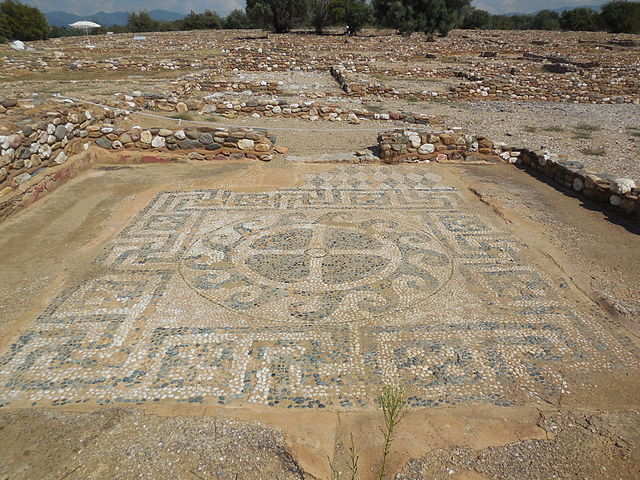
It seems like I only just got back from Oregon and I'm off again, this time to Catalhoyuk in Turkey, via Olynthos in Greece. I am really excited about the Olynthos project . Although I am no expert in ancient Greece, I was always fascinated by the mythology as a child, and it will be great to finally visit Greece. I was invited to join the project as a geoarchaeologist, specifically looking at the micromorphology of floor deposits in collaboration with the archaeobotany and geochemsitry experts. The excavations are co-directed by Lisa Nevett  at the University of Michigan in collaboration with the Greek Ministry of Culture & Sports and the British School at Athens . One focus is the excavation of house Bix6 on the North Hill. New data on artefacts and their distribution as well as geochemical testing by fellow geoarchaeologist  Carla Lancelotti have indicated broad spatial differences in uses between rooms in the building. I will be applying sediment micromorphology to ...

A day in London

Image
I was hoping to post this whilst on the train but the not so great free wifi scuppered my plans. I arrived in London yesterday evening following a day of exam board meetings. The exam board is where we go through all the marks and see who has passed, what grades they have, and who gets prizes. The whole process is anonymised until final marks are confirmed, then we get to see who got which prizes. I was really happy to see some of the first students I taught when I joined Newcastle finish their degrees and do so well! No names though as I'm not sure the details have been released to students yet. So, I'm in London for two reasons - firstly to go to an appointment at the Turkish consulate to collect visas for myself and other team members for fieldwork at Catalhoyuk in July, and secondly for University Archaeology Day . I think the last time I went to Turkey was 2013 - how time goes by so quickly! Up until then I had been pretty much every year since 2004! University Archaeol...

Field season is about to begin

Field season is beginning a bit earlier than usual for me this year. 2015 - 16 was wonderfully successful in terms of project development and grants, which in turn means that there is a lot going on in 2017. The first round will start at the end of next week, when I will be heading off to Oregon for the main period of fieldwork for the NERC project at Paisley Caves, which I've been blogging about a fair bit. I can't wait to be back in central Oregon getting my hands dirty, literally. It is such a beautiful landscape, very quiet and we'll be a small team, which I prefer. We'll be camping near the site, and taking showers at Summer Lake Hot Springs.  So the stress of sampling at such an important site will be rewarded with a bit of relaxation at the end of the day! When I get back from Oregon I'll be making frantic arrangements to get my research visa for Turkey. This involves leaving your passport on the consulate in London for 1-2 weeks, which is a bit difficult w...

I love middens

Image
We are in the process of updating the School website for History, Classics and Archaeology at Newcastl e. I've been asked to provide some high resolution photos for various sections, and so have been digitally digging through my image archive. I came across this amsuing photo from 2004 - my first ever visit to Catalhoyuk . It was either during my MSc or just after I finished. So long ago that I still dyed my hair black! I remember this midden - I think it was Unit 1668, and probably isn't there anymore. The first midden I worked on, looking at archived micromorphology slides at the University of Reading, and trying to compare the phytolith data from the same units. Although the Masters project had a lot of limitations (working with archive samples is very difficult when trying to compare microstratigraphic data), the lessons I learned formed the basis of the project I went on to do for my PhD. So I still have a soft spot for this particular midden! These were taken using one of...

Ladies of the Midden Kiln

Image
Back in March I mentioned that I was involved in a sciart collaboration, where artists and scientists come together to work on collaborative art projects, inspired by scientific research. I love this idea. I was always really into both art and science growing up (and took Art as an A Level subject!), and although I choose to go down the 'science' route for my career, I have maintained a keen interest in art, and particularly how we can use artistic expression to communicate scientific research. The artist I have been working with is Molly McEwan , an Edinburgh based artist and graduate of Duncan of Jordanstone College of Art and talented ceramicist.  The photos to the left are a sneak preview from Molly's exhibition at Wednesday's Girl, a free exhibition showcasing the work of female artists from Scotland, held at Space Club and supported by Somewhere To , an organisation provides spaces and venues for young people across the UK. Molly's solo exhibition , ...

Micrograph of the Month: Bits of Bones

Image
For the past few weeks I have been revisiting some old slides from the TP excavation area at Catalhoyuk . I collected these samples  in 2004, and they were some of the first that I worked on for my PhD. At the time I found them a bit disappointing, as there is a lot of bioturbation and erosion  going on in this part of the site, which means that trying to reconstruct activities using microstratigraphic analysis is difficult. The TP area is located very close to the surface of the mound, so despite the fact that these are the youngest deposits, the preservation is nowhere near as good as the earlier, deeply buried deposits. In the end I focused more on the South and 4040 areas, with the TP samples being used as a brief comparison of how different the taphonomic processes are in different parts of the site. Which brings me on to this month's photos! I was contacted by Kamilla  PawÅ‚owska who is conducting zooarchaeological analysis in the TP area, and is...

Micrograph of the Month: Melted Silica Bubbles

Image
Melted silica in ashy deposits at Neolithic Boncuklu (Turkey) above, and Kamiltepe (Azerbaijan) below. Silica is one of the most common components of plant ash, and is often seen in the form of phytoliths. In the case studies I have worked on, phytoliths in ash can have >50% abundance in thin section, and there may be millions of them per gram of sediment. Less common are these features, also composed of silica but with a very different appearance. These are 'bubbles' of melted silica, and they occur when silica is present in conjunction with alkali salts. Heating under these conditions causes the silica to melt and form what has been termed a 'glassy slag' or vesicular glass (e.g. see Canti 2003). The word vesicular refers to the gas bubbles you can see within the larger silica mass (also bubble shaped!). I prefer to call it melted silica rather than use the word 'glass' as it can be confusing in an archaeological context. The two examples here are from...

Taking over the world, one slide at a time

Image
So, I’m back from holidays in sunny Florida and have finally got through the email backlog. My September to do list is getting longer and longer, but it’s not all bad! Just before I went on hols I submitted an application to the University of York Teaching and Learning Development Fund, and it was successful! So one of my new tasks is to set up a microscope teaching laboratory at BioArCh, which will provide state of the art teaching facilities for microscopy, including microfossil analysis, artefact analysis and thin section micromorphology. The funding covers purchase of a new suite of teaching microscopes with image acquisition facilities, as well as reference collections for key areas of teaching. This is great news; we’ve had a number of students interested in working with microscopic analysis and have so far made do with our research microscope and my own personal research kit. The new facility will mean that we can incorporate further microanalysis into teaching, particular...

The lady of the höyük

Image
On either side the höyük lie Marshland and Cyperaceae, That cloth the wold and meet the sky; And thro’ the mounds a river runs by To the many-levelled höyük; And up and down the people go. Climbing ladders to and fro Round a höyük there below. The höyük of Çatal! Marsh birds sing and sheep/goat shiver, Phragmites reeds go on forever, Marls and clays are gathered hither, Resources flourish, by the river Flowing down to Çatalhöyük. Mudbrick walls and buildings hidden, Overlook a space of midden, Beneath the building floors are hidden The dead of Çatalhöyük. By the edges, backswamp sealed, Lies early midden, now concealed, The cattle graze, perhaps, a field Where wheat and barley grow to yield, Surplus at Çatalhöyük. In the houses, people sweep, They form deposits, Sounding Deep, Yearly plaster coatings keep The walls at Çatalhöyük. On the rooftops people meet And piles of rubbish form the streets; The ash and bones, remains of feasts When trampled down, the tell increased, Preserved a...

New micromorphology slides from Catalhoyuk and Boncuklu

Image
I just recieved a nice suprise in the post today - a new set of micromorphology slides from the 2009 field season at Catalhoyuk and 2010 season at Boncuklu . I have technically been working on material from Catalhoyuk since 2003, when I analysed midden samples at the University of Reading for my MSc thesis, though I didn't visit the site myself until 2004 when I started my PhD. I've been working on the site ever since, in collaboration with Dr Wendy Matthews (micromorphology) and Dr Ian Bull (coprolites). It really is a fantastic case study for the type of high resolution approach that I am interested in. As you can see from the following pictures, the level of preservation (particularly in the lower, deeply buried deposits) is phenomenal, and enables reconstruction of past human acitivites to the extent that we can recognise individual actions such as the dumping of a fine layer of ash. More recently I have become involved in work at Boncuklu, which is being led by Professo...