Posts

Showing posts with the label microscopes

Wolfson Archaeology Lab, Newcastle
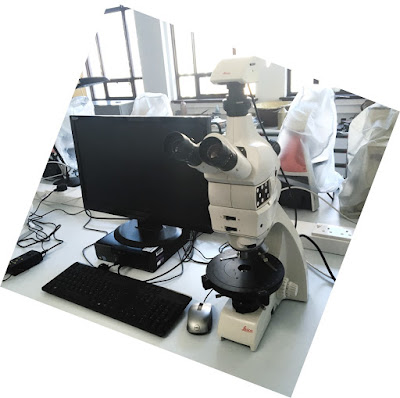
Image
When I started at Newcastle one of the first major roles I undertook was taking over as Director of the Wolfson Archaeology Laboratory. This sounds rather grand, but in reality it mostly involves managing room bookings and making sure everyone has all the kit they need for practicals, research and teaching. Part of the job involves looking after a zooarchaeology reference collection, hence the post last month about attending the zooarchaeology  short course at Sheffield . I have also made various wonderful purchasing decisions, vastly expanding our suite of microscopes to include a range of Leica DM750P scopes for teaching, and dedicated scopes for research with even fancier specs including reflected light capabilities, image analysis software etc. The next stage will be to transform the side room, currently used mostly for storage, into a dedicated space for research. With a new lab based PhD and PDRA started in January, and possibly a Fellow later in 2017 (if all goes to plan), i...

Pollen for Archaeologists

Image
The past few weeks have been pollen themed. Teaching pollen for Environmental Archaeology, and a new paper out on pollen analysis (and geoarchaeology) at RadzyÅ„ CheÅ‚minski in Poland . The latter is from my time working on the Ecology of Crusading project , and is a nice case study in using multi-proxy approaches, including historical documentary sources, to investigate landscape change. Pollen analysis is not my area of research expertise, but I have spent a long time working with pollen data. As a geography undergraduate I had several pollen classes for modules in  Quaternary   Environments  and Biogeography, and it also featured heavily in my MSc Geoarchaeology. Pollen analysis does what it says on the tin - we extract pollen grains from sequential layers in sediment cores, and count them to see how vegetation has changed over time. If we have a sediment layer dated to 1000 years ago that is full of oak pollen for example, we can reasonably assume that there was an oa...