Posts

Showing posts with the label oregon

Micrograph of the Month: Inclusions in omnivore coprolite

Image
I am so happy that I've actually managed to get some microscope work done over the past couple of weeks. It feels like forever since I had the time to do any lab work, or spend time looking down the microscope. Even on my research leave, I have been so busy writing papers and grant applications that microscope time has taken a back seat. I am currently working on the 30 or so slides we collected as part of a NERC project at Paisley Caves in Oregon . This week I have been focusing on characterising the different types of faeces that are found in the sediments. There are lots of different types - rat and bat dung , ovicaprid type pellets, and of most interest of course, the potential human coprolites. I say potential, as we can't know for sure if they are human without conducting additional biomolecular analysis , but the pictures below show a likely human candidate. In any case we can say that it is omnivore coprolite, containing both digested bone fragments and plant tissues. T...
NERC project first year anniversary

Yesterday marked the end of the official first year of the NERC project . The past year has gone by so quickly, and it was reassuring to actually sit down with the research officer who looks after the accounts, and see that actually everything is in place and we're not too far off on the budget, despite a few hiccups and changes to the project timetable. I've learned a great deal about being a PI and the whole process of running a large collaborative project. Mainly that the job of a PI is very much research management rather than actually doing the research. It has been difficult to get used to delegating tasks to team members and resisting the urge to try and do everything myself. I miss being in the lab - but I hope to get back to doing at least a little bit at the end of January next year when I have a semester of research leave. Hopefully this will also mean I have time to do more regular blog updates, with more fun micromorphology images from all the slides that I will be...

Micrograph of the Month: Wood fragment

Image
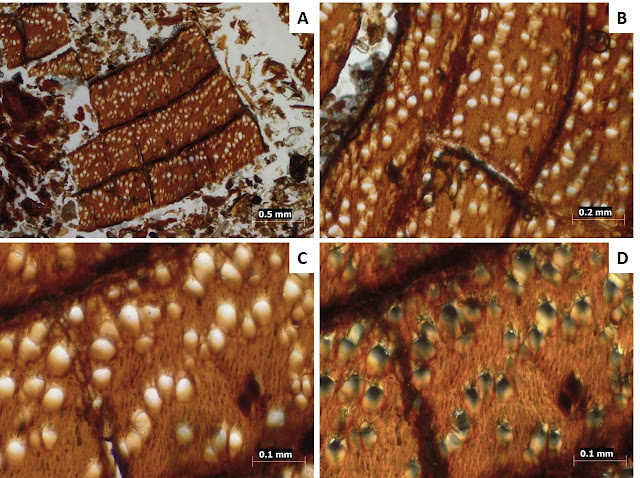
I'm in the middle of writing a brief introductory paper about the work we are doing at Paisley Caves, which includes some of the micromorphology results from our pilot study. The slides from this site are complex, and also so fascinating. Complex because the are very heterogeneous and include a huge variety of biogenic material, including lots of fragments of plant tissues, and there is also some weird stuff going on with the chemistry in the cave environment. Here is an example of a small fragment of wood, within a layer of mixed material overlying a layer of microfaunal dung pellets. The layer is between two radiocarbon dates approximately 8180 and 9565 years cal BP. In the picture below I've shown it at a range of magnifications, and images C and D show it in PPL (C) and XPL (D). Modern wood in XPL usually looks a bit fluorescent because cellulose is birefringent. Usually with archaeological material I'm much more accustomed to seeing wood in the form of charcoal! The on...

Paisley Caves - notes from the field part 3

Image
Many many samples We are coming to the end of the field season for the NERC project at Paisley Caves. Only a few days until I return to Newcastle, and I've been spending the last few days packing up all the samples and sorting out the paper work for exporting them. One box is heading straight to Earthslides for micromorphology slide prep, and the others are going back to Newcastle for microfossil and biomarker work. In the meantime team member John Blong is heading to Eugene to spend a few weeks at the Oregon Museum of Natural and Cultural History , collecting extra material from the excavation archives. I have discovered that cool boxes are a great way to pack samples; the boxes are very lightweight and also pretty sturdy, and I am hoping the fact there is a lid + obvious top and bottom will mean that they are not shaken about too much on their journey back to the UK. Cool boxes are fairly pricey new back in the UK, but you can get them fairly cheap in the US, and I can gua...

Paisley Caves - notes from the field part 1

Image
It's the end of the first week in Oregon as part of our NERC project at Paisley Caves. As usual fieldwork fills me full of ideas for blogging, with none of the time or internet access to post them. The weather has been hugely variable here. For the first few days it was below freezing at night time. I was in my tent in a super warm sleeping bag, with fleece jogging bottoms and beanie hat, and I was still not really that warm. Then after the second day the weather switched to baking hot, and by the end of the week we were all in t-shirts and covered in sunscreen. The view of the landscape from the entrance to the Paisley Caves is amazing - a huge expanse of sagebrush desert with the occasional agricultural feature in the distance. Dirt tracks snake across the landscape, heading towards the town of Paisley on the left, and Summer Lake hotsprings on the right. I'm going to miss this view. The day begins at 5.30, waking up in the tent to varying degrees of chill, getting d...

Adventures in medium sized mammal bone preparation, part 2

Image
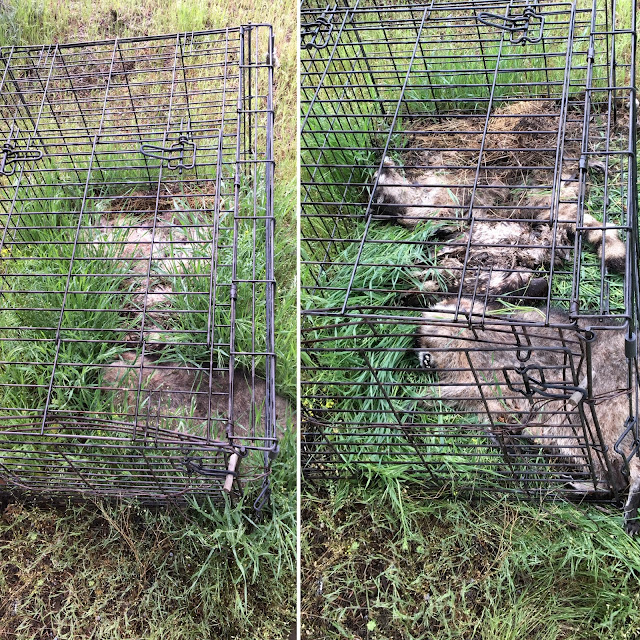
Well, I arrived in Oregon a couple of days ago, trying (without auccess) to get over jet lag before starting firldwork fot the NERC project tomorrow. Before I start with the stream of NERC related posts, a little update on my taphonomic experiment that I posted about back in November . Readers may recall that we came across some recently deceased racoons plus a hawk on the side of the road, and I decided they would make a fine addition to my animal bone reference collection. I set them up in a wire cage to be left to the elements, thinking that when I came back 6 months later they would be in the advanced stages of decay, perhaps even ready to extract and clean up the bones. Nope. 6 months sounds like plenty of time for two medium sized mammals plus one hawk to decay, but I didn't account for the fact that when I deposited them back in November, winter was coming, and they have been buried under two feet of snow for the best part of those 6 months! So, they pretty much look like th...

Field season is about to begin

Field season is beginning a bit earlier than usual for me this year. 2015 - 16 was wonderfully successful in terms of project development and grants, which in turn means that there is a lot going on in 2017. The first round will start at the end of next week, when I will be heading off to Oregon for the main period of fieldwork for the NERC project at Paisley Caves, which I've been blogging about a fair bit. I can't wait to be back in central Oregon getting my hands dirty, literally. It is such a beautiful landscape, very quiet and we'll be a small team, which I prefer. We'll be camping near the site, and taking showers at Summer Lake Hot Springs.  So the stress of sampling at such an important site will be rewarded with a bit of relaxation at the end of the day! When I get back from Oregon I'll be making frantic arrangements to get my research visa for Turkey. This involves leaving your passport on the consulate in London for 1-2 weeks, which is a bit difficult w...

Adventures in medium sized mammal bone preparation

Image
I think the zooarchaeology short course at Sheffield really inspired me, as now I think about animal bones as well as soils and plants in all situations. I'm currently working in central Oregon doing some preliminary work for the NERC project . As I continue to work in this region, we will need to build reference collections to work with. This is built into the NERC project, in terms of a plant microfossil reference collection. Animal skeletons in general are not so easy to get a hold of as plant specimens. Being the resourceful, perhaps slightly strange academic that I am, I noticed a few carcasses by the side of the road and figured why let them go to waste? The landscapes of the USA are so different to the UK, and something that is very noticeable is the amount of roadkill. In the UK I think animals that are hit by cars are cleared up pretty quickly. In the US the roads are much bigger, and animals that are hit just stay there. Or get removed by scavengers. This week I noticed ...

First NERC project meeting in Oregon

Image
The NERC project officially started on the 1st November. Since then we've held interviews for the first PDRA post, and last week I traveled to Oregon for the first project meeting with partners Dr Dennis Jenkins and Dr Tom Stafford, at the Oregon Museum of Natural and Cultural History . It felt very surreal, finally having got the grant that we talked about for so long, and to be honest, did not quite expect to get! Not that we all don't think it's an amazing and worthwhile project, but getting funding for archaeological science is pretty difficult, and the success rate for NERC is really low ( 11% for the standard grants, new investigator scheme in 2015 ). I've made this journey many times, as I have family in central Oregon, but I must be getting old or something as the jet lag really kicked in this time. Still, many coffees later we had a productive meeting, going over the schedule for the next three years, planning the first session of fieldwork in the Spring, and g...

The story of how I started working in Oregon

If you follow me on twitter you may have seen a series of posts over this year relating to a NERC application I submitted. From writing the thing, >10,000 words (that's a whole undergraduate dissertation!), going through the internal review process, finally submitting it in January. Then anxiously waiting for reviewer feedback, frantically responding to reviewer queries within a very short time frame, then waiting for another couple of months to hear...the amazing news that I was awarded the grant! When the administrative process is complete, I'll write a proper post about the project and what it is we hope to do, but for now I wanted to tell the story of how I ended up working on a project that initially seems far removed from working on Neolithic middens in the Near East, or even Neolithic pottery in Britain. I like this story, as it goes to show how opportunities turn up in strange ways, often when you don't expect them, and that the research process can take you in ...

Micrograph of the Month: The Other Paisley Poop

Image
Paisley Caves became well known a few years ago for it's famous coprolites, or fossil faeces, which were found to contain human DNA, dated between 14,170 and 14,340 cal. BP. Although there have been questions over the identification of these as human (and work is still ongoing), this ancient DNA analysis currently provides some of the earliest evidence for human occupation of North America. The research at Paisley has been key in demonstrating the utility of coprolites as an archaeological ecofact that can contribute to the wider picture of the human past, rather than simply a 'novelty' area of study or one which is purely ecological . But human poop isn't the only kind we find at Paisley Caves, in fact it isn't even the most common, by far! In this month's micrographs we have pictures of the poop that occurs most frequently at the site, bat poop. This stuff is fascinating, and is a huge contributor to the sediment profile of the caves. In the upper left at the...

Geoarchaeological surveying in Powell Butte, OR

Image
Deschutes National Forest April is not usually this busy but I've been away for almost 2 weeks visiting family in Oregon, hence the lack of updates. Prior to that I had a mad week of coursework marking, and now upon returning there's a stack of exam marking in my near future. Do not despair however, exciting micrographs are ready to be posted for May, and to make up for the lack of posting in April, here are some lovely images from hiking in central Oregon. Sorted sediments on meander beach Although it was technically a holiday, I can never resist having a bit of a dig, and spent a lovely afternoon test pitting around the in-laws property in Powell Butte (Crook County). It's hard to break the habit of staring at the ground looking for finds whilst taking a stroll, and last year we found a single fragment of worked obsidian, so this year we decided to start a survey. Nothing archaeological in the test pits alas, but we hope to extend the survey gradually every tim...