Posts

Showing posts with the label olynthos

Getting ready for fieldwork
Image
It feels like this year has gone by even quicker than usual, and it is a bit surreal that I'm gearing up to head back out on fieldwork already. I had actually told myself that I would not do any fieldwork this year, and spend more time in the lab instead, but plans change and a couple of opportunities came up than I couldn't refuse! Last year blog readers will remember I went to Olynthos in Greece to collect some pilot samples for a new project, looking at use of space within this ancient Greek settlement. It was the first time I had been to Greece, and the project itself is fascinating - lots of mudbricks to excite the geoarchaeologists among you. Earlier this year I was delighted that we successfully applied for funding for a PhD studentship from the AHRC Northern Bridge consortium , and Mara Lou Schumacher will be joining Newcastle later this year to work on the Olynthos material, co-supervised by Prof. Lisa Nevett at Michigan . So I'll be heading back to Olynthos later...

Geoarchaeology and mudbricks

Image
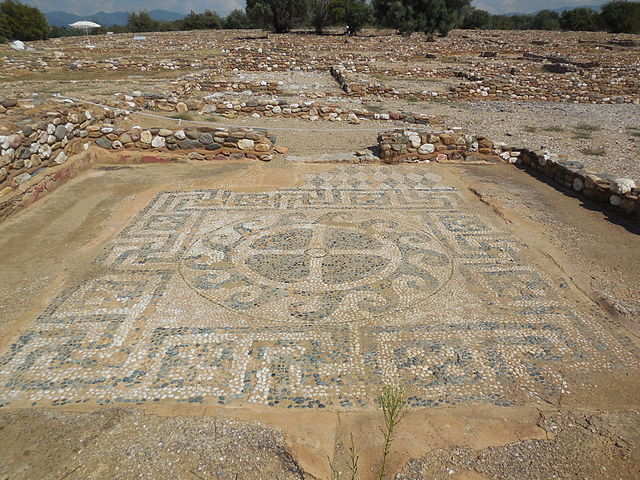
Remains of stone wall base, and a whole lot of roof tiles at Olynthos Anyone who is familiar with Catalhoyuk, or indeed Near Eastern prehistory in general, will know there has been a lot of focus on mudbricks. What are they made of? What can the raw materials and manufacturing processes tell us about Neolithic society? And also floors - we love floors in the Near East, counting them, describing them, analysing them. I was therefore a little surprised when I was doing some background research on Olynthos , to find that no-one has really looked that much at floors, or mudbricks, in classical archaeology. In fact, I was surprised to find out that the houses were made of mudbricks at all, though this is probably just due to my lack of familiarity with the period. We are so used to seeing the remains of stone walls, and the stone monumental architecture, but the mudbricks don't seem to preserve. The roof tiles on the other hand are everywhere (as can be seen nicely in the image from...

Getting to know Olynthos

Image
Today was my last day on site at the classical Greek city of Olynthos in northern Greece. Although I have never studied Greek archaeology, or indeed anything classical, ancient Greece is something I was always fascinated by as a child. If I'd thought to study archaeology as an undergraduate I can imagine that ancient Greece is something I would have gone for. Regular blog readers know I was a geographer before I was an archaeologist, and that background has situated me more in prehistory, with it's greater emphasis on long term environmental change and human-environment interactions. But yet again I find myself being fascinated by themes and comparisons rather than specific time periods, and also the differences in approaches to archaeology in different areas. Ancient Greece is exciting as there is a wealth of documentary evidence and we know so many of the little details compared to prehistory. But like other historic periods I have worked on (e.g. The Ecology of Crusading ...

Off to Catalhoyuk, via Olynthos

Image
It seems like I only just got back from Oregon and I'm off again, this time to Catalhoyuk in Turkey, via Olynthos in Greece. I am really excited about the Olynthos project . Although I am no expert in ancient Greece, I was always fascinated by the mythology as a child, and it will be great to finally visit Greece. I was invited to join the project as a geoarchaeologist, specifically looking at the micromorphology of floor deposits in collaboration with the archaeobotany and geochemsitry experts. The excavations are co-directed by Lisa Nevett  at the University of Michigan in collaboration with the Greek Ministry of Culture & Sports and the British School at Athens . One focus is the excavation of house Bix6 on the North Hill. New data on artefacts and their distribution as well as geochemical testing by fellow geoarchaeologist  Carla Lancelotti have indicated broad spatial differences in uses between rooms in the building. I will be applying sediment micromorphology to ...