Posts

Showing posts with the label lipids

Appetite for (less) Destruction

Image
This week we had the annual research away day for the Department of Archaeology at Durham . It was the first such event I have been to since joining the department just over a year ago, and it was great to see the range of brilliant work going on across the breadth of the discipline. I presented a short provocation on what the future of archaeology might look like in an era increasingly shaped by biomolecular data.  We are unquestionably living through what has been termed a 'biomolecular turn' in archaeology. Advances in ancient DNA, proteomics, lipids and isotopic analysis have opened up extraordinary possibilities for reconstructing past lives, movements, diets and relationships. These methods have transformed the kinds of questions we can ask, and in many cases, the kinds of answers we can plausibly give. But they also raise important challenges. As with DNA evidence in forensic science, biomolecular data is powerful, but it does not speak for itself. It must be interpreted...

Comparing multiple biomarkers

Image
This year has been very productive from a research perspective. We are at the point of the NERC project where all the results are starting to come in , and it has made me remember the excitement of doing research, rather than the headache of applying for grants and all the admin associated with a complex international project. The postdoc team, Dr John Blong and Dr Helen Whelton , are in Copenhagen this week, collecting the final set of samples for the project, currently archived at the University of Copenhagen's Centre for Geogenetics . Up until now we have been working on samples from the archive in Oregon, and samples we collected during our fieldwork. The samples at Copenhagen are some of the most important from Paisley Caves, the ones that provide the earliest occupation dates from the site, that were found to contain human aDNA. By applying lipid biomarker analysis to these samples, we will be able to compare the DNA and lipid results, something I have been keen to do from a...

NERC project first year anniversary

Yesterday marked the end of the official first year of the NERC project . The past year has gone by so quickly, and it was reassuring to actually sit down with the research officer who looks after the accounts, and see that actually everything is in place and we're not too far off on the budget, despite a few hiccups and changes to the project timetable. I've learned a great deal about being a PI and the whole process of running a large collaborative project. Mainly that the job of a PI is very much research management rather than actually doing the research. It has been difficult to get used to delegating tasks to team members and resisting the urge to try and do everything myself. I miss being in the lab - but I hope to get back to doing at least a little bit at the end of January next year when I have a semester of research leave. Hopefully this will also mean I have time to do more regular blog updates, with more fun micromorphology images from all the slides that I will be...

SAA conference, Vancouver 2017, Part 1

Image
Me looking thrilled to be presenting my poster I just got back at the beginning of the week from the Society for American Archaeology conference, held his year in Vancouver. Although it is 'American' archaeology, the geographic spread of attendees and research topics is very international, and I ended up catching up with friends and colleagues from all over the UK as well as the US. I ended up being incredibly busy as I foolishly agreed to do three different sessions. Many months ago I was asked to participate in two sessions as a discussant, as well as submitting a poster on my NERC project. I assumed this meant a role of leading the questions at the end of the session, but on arrival realized it is almost the equivalent of a keynote, and involved giving an actual 15 minute presentation summarizing the papers and state of the field! Luckily the sessions are both topics on which I am passionate, and I managed to put together two talks that went very well. The first was ...

Say Cheese! Feeding Stonehenge

Image
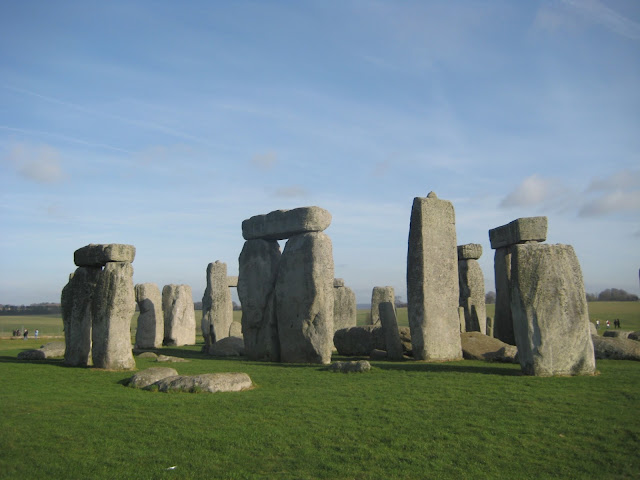
The beginning of the semester at Newcastle is just flying by. So many exciting opportunities for the future - but right now a little something from the past. Back in 2010 I started a postdoctoral position with the BioArCh group at the University of York, investigating food residues in pottery from Durrington Walls, thought to be the settlement that housed the builders of Stonehenge. I've blogged about the progress of the project on a number of occasions , and wrote about it for the Day of Archaeology back in 2012. This week the academic paper from all that hard work was  published in Antiquity journal, along with a university press release , and it's very satisfying to see the final results in print. Being related to Stonehenge, I suspected it may be of general interest, and I was quite excited to see whether the media would run the story. I spent yesterday evening watching with a combination of awe and horror at how this process unfolds - a carefully worded story of science...

Faecal lipids and fungal spores as proxies for ancient pastoralism

Image
I was recently alerted to this interesting new paper (open access!) through Google Scholar citation alerts, which is a very useful service for finding out when your papers are cited by other authors (in this case my 2011 paper on faecal lipid residues at Catalhoyuk ). The authors studied a sequence of lake sediments from Lake Igaliku in SW Greenland, looking at changes in the quantity of DOC and fungal spores. DOC is a bile acid (deoxycholic acid), and is found in both human and ruminant faeces, but at a higher concentration in ruminants. Humans have higher amounts of LC (another bile acid, lithocholic acid). Interestingly no LC was found, suggesting that the DOC comes entirely from herbivores (and that the runoff 'polluting' the lake is largely agricultural, rather than coming from settlement sewage waste). The fungal spores that were found are from coprophilous fungi - i.e. fungi that grow on faeces! The amount of DOC present correlated with the number of fungal spores, wi...