


Micrograph of the Month: Varieties of Gypsum 1
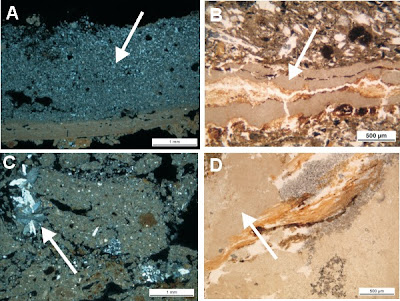
A: gypsum plaster (Tell Brak, building) B. microcrystalline gypsum (Catalhoyuk, midden) C. gypsum rosette (Kamiltepe, building) D. microcrystalline gypsum (Kamiltepe, external area) This month we have some micrographs showing examples of some different ways you might encounter gypsum in archaeological thin sections, part 1 as there are a few other forms that I don't have photos of yet but will aquire at some point. Gypsum (aka calcium sulphate) often occurs in Near Eastern samples as a post-depositional feature, where the calcium sulphate salt, dissolved in water, precipitates as the water evaporates. The growth of the crystals can often cause a lot of damage to intact deposits, as the growth of the crystals pushes apart the material. The crystals can have a widely variable morphology, as a result of different formation mechanisms. As well as precipitation from water evaporation, the salts can precipitate due to the solution becoming saturated (i.e. there is so much present no ...