Posts

Showing posts with the label midden

I love middens

Image
We are in the process of updating the School website for History, Classics and Archaeology at Newcastl e. I've been asked to provide some high resolution photos for various sections, and so have been digitally digging through my image archive. I came across this amsuing photo from 2004 - my first ever visit to Catalhoyuk . It was either during my MSc or just after I finished. So long ago that I still dyed my hair black! I remember this midden - I think it was Unit 1668, and probably isn't there anymore. The first midden I worked on, looking at archived micromorphology slides at the University of Reading, and trying to compare the phytolith data from the same units. Although the Masters project had a lot of limitations (working with archive samples is very difficult when trying to compare microstratigraphic data), the lessons I learned formed the basis of the project I went on to do for my PhD. So I still have a soft spot for this particular midden! These were taken using one of...

Micrograph: Layers within layers

Image
I love this image. It's another one from Catalhoyuk , a nice midden in the South Area (unit 17739). I published a paper on these deposits in Antiquity which included this image , so I'll let you read the paper to find out more about this area and its significance. Here I wanted to show a close up of this image and the beautiful but daunting complexity of archaeological deposits under the microscope. What we are looking at is a tiny fragment of wall plaster mixed in with ashy debris and charcoal. A few years ago I did a post about these plaster deposits, as they are found within buildings at Catalhoyuk , on floors and walls. By counting the layers we can see the frequency with which the inhabitants were re-plastering and 'repainting' their houses - regular cycles of maintenance on an annual and seasonal basis. This layer in the midden shows a fragment which has fallen off a wall, and somehow made its way into the midden, probably through sweeping and dumping of debris, ...

Micrograph: Partially burnt sediment with plant voids

Image
I've been preparing for teaching a micromorphology lab class tomorrow, on the topic of architectural materials. Having recently dug out my old laptop ( to look at old job applications... ), I came across my huge archive of micromorphology images. I really need to figure a way of making these available online. I have so many and they are such fantastic references. I found this nice example of a partially burnt aggregate; it is perfect for showing how pseudomorphic plant voids appear in a plant-tempered clay. On the right hand side of the image, the plant temper (grasses) has been burnt, and so has preserved in the form of microcharcoal. On the left hand side, where the aggregate escaped the burning, the plants have totally decayed, leaving only the voids in the shape of the grasses. It also shows how the colour of the sediment change as they are heated, becoming a distinctly darker brown. This sample is from the Deep Sounding midden at Catalhoyuk, some of the earliest deposits that...

Ochre in Orkney

Image
Oh the excitement! Today I received a parcel from Earthslides , with 20 new thin section samples from the Ness of Brodgar . These samples were collected in 2014 and are mostly from the Trench T midden. Although I don't yet have the kit in place to do a proper analysis, I couldn't resist having a quick peek with my old Swift scope. The level of complexity is daunting - so may fine layers of stratigraphy hidden within layers that appear relatively homogeneous in the field. But already I can see something interesting things - layers of burnt peat,  a very large amount of burnt bone, and even a tiny fragment of red ochre pigment, about 2mm in diameter. This pigment has been found in various contexts in Orkney (and elsewhere around the world), for example Gordon Childe at Skara Brae found containers of pigment he interpreted as 'paint pots '.  At the Ness it is thought that the pigment was ground down and used as a paint for the stone walls in buildings. Behold my attempts a...

Micrograph of the Month: Krotovinas at Çatalhöyük

Image
Did you know that there is a word for an animal burrow that becomes backfilled with soil/sediment? That word is krotovina! At Catalhoyuk , burrowing by small mammals is probably one of the most destructive forms of bioturbation on site. Ground squirrels, or suslik as they are known in Turkey, have a great time digging their way through the nice soft archaeological sediments, mixing up the deposits as they go. When marking out locations for micromorphology sampling we try and avoid these burrows, as we want to look at intact stratigraphy. Every once in a while however, what looks to be undisturbed deposits turns out to have a hidden burrow when the slide is made. It makes the sample almost useless it terms of analysis, but in this case has given a nice example of bioturbated deposits for my teaching reference collection of slides! I have included pictures of the midden section that these micrographs come from, as it is much easier to understand what a krotovina is at the macroscale. The...

Return to the Ness! Day 1

Image
Layers of ashy midden deposits sitting on glacial till A dizzying view of excavations in Trench T After a small adventure involving delayed flights, gale force winds and navigating with no GPS signal (how did we ever cope before smart phones with Google Maps?), I finally arrived in Orkney yesterday. This is actually the last week of excavation before the trenches are covered over until next year, so it’s all very quiet on site. Most of the students have left, and the remaining teams are working to complete recording by the end of the week. I have had a quick tour around to get a feel for what’s happened since I was here last year, and have spent today planning my sampling strategy. As usual so much is going on and there’s plenty for a micromorphologist to do. This year I am focusing on collecting samples from middens in Trench T. Regular blog readers will have seen the snippets I’ve posted about my analysis of middens in the central excavation areain 2013 . Although analysis o...

Micrograph of the Month: Char and Charcoal

Image
Getting ready for upcoming fieldwork at the Ness of Brodgar by going over the micromorphology slides I collected last year from middens. Analysis of these is still ongoing, but here is a peek at some of the things we can see so far. The image below shows two different types of material, char and charcoal. On the left are the images in PPL, on the right, XPL . Charcoal can be seen in the lower left image, and obviously is the remains of burnt wood, we can see the cell structure quite clearly. On the upper left however is something that initially looks like charcoal, but on closer examination is a little different, tentatively interpreted as char. Char is a term given to burnt debris from other organic material. I haven't see this in any other slides I've analysed, but it has come up in a couple of references, where it is suggested to be the result of fat burning. At first I thought perhaps the charcoal could just be highly broken up and degraded, but it looks as if the charred...

Middens and microfauna

Image
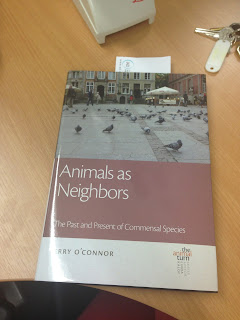
There was a nice surprise in the post for me this morning - a copy of a new book by Professor Terry O'Connor , Animals as Neighbours: the Past and Present of Commensal Species . I contributed an image for one of the figures, of midden deposits built up around Neolithic buildings at Catalhoyuk, Turkey. As O'Connor notes, Catalhoyuk is one of the earliest human settlements to have been colonized by house mice! Not surprising, considering the sheer volume of domestic waste deposits that accumulated in such close proximity to where people were living, and the density of human occupation. This also goes to show how useful it is to integrate different lines of evidence in archaeological research - my own work on middens at Catalhoyuk has shown they contain abundant human and animal dung, which also has interesting implications for understanding human health. Dr Emma Jenkins , who works on the microfauna at Catalhoyuk, has also identified large quantities of digested microfaunal mat...

Micrograph of the Month: Starch inside a waterlogged seed

Image
Here we have a series of micrographs showing a seed, embedded within waterlogged midden deposits at Neolithic Catalhoyuk. These are the earliest deposits from the Deep Sounding in the South Area, and are some of the only waterlogged contexts at the site. These deposits make a particularly interesting comparison to the later middens at the site, as we can look at the differences between waterlogged and non-waterlogged versions of similar deposit types. In the many sections I have looked at, getting sections through seeds like this does not occur too often. I have see larger seeds from Celtis (hackberry) more frequently. This teeny little seed looks like it might be a Chenopod (the little bump on the left of the seed is a feature of Chenopods), though I'd have to ask an archaeobotanist to confirm. The exciting thing about this is you can see the organic part of the seed still preserved within the endocarp - the orangey colour is typical of mineralised organic remains. In the lowe...

Investigations at the Ness of Brodgar Days 4 and 5

Image
Ben Chan discusses this week's progress on the site tour This week has gone by so quickly, but we have managed to collect some great sets of samples, more than we can get made into slides at the moment! The first lot have already been sent off to Earthslides to get made into thin sections. An important lesson from the field - if you get over enthusiastic about collecting blocks of soil that weigh >1kg each, they will not fit in your luggage and will incur hefty postage fees. And lesson 2, blocks of soil wrapped in tissue and tape look very odd on the airport X ray and your bags will likely be searched. I ended up taking about 20 block samples in all, and spent much of my last day in Orkney panicking about how to transport them back.  Friday was my last day on site, and the day started with a site tour with each supervisor summarising what has been going on in the building/trench that week. A week is just not long enough to get my head around everything going on at the Nes...

Investigations at the Ness of Brodgar Days 2 and 3

Image
Planning sampling strategy with Jo After planning the sampling strategy, the next few days have been spent collecting samples. I decided to focus on two areas of nicely stratified midden for the main sampling, and have collected overlapping sample blocks to provide an overview of the entire sequence. Already it's possible to see some quite ashy areas, so hopefully we will be able to get some nice information on resource use, and hopefully what activities the fuels relate to. We decided on a further 4 areas as secondary sample sets with a smaller number of samples, testing specific hypotheses from the excavations. More on those later this week. As well as the Orkney students, we also have a team here from Willamette University, Oregon, led by Professor Scott Pike . Professor Pike has a background in geology and expertise in pXRF (portable X-ray fluorescence). In brief this involves using a piece of kit that looks like a ray gun to fire X rays at material, which then...

Investigations at the Ness of Brodgar, Day 1

Image
ORCA project officer Dan explains what's going on with middens Marvelous midden at the Ness of Brodgar - check out those ashy layers! Earlier this year I was fortunate enough to be awarded 2 small grants from the Society of Antiquaries of Scotland and the Orkney Archaeological Society , to carry out a pilot microarchaeology study at the Ness of Brodgar site in Orkney. The Ness of Brodgar is part of the Heart of Neolithic Orkney World Heritage Site , and excavations are directed by Nick Card of ORCA/UHI . The site is one of the finest examples of Neolithic archaeology in the UK (along with the rest of Orkney!), and the extent of preservation of the buildings and middens provides a rare opportunity to study the subsistence activities of the inhabitants. The architecture here is some of the most impressive I've ever seen. It's interesting to note that the dates for the Neolithic here go to around 2500BC - roughly the same date that the Great Pyramid of Giza was cons...

Middens from the Mound of Beads

Image
Ashy midden deposits in thin section. Since starting my new job as a Research Fellow, I feel like the amount of actual research I have done is limited! But I have spent plenty of time applying for money to do research. It must be nice being a researcher in a subject that doesn't require expensive laboratory work or sample processing. I have daydreams about spending all my time just reading and writing in a nice quiet library somewhere, preferably overseas and sunny. On the plus side, the more funding applications I write, the quicker it gets, and sometimes I even get the money! I just found out recently I was awarded a University of Edinburgh Munro Research Grant to complete the pilot work I've been doing on material from Boncuklu Hoyuk ('the place of beads') in Turkey. I started working there after finishing my PhD, I think the first samples I collected were in 2009, but due to the expense of producing thin sections, I was not able to get them processed at the time...

Holidays in Academia

Image
July has been very busy, and it appears to be August already! Finished the final analysis for Feeding Stonehenge and now in the process of writing up the research, and taking a short break before starting officially on the Ecology of Crusading project at the end of August. Though as they say taking a holiday in academia is just doing work somewhere else, so here I am in sunny Florida sorting through some of the submissions for the special issue of Archaeological and Anthropological Sciences journal, "Experimental Archaeology" that emerged from the conference we held at York at the beginning of the year . The deadline for submissions is aproaching, but there is still time to submit a paper for consideration, more details here . In other archaeology related news, I just can't seem to get away from middens. Pensacola is full of historic archaeological stuff, including this gem. I'm still trying to work out the connection between the commanding officer's residence...

Today my desk is covered in....

Image
Sometimes I have a moment where I realise just how odd my day to day work probably appears to non-archaeologists. And probably even amongst archaeologists some of the things I end up with on my desk are quite odd. I seem to have aquired a sort of reputation as a coprolite person, and have aquired quite the collection of material from all over the place. I didn't set out intending to be a coprolite person, it just happened as I couldn't really ignore them. During my PhD, which initially focused on formation processes of middens at Catalhoyuk , I came to realise that the middens contained quite a large quantity of coprolites, and if I wanted to understand what people were dumping (lol) into middens, I had to investigate what people were doing with this particular type of waste. For those of you not in the know, coprolite is a catch all term for ancient faecal material (though technically there are different terms depending on whether it is an actual fossilised bit of poo versus a...