Posts

Showing posts with the label environment

Environmental Archaeology at Birdoswald Roman Fort

Image
Some very exciting news, I'll be overseeing the environmental work for a new 5 year excavation project at Birdoswald Roman Fort , a collaboration between Newcastle University and Historic England, co-directed by Tony Wilmott and Prof. Ian Haynes . Birdoswald is a Roman Fort on Hadrian's Wall, and sits on the longest remaining section of the Wall that is still standing. There's loads of great information on the history of the site on the  English Heritage website here . The excavations will be used as a field school to train Newcastle University archaeology students, as well as being a research project. The environmental work will largely follow the Historic England guidelines which can be found here . I will be overseeing the running of the flotation tank, with a team of postgraduate students and our technicians, and also advising on any additional soil sampling for geochemistry, micromorphology etc as the excavations progress. We are lucky enough to have access to a large...
Adventures in fish bone preparation

Image
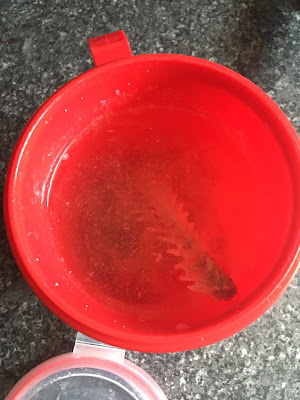
Cold water maceration If you follow my Twitter feed you may have noticed a string of posts discussing the best methods for preparing specimens for animal bone reference collections. This all started a while back when I decided to take the Sheffield Zooarchaeology short course . Having had little training in bones I thought it would be a good idea to get some basic skills, as I am responsible for the reference collections at Newcastle. However the majority of our existing collection is large domesticates, and being an environmental archaeologist, I figured we needed some microfauna. I already have a lecture in my Environmental Archaeology module that covers animal remains as environmental indicators, and wanted to expand this to include a practical. Being a second year undergraduate module this is very much an introduction to the subject, and the learning outcomes focus more on understanding the implications of recovery and taphonomic issues, rather than developing expertise in spec...

Zooarchaeology short course at Sheffield

Image
For the past three days I've been doing a short course in Zooarchaeology at Sheffield . The Sheffield lab is one of the best places in the UK, and probably Europe, for animal bone research, and I was amazed at the extent of their reference collections. An absolutely fantastic resource. Although I have spent many years working with zooarchaeologists, and have a basic understanding of the subject, I've never worked directly with this material myself. As I am now responsible for the Wolfson Laboratory at Newcastle , and therefore our animal bone reference collection, I figured I should learn a bit more about them! It was very interesting to hear about a lot of research themes that I am interested in from the perspective another specialism. Taphonomy for example is something that I deal with myself a lot in the analysis of environmental samples, and it was very informative to hear how other people approach this topic. Whilst a lot of zooarchaeology focuses on the relationships be...

Microfossil of the Month: Sponge Spicule

Image
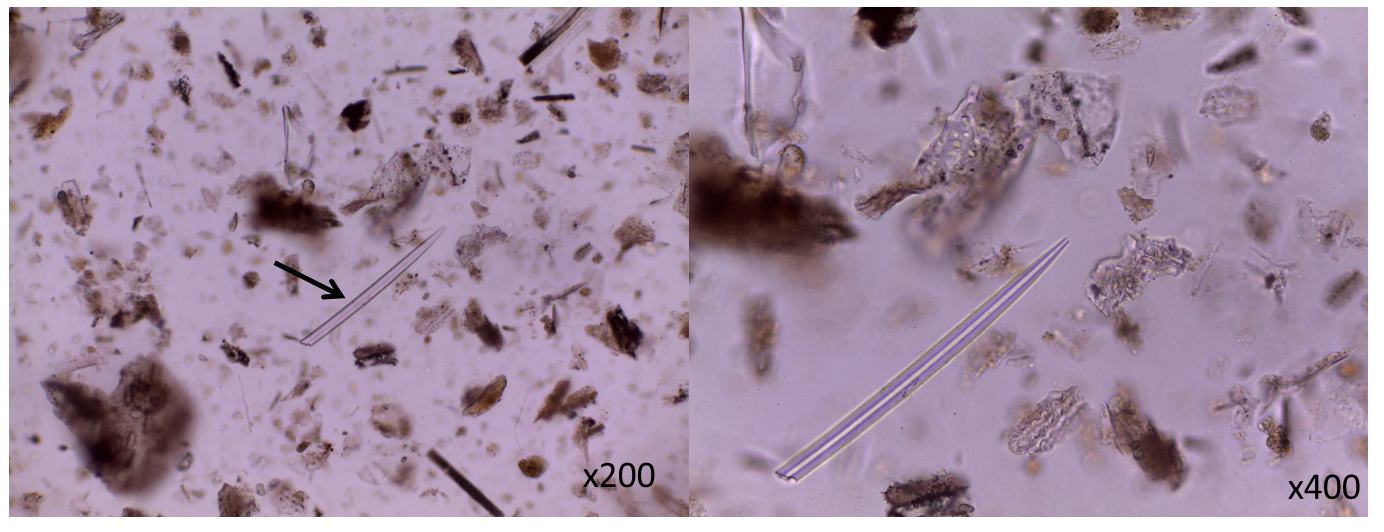
Something a little bit different - this month I have an image of a siliceous sponge spicule! This show up occasionally in my phytolith slides, and are very distinctive. Sponges, or poriferans to give them their scientific name, are characterised by an unusual feeding system that involves drawing water in through little pores in the outer walls, and filtering food from the water as it moves around their bodies, before being pumped back out again. This flow of water occurs in one direction and is driven by beating flagella. Sponge spicules provide structural support and protection from predators. They come in all sorts of shapes each with a different name - the single spike shape that you can see looks like a monaxon, though it is also possible that is has broken off a larger 'polyaxon' type. The formation of spicules seems to be better understand than that of my other favourite siliceous microfossil, the phytolith, and is controlled largely genetically, but with environmental c...

The interdisciplinary continuum in studies of Humanity and the Earth

Sometimes I find it hard to put myself into a subject area box. I was a Geography undergraduate, a Geoarchaeology MSc student, and did a PhD jointly in Chemistry and Archaeology. What does that make me? I used to say I was a geoarchaeologist, applying the methods of geoscience to archaeological questions. But I realised that was too narrow, as even the methods I draw upon vary depending on the question being asked, and indeed a multi-proxy approach is something which I try  to promote. My main research interests are the relationships between humans and the environment, how this has changed over time, and how it varies in different geographic settings. Very much a theme of environmental archaeology, but also geography. Geography has been called the subject that bridges the human and physical sciences, encompassing the Earth and all of its natural and human components, and the dynamic relationship between the two. Physical geography seeks to describe and explain the spheres of t...

Return to the Ness! Day 1

Image
Layers of ashy midden deposits sitting on glacial till A dizzying view of excavations in Trench T After a small adventure involving delayed flights, gale force winds and navigating with no GPS signal (how did we ever cope before smart phones with Google Maps?), I finally arrived in Orkney yesterday. This is actually the last week of excavation before the trenches are covered over until next year, so it’s all very quiet on site. Most of the students have left, and the remaining teams are working to complete recording by the end of the week. I have had a quick tour around to get a feel for what’s happened since I was here last year, and have spent today planning my sampling strategy. As usual so much is going on and there’s plenty for a micromorphologist to do. This year I am focusing on collecting samples from middens in Trench T. Regular blog readers will have seen the snippets I’ve posted about my analysis of middens in the central excavation areain 2013 . Although analysis o...