Posts

Showing posts with the label NERC

My first video conference presentation - EAA Barcelona 2018

Image
Following on from my previous post , I am disappointed I couldn't go to Barcelona in person for the European Association of Archaeologists conference last week. The EAA itself is one of the few chances I get to meet up with European colleagues and friends in person, and Barcelona is one of my favourite cities. On the plus side, it did give me the opportunity to learn how to make a video presentation. It turns out my beloved Surface tablet has a bells and whistles version of PowerPoint that lets you record your presentation with video and sound all in one go, and export it as an MP4. The presentation focused on pilot studies I have been leading as part of a Wellcome Trust seed award in Humanities and Social Sciences, to test the feasibility of applying various civil engineering methods to an archaeological settlement, and building a network of researchers in Turkey and Europe. Pilot studies are fantastic as a 'proof of concept' to justify full scale studies, but also in som...

Comparing multiple biomarkers

Image
This year has been very productive from a research perspective. We are at the point of the NERC project where all the results are starting to come in , and it has made me remember the excitement of doing research, rather than the headache of applying for grants and all the admin associated with a complex international project. The postdoc team, Dr John Blong and Dr Helen Whelton , are in Copenhagen this week, collecting the final set of samples for the project, currently archived at the University of Copenhagen's Centre for Geogenetics . Up until now we have been working on samples from the archive in Oregon, and samples we collected during our fieldwork. The samples at Copenhagen are some of the most important from Paisley Caves, the ones that provide the earliest occupation dates from the site, that were found to contain human aDNA. By applying lipid biomarker analysis to these samples, we will be able to compare the DNA and lipid results, something I have been keen to do from a...

Micrograph of the Month: Inclusions in omnivore coprolite

Image
I am so happy that I've actually managed to get some microscope work done over the past couple of weeks. It feels like forever since I had the time to do any lab work, or spend time looking down the microscope. Even on my research leave, I have been so busy writing papers and grant applications that microscope time has taken a back seat. I am currently working on the 30 or so slides we collected as part of a NERC project at Paisley Caves in Oregon . This week I have been focusing on characterising the different types of faeces that are found in the sediments. There are lots of different types - rat and bat dung , ovicaprid type pellets, and of most interest of course, the potential human coprolites. I say potential, as we can't know for sure if they are human without conducting additional biomolecular analysis , but the pictures below show a likely human candidate. In any case we can say that it is omnivore coprolite, containing both digested bone fragments and plant tissues. T...

NERC project conference and seminar presentations

Image
Go team! There was liberal use of the poop emoji. The blog has been quiet this year, but there is lots to report. As well as the announcement of the Earthslides relocation to Newcastle , our NERC project is now a few months into its second year , and we are beginning to see results from all the hard work that the lab team have been doing. Back in April project research associates Dr John Blong and Dr Helen Whelton gave presentations on the palaeoecological analyses and faecal lipid residue work respectively, at the Society for American Archaeology conference in Washington DC. The papers were part of a session we organised on Coprolite Research: Archaeological and Palaeoenvironmental Potentials. Despite being amusingly puntastic, the session really highlighted how coprolites are an extremely important archive of information, despite the fact they are often dismissed in archaeological analyses. I was also very proud to see geoarchaeology PhD student Alicia Sawyer give a great pr...

The role of luck in an academic career

Hello blogging friends, and apologies yet again for the lack of updates. Did I mention that I was on sabbatical at the moment? You would think this would mean more time to do blogging, but in fact it has been a whirlwind of catch up for the NERC and Wellcome Trust projects, both of which have gone amazingly well and have produced some really exciting results. So I've been busy working with the team to start writing up results, presenting at conferences, and crucially, applying for more grants to keep the research going (and keep everyone employed...). Tangentially related to this is some good news - firstly, I passed my 2 year probation period at Newcastle (I've been here 2 years and 7 months now), and in the same week, I also found out I am being promoted to Senior Lecturer. Hurray! I think the 2 grants went a long way towards getting that promotion. And this is where luck yet again plays a role in an academic career, even after getting over the many hurdles it takes to actua...

NERC project first year anniversary

Yesterday marked the end of the official first year of the NERC project . The past year has gone by so quickly, and it was reassuring to actually sit down with the research officer who looks after the accounts, and see that actually everything is in place and we're not too far off on the budget, despite a few hiccups and changes to the project timetable. I've learned a great deal about being a PI and the whole process of running a large collaborative project. Mainly that the job of a PI is very much research management rather than actually doing the research. It has been difficult to get used to delegating tasks to team members and resisting the urge to try and do everything myself. I miss being in the lab - but I hope to get back to doing at least a little bit at the end of January next year when I have a semester of research leave. Hopefully this will also mean I have time to do more regular blog updates, with more fun micromorphology images from all the slides that I will be...

Micrograph of the Month: Wood fragment

Image
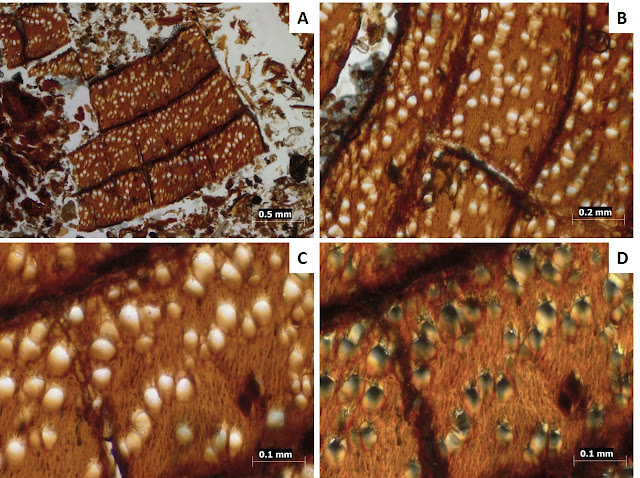
I'm in the middle of writing a brief introductory paper about the work we are doing at Paisley Caves, which includes some of the micromorphology results from our pilot study. The slides from this site are complex, and also so fascinating. Complex because the are very heterogeneous and include a huge variety of biogenic material, including lots of fragments of plant tissues, and there is also some weird stuff going on with the chemistry in the cave environment. Here is an example of a small fragment of wood, within a layer of mixed material overlying a layer of microfaunal dung pellets. The layer is between two radiocarbon dates approximately 8180 and 9565 years cal BP. In the picture below I've shown it at a range of magnifications, and images C and D show it in PPL (C) and XPL (D). Modern wood in XPL usually looks a bit fluorescent because cellulose is birefringent. Usually with archaeological material I'm much more accustomed to seeing wood in the form of charcoal! The on...

Paisley Caves - notes from the field part 3

Image
Many many samples We are coming to the end of the field season for the NERC project at Paisley Caves. Only a few days until I return to Newcastle, and I've been spending the last few days packing up all the samples and sorting out the paper work for exporting them. One box is heading straight to Earthslides for micromorphology slide prep, and the others are going back to Newcastle for microfossil and biomarker work. In the meantime team member John Blong is heading to Eugene to spend a few weeks at the Oregon Museum of Natural and Cultural History , collecting extra material from the excavation archives. I have discovered that cool boxes are a great way to pack samples; the boxes are very lightweight and also pretty sturdy, and I am hoping the fact there is a lid + obvious top and bottom will mean that they are not shaken about too much on their journey back to the UK. Cool boxes are fairly pricey new back in the UK, but you can get them fairly cheap in the US, and I can gua...

Paisley Caves - notes from the field part 2

Image
Back from the field now and making sense of all the photos and paperwork. As well as taking samples from Paisley Caves itself, we also spent a day doing a survey of the local vegetation and collecting samples for a botanical reference collection. Part of the project involves analysis of pollen and other plant remains from sediments and coprolites, and whilst there are several available collections and published material on the likely species that we will find, it is always helpful to build a project specific reference collection, and this will be added to the growing library of material based in the Wolfson lab at Newcastle. This will be one of the major tasks undertaken by project research associate John Blong , and he will be collaborating with project affiliate Katelyn McDonough , who analysed material from Paisley for her Masters and is currently working on botanical remains at the nearby Connelly Caves for her PhD. This is the first fieldwork where I have had the chance to put m...

Paisley Caves - notes from the field part 1

Image
It's the end of the first week in Oregon as part of our NERC project at Paisley Caves. As usual fieldwork fills me full of ideas for blogging, with none of the time or internet access to post them. The weather has been hugely variable here. For the first few days it was below freezing at night time. I was in my tent in a super warm sleeping bag, with fleece jogging bottoms and beanie hat, and I was still not really that warm. Then after the second day the weather switched to baking hot, and by the end of the week we were all in t-shirts and covered in sunscreen. The view of the landscape from the entrance to the Paisley Caves is amazing - a huge expanse of sagebrush desert with the occasional agricultural feature in the distance. Dirt tracks snake across the landscape, heading towards the town of Paisley on the left, and Summer Lake hotsprings on the right. I'm going to miss this view. The day begins at 5.30, waking up in the tent to varying degrees of chill, getting d...

Field season is about to begin

Field season is beginning a bit earlier than usual for me this year. 2015 - 16 was wonderfully successful in terms of project development and grants, which in turn means that there is a lot going on in 2017. The first round will start at the end of next week, when I will be heading off to Oregon for the main period of fieldwork for the NERC project at Paisley Caves, which I've been blogging about a fair bit. I can't wait to be back in central Oregon getting my hands dirty, literally. It is such a beautiful landscape, very quiet and we'll be a small team, which I prefer. We'll be camping near the site, and taking showers at Summer Lake Hot Springs.  So the stress of sampling at such an important site will be rewarded with a bit of relaxation at the end of the day! When I get back from Oregon I'll be making frantic arrangements to get my research visa for Turkey. This involves leaving your passport on the consulate in London for 1-2 weeks, which is a bit difficult w...

SAA conference, Vancouver 2017, Part 1

Image
Me looking thrilled to be presenting my poster I just got back at the beginning of the week from the Society for American Archaeology conference, held his year in Vancouver. Although it is 'American' archaeology, the geographic spread of attendees and research topics is very international, and I ended up catching up with friends and colleagues from all over the UK as well as the US. I ended up being incredibly busy as I foolishly agreed to do three different sessions. Many months ago I was asked to participate in two sessions as a discussant, as well as submitting a poster on my NERC project. I assumed this meant a role of leading the questions at the end of the session, but on arrival realized it is almost the equivalent of a keynote, and involved giving an actual 15 minute presentation summarizing the papers and state of the field! Luckily the sessions are both topics on which I am passionate, and I managed to put together two talks that went very well. The first was ...

What's new in 2017?

Image
Writing this post as quickly as possible to make sure I don't have a month with NO POSTS! Since my merry xmas post  in December, I took a break from anything work related over the holidays, then as soon as the new year happened, I went to Belize for 2 weeks , where I had zero email or internet access. That was quite nice in some ways, and it was especially enlightening to see how long my iPhone battery lasts when it is not connected to anything ( a whole week!). The last few days of the trip we were staying at a rather fancy resort , which of course had wifi, and I spent much of that time going through a huge email backlog, desperately deleting all the 'not important' ones, to try and narrow the list of things that requires a response to something manageable. I have so many things to blog about in relation to my experience in Belize, everything from plant taxonomy to fieldwork and family, to Mayan archaeology and the similarities and differences between different subjects...

First NERC project meeting in Oregon

Image
The NERC project officially started on the 1st November. Since then we've held interviews for the first PDRA post, and last week I traveled to Oregon for the first project meeting with partners Dr Dennis Jenkins and Dr Tom Stafford, at the Oregon Museum of Natural and Cultural History . It felt very surreal, finally having got the grant that we talked about for so long, and to be honest, did not quite expect to get! Not that we all don't think it's an amazing and worthwhile project, but getting funding for archaeological science is pretty difficult, and the success rate for NERC is really low ( 11% for the standard grants, new investigator scheme in 2015 ). I've made this journey many times, as I have family in central Oregon, but I must be getting old or something as the jet lag really kicked in this time. Still, many coffees later we had a productive meeting, going over the schedule for the next three years, planning the first session of fieldwork in the Spring, and g...

Training in Belize!

Image
2016 - the year where the exciting news just keeps on coming! I found out recently that I've been selected to take part in a NERC training course, Fieldwork Skills in the Tropics, run by the Royal Botanic Gardens Edinburgh , as part of their MSc in Biodiversity and Taxonomy of Plants . The course runs over two weeks next year, in Belize! It's been over a decade since I first left the UK on my first fieldwork abroad, but the thought of travelling somewhere new is still as exciting now as it was then. Probably even more so as I have some idea what I'm doing now. This course covers vegetation survey, monitoring and plant identification, with some GIS. Part of the application process involved a statement of why you would like to attend, with priority given to those with NERC funding, ECRs and students. Whilst I now work as an archaeologist, my background is in geosciences/geography, and I've always maintained that perspective in my research and teaching. My long term aim is...

Bristol visit

Image
I just got back from a great visit to Bristol, to discuss timetables and a plan of action for the NERC grant. My coI is Dr Ian Bull of the OGU , and expert on all things faecal biomarker related. The last time I was in Bristol was in 2014, when I was a research fellow at Edinburgh , doing a whole range of pilot studies on various projects. The first time I went to Bristol was during my PhD, around 2004, to be trained in faecal biomarker analysis. Ian is like the unofficial third supervisor and the guy who showed me how to write a good academic paper. So it's somewhat surreal, but exciting, to be going back there as a PI. I'm always blown away by the amazing laboratory facilities they have -  it has to be one of the best places in the world for organic geochemistry, and there's always some fancy new kit to gawk at. We had a visit to the new radiocarbon AMS lab in archaeology. It's the first time I've seen one of these in person - such a complex bit of kit, it's i...

Where did all that time go

I can't believe it's already June, getting close to a year in my job at Newcastle . I can't even call it my new job anymore! It's been an amazing year so far. Even though I have been swamped with designing new modules and getting used to the teaching and admin processes here, I have really enjoyed everything. I even managed to get some research related activities in. I applied for a NERC new investigator grant back in January, which in itself was a learning process. 10,000 words in total for that application, and that wasn't even the hard part; sorting out the finances for an international project split between two institutions (my co-I is at Bristol) was more of a headache that I expected. Then the reviewing process, oh the reviewing process. Despite being told that being interdisciplinary is one of my major strengths, and I do believe that it leads to better, more innovative research, it makes things surprisingly hard when it comes to applying for funding. There...

Analysing lipid residues in archaeological soil and faeces at the NERC LSMSF

Image
It's been a while since I've been in the lab, but last week I got to spend the entire week working in the NERC LSMSF (Life Sciences Mass Spectrometry Facility) in the Organic Geochemistry Unit at the University of Bristol. I have worked with Bristol for many years now as they have arguably the best set up in the world for archaeological and environmental geochemistry. For this visit I was working mostly on samples from the Ecology of Crusading project , with a few extra coprolite samples thrown in from Catalhoyuk and Durrington Walls (more on those at a later date!). The EoC samples are part of a larger programme of geochemical analysis, designed to look at human impacts on the landscape associated with colonisation in the medieval period. We are looking for evidence of increased faecal inputs (lovely!) associated with clearance of land for pasture, and maybe even human 'sewage' inputs from intensification of activity. Although I have developed the facilities for pot...