Posts

Showing posts with the label archaeobotany

X-rays and Barley Mutants!

Image
Blog readers may be familiar with the botanical terms monocots and dicots. Dicots include many woody species, and monocots include important cereal crops such as wheat and barley (i.e. grasses). These are basics of plant biology that I teach my students in environmental archaeology. Monocots such as cereals of course are central in archaeological research around the origins of agriculture and domestication, whilst dicots feature in studies of ancient fuel use.  One of the major differences between monocots and dicots is the organisation of the stem. Dicot stems, or cambium, have radial growth, that forms the distinct rings that we use for dendrochronology. This growth is controlled by the interaction of two proteins, TDIF and PXY. Monocots do not have a cambium, but they do have the genes for TDIF and PXY. What then, is the function of these genes in monocots, if not to produce cambium? This question is the basis of a major BBSRC funded project I've been involved in for t...

First week at Birdoswald

Image
It’s Day 7 at Birdoswald excavations for me! I was supposed to be here earlier but ended up having to self-isolate as my daughter’s nursery bubble had a positive covid case. How funny that has become such a standard part of life. It was a little frustrating watching all the news and photos from the dig being posted online whilst being stuck at home, but I am so happy to have finally got here! I am especially grateful to the wonderful B&B where I am staying, Bush Nook , who very kindly let me alter my dates at the last minute and have been wonderful hosts. Fancy bacon sarnies and coffee for breakfast, and a nice hot power shower – what more could an archaeologist want from fieldwork accommodation? I was perhaps a little ambitious in my plans to cycle to site every day. Although it is only 2 miles away, the route it turns out has two rather steep sets of stairs and hill, so I abandoned the bike and took to a leisurely stroll each morning. It is absolute bliss after being stuck wor...

Micrograph of the Month: Mixed fuels

Image
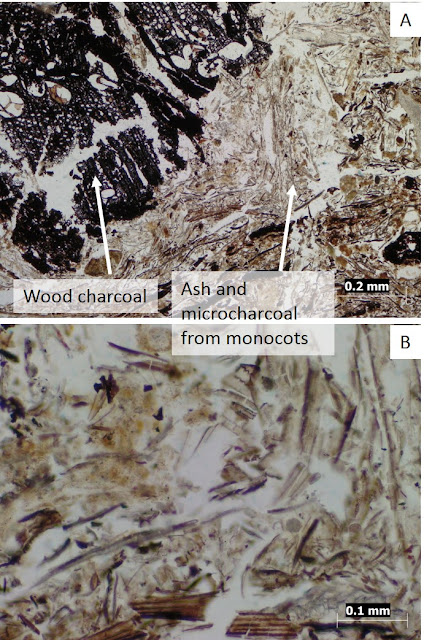
It's been too long since I've looked at any new thin section samples, but today I had the chance to look at some new stuff from Catalhoyuk . Here are some lovely mixed fuel deposits from an external area, showing A. wood charcoal (Quercus?), with microcharcoal and phytoliths from grasses and sedges. B. is a close up of the ash to try and show some of the phytoliths but it is hard to get a good photo in focus even though the slide is only 30 microns thick. Probably redeposited given the random orientation of the phytoliths.

Paisley Caves - notes from the field part 2

Image
Back from the field now and making sense of all the photos and paperwork. As well as taking samples from Paisley Caves itself, we also spent a day doing a survey of the local vegetation and collecting samples for a botanical reference collection. Part of the project involves analysis of pollen and other plant remains from sediments and coprolites, and whilst there are several available collections and published material on the likely species that we will find, it is always helpful to build a project specific reference collection, and this will be added to the growing library of material based in the Wolfson lab at Newcastle. This will be one of the major tasks undertaken by project research associate John Blong , and he will be collaborating with project affiliate Katelyn McDonough , who analysed material from Paisley for her Masters and is currently working on botanical remains at the nearby Connelly Caves for her PhD. This is the first fieldwork where I have had the chance to put m...

The details of giant daisies

Image
Today is the end of the Semester, and I'm definitely ready for a break after an extremely busy few months. Lots of great news this year, with two successful grant applications - the NERC project which I've been posting about, and a new Wellcome seed award which will be starting next year, developing further work at Catalhoyuk in Turkey. I have also had my own assignment deadline this week, for the NERC training course that I am going on in January . Everyone in the group has been assigned a plant family, and we had to do a bit of research on the genera and species that are found in Belize, and write a short information sheet on key characteristics. I think the expedition leader took pity on me as one of the participants without a background in botany, and I was assigned the Asteraecae (Compositae), which happen to be one of the easier families to identify. Or at least, it is one I am familiar with - daisies and sunflowers! Some of the terminology was familiar, ringing bells fro...

Integrating archaeological science at medieval Riga

Image
Team palynology and zooarchaeology Team archaeobotany and geoarchaeology Lovely weather here in London today, though mostly being experienced inside a meeting room at the Warburg Institute ! I'm away from Edinburgh this week, firstly for a project meeting for the Ecology of Crusading project and then for a week of lab work in Bristol - more on that to come! This weekend I am here with fellow team members Rowena Banerjea , Alex Brown , Monica Badura and PI Aleks Pluskowski , discussing our  analyses of deposits from medieval Riga. This is the first time we've all got together to integrate our data, and to get updates on the dating of the deposits. So far  we have potentially the earliest known building in Riga, on the basis of dendrochronological dates, and some great archaeobotanical data on the types of plant materials that were being used - along with the micromorphology it looks like a lot of the plant material is associated with construction, such as wood chipping...