Posts

Showing posts with the label bioturbation

Micrograph of the Month: Krotovinas at Çatalhöyük

Image
Did you know that there is a word for an animal burrow that becomes backfilled with soil/sediment? That word is krotovina! At Catalhoyuk , burrowing by small mammals is probably one of the most destructive forms of bioturbation on site. Ground squirrels, or suslik as they are known in Turkey, have a great time digging their way through the nice soft archaeological sediments, mixing up the deposits as they go. When marking out locations for micromorphology sampling we try and avoid these burrows, as we want to look at intact stratigraphy. Every once in a while however, what looks to be undisturbed deposits turns out to have a hidden burrow when the slide is made. It makes the sample almost useless it terms of analysis, but in this case has given a nice example of bioturbated deposits for my teaching reference collection of slides! I have included pictures of the midden section that these micrographs come from, as it is much easier to understand what a krotovina is at the macroscale. The...

Micrograph of the Month: Bits of Bones

Image
For the past few weeks I have been revisiting some old slides from the TP excavation area at Catalhoyuk . I collected these samples  in 2004, and they were some of the first that I worked on for my PhD. At the time I found them a bit disappointing, as there is a lot of bioturbation and erosion  going on in this part of the site, which means that trying to reconstruct activities using microstratigraphic analysis is difficult. The TP area is located very close to the surface of the mound, so despite the fact that these are the youngest deposits, the preservation is nowhere near as good as the earlier, deeply buried deposits. In the end I focused more on the South and 4040 areas, with the TP samples being used as a brief comparison of how different the taphonomic processes are in different parts of the site. Which brings me on to this month's photos! I was contacted by Kamilla  Pawłowska who is conducting zooarchaeological analysis in the TP area, and is...

Micrograph of the Month: Fabulous Fungi

Image
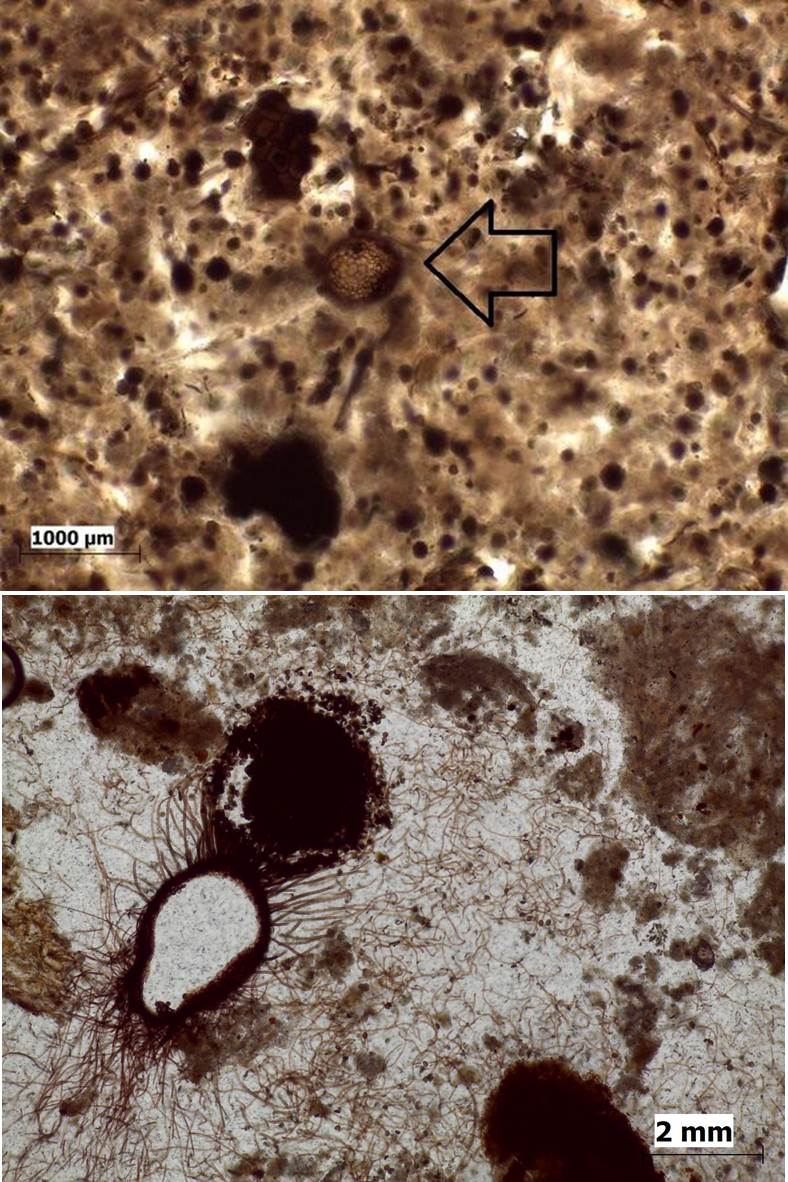
Followers of my Twitter account may recognise these little creatures! I posted the pics separately a while ago to see if anyone could help with identification. So far no response, if anyone has any clues or reference suggestions do let me know. Both are from medieval floor deposits that have undergone significant post-depositional bioturbation. The lower image is one of my favourites. The hyphae are like little tentacles that spread all the way through the sediment. That is the little string like projections that you can see extending from the sporongium. Which is the spherical bit containing all the little spores, and in this particular view is nice and ripe with little spores bursting forth. It is quite creepy to come across all of a sudden when you are looking down a microscope and not expecting it! The one at the bottom has a clear area in the middle, because the top has been abraded away during the thin section preparation process. Basically we are looking at an 'aerial' v...