Posts

Showing posts with the label castles

Crusader Castles of the Baltic

Image
I wrote a feature article for Current World Archaeology Magazine on the Ecology of Crusading project, which has just been published in issue 57. It's a brief overview for a general audience, so there's lots of basic info on the environmental and lab methods we are using as well as some of the preliminary results. And of course lots of fab photos of castles, fieldwork and whatnot. I like writing more general articles like this - it's something I can show the parents and they get all excited about. Pages of technical jargon in J. Arch. Sci. and the like never get quite the same reaction. http://www.world-archaeology.com/features/crusader-castles/ It's exactly 10 issues since the last piece I wrote for them in issue 47, 2011, on Catalhoyuk under the Microscope, which you can read an excerpt from here: http://www.world-archaeology.com/features/turkey-neolithic-life-at-catalhoyuk/
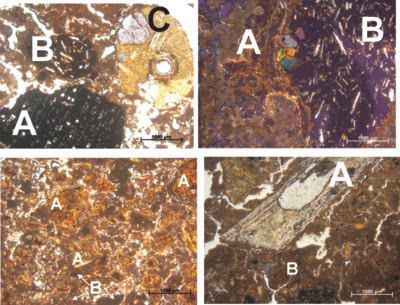
Micrograph of the Month - Beautiful Basalt

Image
These are examples of some of the floor deposits from Margat Castle, Syria (you can see the full thin section in my previous post here ). The upper left shows A. a microscopic fragment of charcoal, B. A rounded basalt pebble and B. a rounded weathered basalt pebble, all embedded within a calcitic fabric, most likely a lime based material. The upper right shows a lower portion of the floor, where the inclusions are angular. The 'bubbly' shape of part A. suggest vesicles from vitrification. Part B is the inner unweathered core of basalt. The lower left image shows A. smaller fragments of weathered vitrified granite that appear to have been crushed up and embedded in the B. lime floor matrix. The lower right image shows A. a fragment of highly weathered bone in B. a 'pure' lime floor that overlays all the pebbly floors. At least, that's what I make of it so far! Might have to enlist the help of a geologist to figure out where the materials are coming from and ex...

Elementary, said he

Image
80s-tastic plasma lamp (Wikipedia) Today I was mostly preparing lake sediment core samples for ICP. ICP stands for Inductively Coupled Plasma, and comes either in the MS (mass spectrometry) or OES (optical emission spectrometry) variety. Both are methods for measuring the different elements present in a sample. The ICP bit is a 'torch' containing a gas, typically argon, that is ionised by heating it via electromagnetic induction (remember those weird glowing globe plasma lamps?). Still confused? This means there is a coil wrapped around the torch, which produces a very strong electromagnetic field when turned on. The argon gas is ''lit' by an electrostatic spark, and the gas becomes ionised. The sample (dissolved in liquid) is sprayed into the argon flame, and also becomes ionised. As different components in the sample become ionised they gave off a characteristic energy. The MS and OES parts is the bit that detects the elements present. MS does this by measur...

Riga slides in progress

Image
Riga town samples set in resin, ready for cutting into slides Another week of lab work in Reading this week for the Ecology of Crusading project. The samples I boxed up in September for resin impregnation are now ready for cutting, and hopefully some of them will be finished into slides by the end of the week. They look like they've set really well; I was a little worried there would be problems as some of them were quite damp with lots of 'manure' layers, which can sometimes distort when dried or interfere with resin curing. I boxed up a few more samples from medieval Riga (Latvia), and 3 from Święta góra (Poland) today. It's going to be a tremendous amount of microscope work to get them all analysed, but I'm looking forward to it! I also started preparing some lake core samples for ICP analysis today, which was delayed due to some minor hiccups which will hopefully be corrected tomorrow. That should take the rest of the week, with the Association for Envir...

Microarchaeology at Qal'at al-Marqab

Image
It's about time I say a bit about Qal'at al-Marqab, also known as Margat Castle, Syria. It is the castle for which this blog is named, and looking back over my posts it seems I talk much more about the coprolites than the castles. I visited the site as part of a preliminary assessment into the potential of microarchaeology to investigate activities and use of space at medieval castle sites, back in 2009. I had an amazing time in Syria, working with a joint Syrian-Hungarian team led by Dr Balázs Major from the Pázmány Péter Catholic University. I've been working on the pilot samples on and off since then, but today is the first time I've had a real chance to go through the data in detail. As ever, microscopic analysis is providing fascinating insights into the archaeology that would otherwise be missed. One of my favourite samples is the floor section to the right. Probably one of the most difficult samples I've ever collected, I ended up having to hack the thing ou...

Quo vadis? Cesis!

Image
Back in the lab after a week in the field in Latvia, taking micromorphology samples for the Ecology of Crusading project at Cesis Castle . As I was only there for the week I missed all the fun of actually excavating the trench and uncovering exciting stuff like the fully articulated horse skeleton (hence the nickname 'horse trench'!), and horse related paraphernalia including bridle bosses, spurs and stirrups. Wet muddy trench of doom This did mean that I had a nice fully exposed section to work with, which makes it much easier to work out the best locations for taking micromorphology blocks - in this case to identify the surface residues on the floor and test the hypothesis that this was stable. The benefit of this however was perhaps outweighed by the fact the trench was filling up with water as I collected the samples, and the presence of a huge waterlogged beam conveniently located right where I needed to stand, making it a rather muddy business with some preca...