Posts

Showing posts with the label medieval

Digitized thin section slides!

Image
I can't remember if I posted about this earlier in the year, but I was lucky enough to be awarded two student work experience placements as part of the  Newcastle NWE programme , where students complete flexible paid projects within the university. Two of my Environmental Archaeology students have been working for the past few months, digitizing my entire collection of thin section slides. At some point I hope to make these available online as an open access resource for teaching and research. They did a brilliant job! I've only just had a chance to go through all the scans, having been away on fieldwork, busy with exams, then graduation. Here is one of the scans of a thin section from medieval Riga, that I have been working on as part of the Ecology of Crusading project . Combined with the fact I have just moved the lovely Leica DM750P research microscope into my office (kindly purchased by History, Classics and Archaeology ), I can now get working on my mounting backlog of sa...

Archaeology versus History

Image
I was alerted to a blog post a few weeks ago with the (deliberately I'm sure) provocative title Archaeology is just an expensive way of finding out what historians already know... Of course I immediately felt the need to...actually I didn't. The post does have a point. Archaeology is indeed usually more expensive than historical research. I don't think the central criticism of the article is specific to archaeology. What is actually being complained about here is poorly designed research, without a clear objective. Though it is not clear whether this is because the actual excavation being discussed (a battle field) does not have clear objectives, or that the main source linked to is a Telegraph article. Saying that archaeology just shows what historians already know is a narrow view of the aims of both history and archaeology. Whilst the contribution of archaeology to (in this case) a 200 year old battle that is extensively documented, may be more limited, there are alway...

Geoarchaeology at the Crusader Castle of Margat (Qal’at al-Marqab), Syria

I'm pleased to announce the publication of the final article on my work at Margat Castle, Syria: Shillito, L-M., Major, B., Almond, M., Anderson, E. and Pluskowski, A. in press. Micromorphological and geochemical investigation of formation processes in the refectory at the Castle of Margat (Qal’at al-Marqab), Syria Journal of Archaeological Science For those without a subscription the final version of the manuscript is also available open access on my academia page here (you'll need to log in). This is the end product of a pilot study I started in 2010. It was initially envisaged to be a test for a larger program of research, looking at differences in activities and resource use between different phases of the castle's occupation, but unfortunately due to the deteriorating situation in Syria, I was never able to return. I still have the lovely gifts I was given by the Syrians I worked and lived with. I wish there was some way of knowing if they are ok. I have posted ...

Analysing lipid residues in archaeological soil and faeces at the NERC LSMSF

Image
It's been a while since I've been in the lab, but last week I got to spend the entire week working in the NERC LSMSF (Life Sciences Mass Spectrometry Facility) in the Organic Geochemistry Unit at the University of Bristol. I have worked with Bristol for many years now as they have arguably the best set up in the world for archaeological and environmental geochemistry. For this visit I was working mostly on samples from the Ecology of Crusading project , with a few extra coprolite samples thrown in from Catalhoyuk and Durrington Walls (more on those at a later date!). The EoC samples are part of a larger programme of geochemical analysis, designed to look at human impacts on the landscape associated with colonisation in the medieval period. We are looking for evidence of increased faecal inputs (lovely!) associated with clearance of land for pasture, and maybe even human 'sewage' inputs from intensification of activity. Although I have developed the facilities for pot...

Micrograph of the Month: Fabulous Fungi

Image
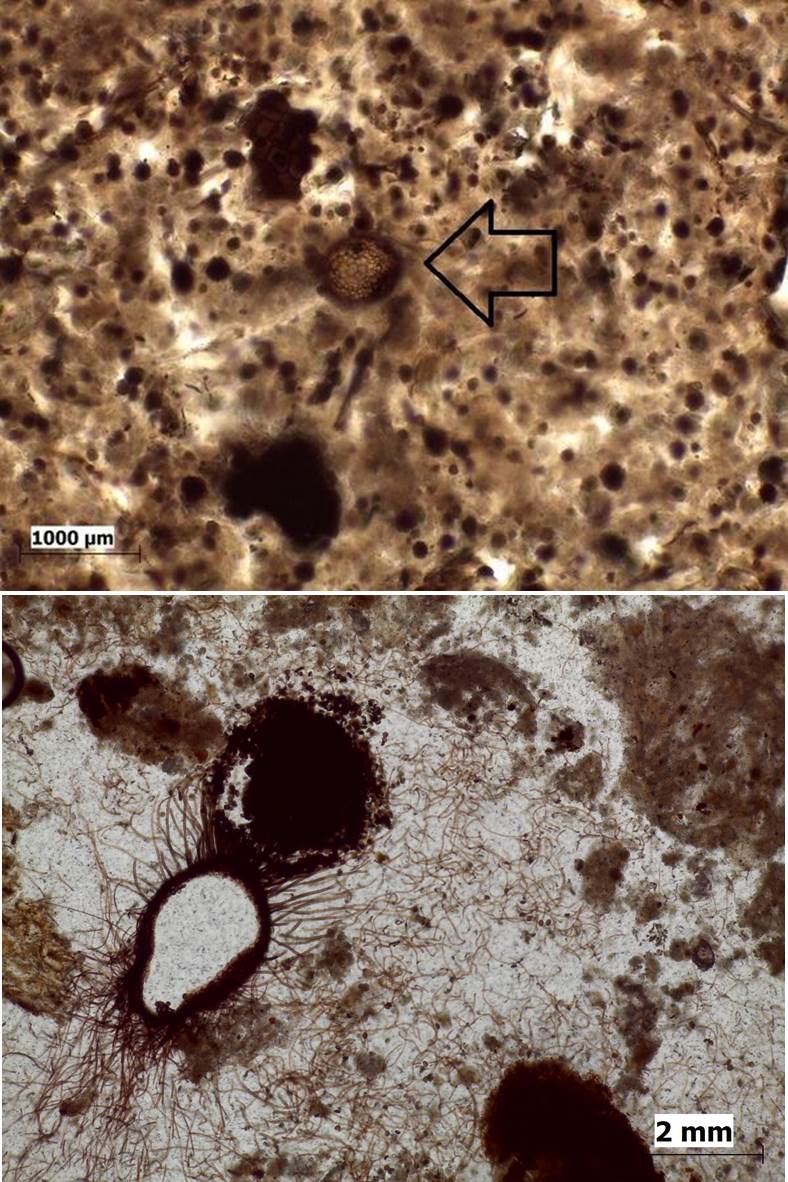
Followers of my Twitter account may recognise these little creatures! I posted the pics separately a while ago to see if anyone could help with identification. So far no response, if anyone has any clues or reference suggestions do let me know. Both are from medieval floor deposits that have undergone significant post-depositional bioturbation. The lower image is one of my favourites. The hyphae are like little tentacles that spread all the way through the sediment. That is the little string like projections that you can see extending from the sporongium. Which is the spherical bit containing all the little spores, and in this particular view is nice and ripe with little spores bursting forth. It is quite creepy to come across all of a sudden when you are looking down a microscope and not expecting it! The one at the bottom has a clear area in the middle, because the top has been abraded away during the thin section preparation process. Basically we are looking at an 'aerial' v...

Integrating archaeological science at medieval Riga

Image
Team palynology and zooarchaeology Team archaeobotany and geoarchaeology Lovely weather here in London today, though mostly being experienced inside a meeting room at the Warburg Institute ! I'm away from Edinburgh this week, firstly for a project meeting for the Ecology of Crusading project and then for a week of lab work in Bristol - more on that to come! This weekend I am here with fellow team members Rowena Banerjea , Alex Brown , Monica Badura and PI Aleks Pluskowski , discussing our  analyses of deposits from medieval Riga. This is the first time we've all got together to integrate our data, and to get updates on the dating of the deposits. So far  we have potentially the earliest known building in Riga, on the basis of dendrochronological dates, and some great archaeobotanical data on the types of plant materials that were being used - along with the micromorphology it looks like a lot of the plant material is associated with construction, such as wood chipping...

More vivianite!

Image
I couldn't resist posting about this lovely micrograph, even though I blogged about this mineral quite recently . This is the same floor sample from medieval Riga, it's absolutely chock full of these iron phosphate crystals (vivianite) in various forms. The last image I posted showed the typical blue amorphous mass, here is another view, this time of a collection of smaller 'rosette' crystals, showing the monoclinic form. You can see that there is a mix of blue and yellowish/grey crystals in these rosettes. Vivianite turns blue on exposure to air, suggesting that this part of the deposit remained waterlogged whilst other parts were partially exposed. Curious that these little crystals appear to be clustering around that white area - a 'crack' in the floor.

Micrograph of the Month: Foram with a Calcite Hypocoating

Image
This month we have some micrographs from floor deposits in the refectory at Margat Castle, Syria . Here we have a fragment of lime, within which is embedded a lovely little foraminifera. Forams are tiny little marine creatures which have calcium carbonate shells, and when they die they form part of the fine sediment which is deposited on the sea floor. This in turn becomes sedimentary rock, and that's the origin of this tiny fragment of limestone. In XPL we can see that the void space inside the foram has a coating of highly birefringent (sparkly) material. These are tiny little calcite crystals. Calcite hypocoatings can result from several processes, but in this case it is likely the result of carbonate rich water percolating through pores in the sediment. Similar coatings can be seen in other voids in this layer. When the water evaporates the carbonate precipitates on the walls of the voids. A bit like the layers of lime-scale that form on taps and kettles if you live somewhe...

Micrograph of the Month: the woods decay and fall

Image
Close-ups of decaying waterlogged wood. Upper left showing 1. latewood with secondary cell wall intact 2. earlywood with loss of secondary cell wall. Upper right showing loss of birefringence in areas subject to decay Another fab example of the sorts of things that go on in medieval waterlogged deposits. I posted some pictures of this waterlogged wood a couple of months ago, as well as a nice example of the formation of vivianite in the same deposits . Here we have another example of waterlogged wood, but I've added some close-ups in cross polarised light (XPL). For the non geoarchaeologists in the audience, this is a technique in microscopy where you change the type of light you use to look at a sample, by inserting polarisers on the microscope. Polarised light vibrates only in one direction. On the geological microscope, the lower polariser causes the light to vibrate in an E-W direction, whilst the upper polariser/analyser filters light that is not vibrating in the N-S d...

Micrograph of the Month: Ferrous phosphate (vivianite)

Image
This month we have a lovely image of a particularly colourful mineral feature called vivianite. Vivianite is an amorphous hydrated ferrous (iron) phosphate, which is blue when oxidised. It has been linked to the decomposition of bone and/or human and animal waste in wet sediments, which fits with what we know about this context. Yes, we are still looking at those waterlogged deposits from medieval Riga ! This is just one example of the many occurrences of vivianite in this layer. The small fragment of wood is also interesting. Unlike the waterlogged wood we looked at a couple of months ago , this fragment has been completely mineralised due to the presence of phosphate in the waterlogged sediment - at first glance I thought it was a bit of bone! You can also see that the pores spaces within the wood have been completely filled with fine sediments, which also indicates waterlogged conditions - the infilling of the voids occurs as fine sediments suspended in water are deposited within...

Micrograph of the Month: Medieval floors

Image
This is the second floor themed micrograph post, you can see examples of Neolithic floors in a post from last year here . You'll notice the same horizontal surface and distinct boundaries, and even a similar type of charred plant, ash and bone debris, however the construction of the floors themselves is quite different. Whereas the prehistoric floors are made from packed mud/earth, these Medieval floors from the town of Riga are made from a calcareous material with a very high quantity of sand grains. It looks very similar to a lime mortar, though I want to do a bit more work on it before saying that for definite. Another difference here, whereas the Neolithic floors were showing signs of post-depositional processes in the form of gypsum crystals, the debris on this floor is remarkably well-preserved. I have put together two photos here, the bottom image showing an earlier floor, overlain by mixed debris, containing tiny bone fragments, wood charcoal and ash. The upper photo show...

Crusader Castles of the Baltic

Image
I wrote a feature article for Current World Archaeology Magazine on the Ecology of Crusading project, which has just been published in issue 57. It's a brief overview for a general audience, so there's lots of basic info on the environmental and lab methods we are using as well as some of the preliminary results. And of course lots of fab photos of castles, fieldwork and whatnot. I like writing more general articles like this - it's something I can show the parents and they get all excited about. Pages of technical jargon in J. Arch. Sci. and the like never get quite the same reaction. http://www.world-archaeology.com/features/crusader-castles/ It's exactly 10 issues since the last piece I wrote for them in issue 47, 2011, on Catalhoyuk under the Microscope, which you can read an excerpt from here: http://www.world-archaeology.com/features/turkey-neolithic-life-at-catalhoyuk/

Christmas Parcels

Image
What excitement is this? Parcels in the post over Xmas! Perhaps more exciting than all the Xmas chocolates and treats? It's the long awaited box of micromorphology slides from Medieval Riga, Latvia! Ok, so maybe not quite as exciting as chocolate, but still pretty fab. I've been waiting for these to be ready since September so it's quite a nice suprise to see them all finished and coverslipped, just in time to get back to work after the holidays. Excuse the camera flash, I will scan them in properly at some point. Waterlogged and charred plant remains, and also (I suspect) animal dung Occupation debris accumulated on a medieval floor from the city of Riga I also got sent a copy of The Archaeology of the Prussian Crusade by Aleks Pluskowski , PI on the Ecology of Crusading project. Parcels of excitement This is something else I have been looking forward to - I did a lot of the line drawings for it and it has been very exciting seeing it come together ...

Micrograph of the Month - Beautiful Basalt

Image
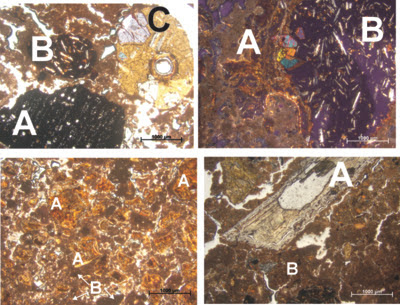
These are examples of some of the floor deposits from Margat Castle, Syria (you can see the full thin section in my previous post here ). The upper left shows A. a microscopic fragment of charcoal, B. A rounded basalt pebble and B. a rounded weathered basalt pebble, all embedded within a calcitic fabric, most likely a lime based material. The upper right shows a lower portion of the floor, where the inclusions are angular. The 'bubbly' shape of part A. suggest vesicles from vitrification. Part B is the inner unweathered core of basalt. The lower left image shows A. smaller fragments of weathered vitrified granite that appear to have been crushed up and embedded in the B. lime floor matrix. The lower right image shows A. a fragment of highly weathered bone in B. a 'pure' lime floor that overlays all the pebbly floors. At least, that's what I make of it so far! Might have to enlist the help of a geologist to figure out where the materials are coming from and ex...

A curious incident

Image
Corroding sample! Yesterday's ICP samples are coming along nicely. I'm happy to say nothing had exploded when I went to check on them this afternoon. Today I also started boxing up the last few samples from medieval Riga, and came across this oddity ---->. All of the samples from Riga were waterlogged, and something strange has happened to this one; you can see all that orange spreading across the bottom of the sample? It is some sort of iron staining, and is very clearly seeping from the sides of the tin into the fine grained clay floor part of the sample. There were also lots of little salt crystals all over the surface, and you can see to the centre right a small area at the top of the metal tin has corroded! I'm wondering if there is a metal object in the block somewhere that is degrading? A few of the other samples had unfortunately started growing mould. In future I will learn to wear a mask when unwrapping waterlogged samples! Hopefully this was just on th...

Elementary, said he

Image
80s-tastic plasma lamp (Wikipedia) Today I was mostly preparing lake sediment core samples for ICP. ICP stands for Inductively Coupled Plasma, and comes either in the MS (mass spectrometry) or OES (optical emission spectrometry) variety. Both are methods for measuring the different elements present in a sample. The ICP bit is a 'torch' containing a gas, typically argon, that is ionised by heating it via electromagnetic induction (remember those weird glowing globe plasma lamps?). Still confused? This means there is a coil wrapped around the torch, which produces a very strong electromagnetic field when turned on. The argon gas is ''lit' by an electrostatic spark, and the gas becomes ionised. The sample (dissolved in liquid) is sprayed into the argon flame, and also becomes ionised. As different components in the sample become ionised they gave off a characteristic energy. The MS and OES parts is the bit that detects the elements present. MS does this by measur...

Riga slides in progress

Image
Riga town samples set in resin, ready for cutting into slides Another week of lab work in Reading this week for the Ecology of Crusading project. The samples I boxed up in September for resin impregnation are now ready for cutting, and hopefully some of them will be finished into slides by the end of the week. They look like they've set really well; I was a little worried there would be problems as some of them were quite damp with lots of 'manure' layers, which can sometimes distort when dried or interfere with resin curing. I boxed up a few more samples from medieval Riga (Latvia), and 3 from Święta góra (Poland) today. It's going to be a tremendous amount of microscope work to get them all analysed, but I'm looking forward to it! I also started preparing some lake core samples for ICP analysis today, which was delayed due to some minor hiccups which will hopefully be corrected tomorrow. That should take the rest of the week, with the Association for Envir...

Medieval manure, from Riga to Reading

Image
Many boxes of medieval stratigraphy I was back at the University of Reading a few days ago to have a look through all the samples that have been collected for the Ecology of Crusading project.   Four cardboard boxes and a tray of miscellaneous samples later, I finally got them all unpacked and ready for the drying oven. It appears at least half the samples have the note ‘manure layer’ attached, so nothing new there. In fact, that'll be the third time this year I've recieved parcels of such material. I should start telling people I am interested in highland single malt whisky as well as coprolite analysis, maybe I’d start getting that in the post regularly too. Anyway. Block of medieval manure  The majority of these samples were collected from excavations of medieval deposits in the centre of Riga (Latvia). I am told that these are the first micromorphology samples ever collected from a commercial excavation in Latvia, by students who took part in the C Ä“ s...