Posts

Showing posts with the label micromorphology

Marvellous Middens at the Auckland Palace Excavation

Image
I was delighted yesterday and today to attend the excavations at Auckland Palace, a joint project between the Auckland Project , the  Department of Archaeology at Durham University  and Archaeological Services Durham University . This is actually the first time I've had the chance to meet any of the Durham undergraduate students since I started my new job at the department in April, and it was great to see everyone in action. Field schools are one of the best parts of doing an archaeology degree - the chance to go out on a real archaeological dig and learn the process of excavation and recording first hand with professional practitioners, and be involved in everything that happens afterwards with samples and artefacts that go back to the laboratory for analysis. Durham has a great set up and lots of the students will have the chance to continue working on material from the excavations for lab projects and dissertations.  I was particularly pleased to see this absolutely m...

Investigating the construction of a Bronze Age burial mound

Image
This post is many years in the making! Back in 2018 I was on an excavation at a site called Cronk Guckley on the Isle of Man with my colleague Prof. Chris Fowler, a brilliant theorist and Neolithic specialist, who is co-director of the Round Mounds project. This is a great project with some really exceptional finds, including this beautiful jet bead necklace. The excavation finished in 2022 and we are now completing all the post-excavation analysis. The project is investigating the nature and timing of Bronze Age ‘round mound’ construction and how funerary practices evolved, on the Isle of Man and surrounding islands. These structure are large earthern monuments that were constructed over the top of a burial. The jet necklace is an exciting piece of evidence, not just because of it's beauty, but because it gives us insights into the people - the jet has been sourced to Whitby, so is great evidence for connections between the Isle of Man and mainland Britain in the Bronze Age, an...

Human-environment interactions in the Hadrian's Wall Landscape

Image
You wait a whole year for a blog post, then two come along at once etc. Following the existential musings of the previous post, I figured I'd better post some fun geoarchaeological stuff. I have been working with a number of colleagues on various projects for the past couple of years, that are loosely related, and fall under the general banner of Human-environment interactions in the Hadrian's Wall Landscape. Regular blog readers will remember in 2021 I talked about the new  excavations at Birdoswald . These have been progressing nicely, and we have uncovered all sorts of amazing finds and environmental material. I have also been working with Dr Eline Van Asperen, and Masters student Damian Rudge, looking at long term changes in the environment, and whether these relate to Roman or earlier activities such as lead mining. In 2022 we were awarded a small grant from the Royal Archaeological Institute  to collect some peat cores with the aid of local volunteer groups. Eline a...

New project: TerraSAgE: Terraces as Sustainable Agricultural Environments.

Image
I am excited to announce a new AHRC research project starting at Newcastle  in January,   TerraSAgE: Terraces as Sustainable Agricultural Environments .The project is led by PI Prof. Sam Turner, and I am one of the project coIs, overseeing the geoarchaeological aspects of the project. Sam and his team have been doing pilot studies for this project for a while now, developing a new OSL dating method to understand the chronology and formation of agricultural terraces from prehistory to historic periods. I became involved in the project last year to advise on geoarchaeological and soil science approaches to the analysis of archaeological and historic terraces. The major aims of the project are to understand how and when terraces were constructed and how they were maintained and managed, and how this varies in different geographic regions, and in different time periods. We also want to understand why terracing developed, and conversely, why it was abandoned in some places but not...

Earthslides lab - the final stages!

Image
It's been a frustratingly long process, but we have finally been given an end date for the set up of the new Earthslides lab at Newcastle - I am pleased to say that it will be up and running by the 22nd December. I started discussions about acquiring Earthslides way back at the end of 2017, when previous owner Julie Boreham announced her retirement. It wasn't until April that I mentioned this on my blog, which is about the time it took to put forward a proposal to the university to purchase the equipment/business, and to secure the funding. After getting an agreement in principle the next major hurdle was finding a space to house the new lab. Space is always an issue, but we managed to find a room in the same building as our existing Wolfson lab , which is ideal. However, as the room was currently a tea room/storage area, it has required a complete refurbishment to make it suitable to use as a lab, hence the rather long delay in the whole process. I have never been in a pos...

Micrograph of the Month: Inclusions in omnivore coprolite

Image
I am so happy that I've actually managed to get some microscope work done over the past couple of weeks. It feels like forever since I had the time to do any lab work, or spend time looking down the microscope. Even on my research leave, I have been so busy writing papers and grant applications that microscope time has taken a back seat. I am currently working on the 30 or so slides we collected as part of a NERC project at Paisley Caves in Oregon . This week I have been focusing on characterising the different types of faeces that are found in the sediments. There are lots of different types - rat and bat dung , ovicaprid type pellets, and of most interest of course, the potential human coprolites. I say potential, as we can't know for sure if they are human without conducting additional biomolecular analysis , but the pictures below show a likely human candidate. In any case we can say that it is omnivore coprolite, containing both digested bone fragments and plant tissues. T...

Micrograph of the Month: Mixed fuels

Image
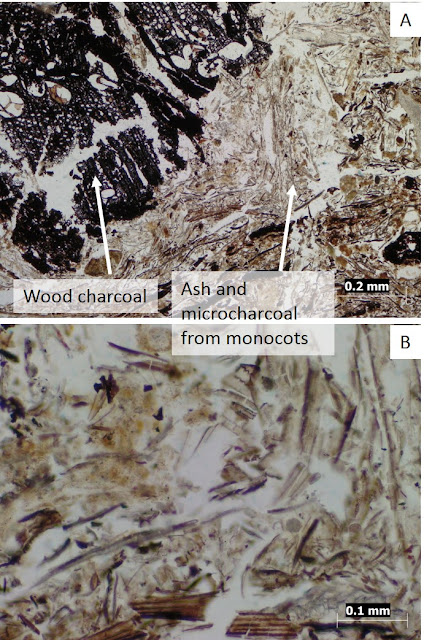
It's been too long since I've looked at any new thin section samples, but today I had the chance to look at some new stuff from Catalhoyuk . Here are some lovely mixed fuel deposits from an external area, showing A. wood charcoal (Quercus?), with microcharcoal and phytoliths from grasses and sedges. B. is a close up of the ash to try and show some of the phytoliths but it is hard to get a good photo in focus even though the slide is only 30 microns thick. Probably redeposited given the random orientation of the phytoliths.

Earthslides @ Newcastle!

Image
I have been meaning to write this post for a while, but have been busy behind the scenes sorting out all the logistics. Finally I can announce that Earthslides is to be relocated at Newcastle, as a new facility within the McCord Centre . After many years providing one of the best thin section processing services in the world (seriously!), Earthslides owner Julie Boreham is retiring in June. We have been in discussions since last year about Newcastle taking over the facility. The whole process has taken up a large part of the past year for me, from getting permission from the university, securing the funding to purchase the equipment, to finding a space at the university to put it in (harder than you could ever imagine!), to finally this morning, our first meeting with estates to assess the new space and go over the requirements for getting it refitted. This has been a long term dream of mine - setting up my own micromorphology lab, where we can train researchers and develop amazing c...

Microfossil in a Micrograph of the Month

Image
It's been a while since I did a monthly microfossil or micrograph post, so I thought I would share this nice example of something combining both. This is a midden deposit from the early Neolithic site of Bonkulu in Turkey - the large greyish object in the middle is a very highly silcified conjoined phytolith from a reed stem/leaf, embedded in a matrix of mixed ashy debris. There is a resemblance to an earlier micrograph I posted from the Babylonian site tell Khaiber, which also contains large mutlicelled reed phytoliths. The deposits at Boncuklu are chock full of these large Phragmites reed phytoliths, likely to be from burning these substantial plants as fuel. The macrobotanical record from the site also contains large volumes of reed stem charcoal.

Getting to know Olynthos

Image
Today was my last day on site at the classical Greek city of Olynthos in northern Greece. Although I have never studied Greek archaeology, or indeed anything classical, ancient Greece is something I was always fascinated by as a child. If I'd thought to study archaeology as an undergraduate I can imagine that ancient Greece is something I would have gone for. Regular blog readers know I was a geographer before I was an archaeologist, and that background has situated me more in prehistory, with it's greater emphasis on long term environmental change and human-environment interactions. But yet again I find myself being fascinated by themes and comparisons rather than specific time periods, and also the differences in approaches to archaeology in different areas. Ancient Greece is exciting as there is a wealth of documentary evidence and we know so many of the little details compared to prehistory. But like other historic periods I have worked on (e.g. The Ecology of Crusading ...

Micrograph of the Month: Wood fragment

Image
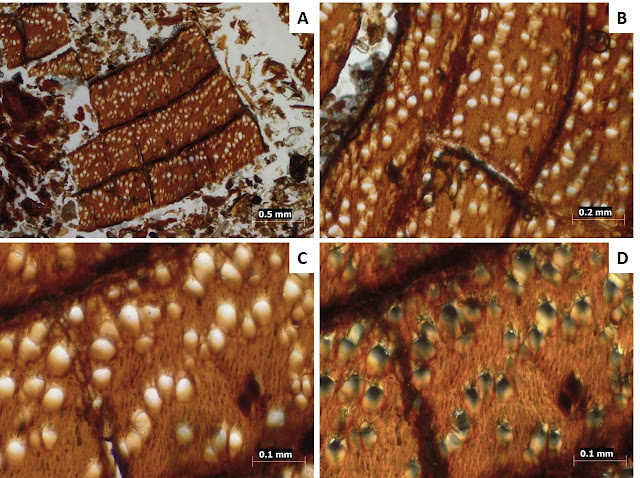
I'm in the middle of writing a brief introductory paper about the work we are doing at Paisley Caves, which includes some of the micromorphology results from our pilot study. The slides from this site are complex, and also so fascinating. Complex because the are very heterogeneous and include a huge variety of biogenic material, including lots of fragments of plant tissues, and there is also some weird stuff going on with the chemistry in the cave environment. Here is an example of a small fragment of wood, within a layer of mixed material overlying a layer of microfaunal dung pellets. The layer is between two radiocarbon dates approximately 8180 and 9565 years cal BP. In the picture below I've shown it at a range of magnifications, and images C and D show it in PPL (C) and XPL (D). Modern wood in XPL usually looks a bit fluorescent because cellulose is birefringent. Usually with archaeological material I'm much more accustomed to seeing wood in the form of charcoal! The on...

Paisley Caves - notes from the field part 1

Image
It's the end of the first week in Oregon as part of our NERC project at Paisley Caves. As usual fieldwork fills me full of ideas for blogging, with none of the time or internet access to post them. The weather has been hugely variable here. For the first few days it was below freezing at night time. I was in my tent in a super warm sleeping bag, with fleece jogging bottoms and beanie hat, and I was still not really that warm. Then after the second day the weather switched to baking hot, and by the end of the week we were all in t-shirts and covered in sunscreen. The view of the landscape from the entrance to the Paisley Caves is amazing - a huge expanse of sagebrush desert with the occasional agricultural feature in the distance. Dirt tracks snake across the landscape, heading towards the town of Paisley on the left, and Summer Lake hotsprings on the right. I'm going to miss this view. The day begins at 5.30, waking up in the tent to varying degrees of chill, getting d...

Micrograph of the Month: TBD

Image
You know nothing, Lisa Shillito! This is how I sometimes feel being a micromorphologist, especially one looking at samples that are a different to the contexts I am used to. Here are some more images from the Lufton Roman Villa sample I mentioned last month . I am not actually going to say much about this as I am not entirely sure what it is, and basically am scouting for opinions from fellow geoarchaeologists. This is a small rounded inclusion about 1mm in length, consisting of lots of brownish purple rhombohedral crystals embedded in a yellowish (almost ash-like?) matrix. As you can see, the crystals themselves don't look much different in XPL. The inclusion is located within a layer of mixed microcharcoal and calcareous debris (probably from the lime layer underneath). There are some bits of lime that have a similar appearance, sort of like iron staining of the carbonate. My guess is possibly iron carbonate crystals replacing the calcium? I will definitely be bringing this slide...

SAA conference, Vancouver 2017, Part 1

Image
Me looking thrilled to be presenting my poster I just got back at the beginning of the week from the Society for American Archaeology conference, held his year in Vancouver. Although it is 'American' archaeology, the geographic spread of attendees and research topics is very international, and I ended up catching up with friends and colleagues from all over the UK as well as the US. I ended up being incredibly busy as I foolishly agreed to do three different sessions. Many months ago I was asked to participate in two sessions as a discussant, as well as submitting a poster on my NERC project. I assumed this meant a role of leading the questions at the end of the session, but on arrival realized it is almost the equivalent of a keynote, and involved giving an actual 15 minute presentation summarizing the papers and state of the field! Luckily the sessions are both topics on which I am passionate, and I managed to put together two talks that went very well. The first was ...

Micrograph of the Month: Roman floors

Image
I haven't posted a micrograph for ages, but this one is so pretty I just had to share it. I'm in the middle of doing an analysis of Roman occupation deposits for the Lufton Roman Villa project . I don't know too much about the wider context yet, but my initial observations of this particular sample suggests we are looking at an old floor surface. There are 3 distinct layers, and the uppermost layer is composed of a calcareous material, in which are embedded lots of tiny crushed up ceramic fragments. The middle layer is a sandy aggregate with the occasional bit of soil/clay and charcoal, and there is a very thin lowermost layer (thin because of the sample size, not sure yet how thick it was in the field) which has a lot of organic material including wood and grass charcoal, and possibly fungal spores. I will be writing more on this as the analysis progresses, but for now here is a nice image of one of the ceramic fragments (the orangey-red rectangular inclusion) embedded in...

Teaching archaeological sediment micromorphology part 2

This semester I've been teaching archaeological sediment micromorphology, as part of a third year module in geoarchaeology. I mentioned a few weeks ago how hard it was to teach a subject this complex in only 2 hours per week, and that in future I was thinking of removing it from Geoarchaeology and turning it into a stand alone module. I still haven't decided whether to do this, as I think it's important to have some teaching of it at UG level, but a module focusing entirely on micromorphology is probably more suitable for Masters level. Related to my frustrations, I made an offhand comment on Facebook that despite it being one of my specialist subjects, sediment micromorphology is very boring to teach. More than any other method I have studied, micromorphology is definitely the one filled with the most jargon. Don't get me wrong, I think jargon is important. We need the specialist language to describe the many complex features and processes that we see in thin sectio...

Thin sections related to pyrotechnology in Bronze Age Sicily

Image
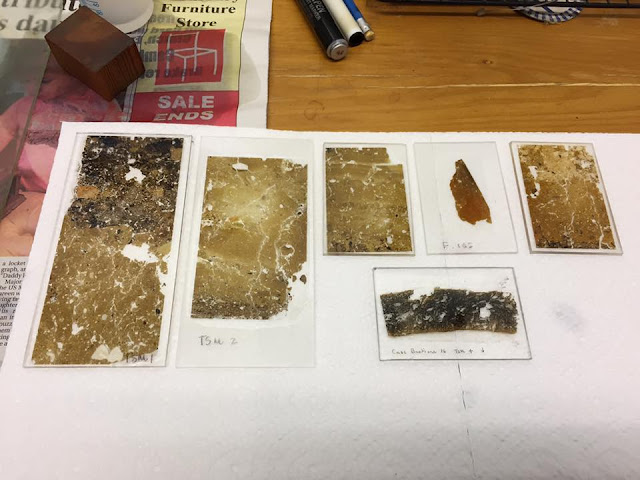
The arrival of new thin sections is always exciting, but always daunting at the same time. Sediment micromorphology has to be one of the more challenging geoarchaeological techniques, simply because of the huge variety in the types of material you can encounter, and a deposit from one site never quite looks the same as one from another, even when they are related to similar activities. The samples from Case Bastione were collected to investigate formation processes and activities of a number of features in the Bronze Age settlement, including a large 'burnt' layer, and some strange pit deposits. The most striking thing about all the samples is the ubiquitous presence of these teeny tiny little creatures - my educated guess is that these are tiny foraminifera of some sort , present within limestone/chalk or another carbonate material (I need to do some research on Sicilian geology!). What is slightly confusing is the presence of a spherulite like appearance within the shells in...

Teaching geoarchaeology and sediment micromorphology

Image
Today I am doing three hours of teaching for PG students on soil. This follows two hours yesterday of teaching 3rd year students sediment micromorphology. My 3rd year Geoarchaeology module is challenging this year, as the class is 75% geography students, so I have had to modify the content a bit to make sure we go over the archaeological concepts. Having non archaeologists in the audience makes you really just how jargon filled the subject is! At the moment the module is set up so that the practical classes are about 25% bulk soil analysis and 75% thin section analysis, but I am tempted to switch this next year and focus on the bulk sediments. As much as I love micromorphology, it is a very challenging subject to teach as it is so time intensive, and I think it would work better as a stand alone module. This will give the students more time to work on materials, and to focus the seminars specifically on micromorphology. At the moment the Geoarchaeology module seminars are focused on br...

New thin section slides from Sicily

Image
If you follow Hidden Worlds on Facebook you may have spotted a set of samples from Sicily have been progressing nicely over the past few weeks. These are samples that we collected last summer during a field school, at a site called Case Bastione . It is a Bronze Age settlement located in central Sicily, and has some really interesting features that we are describing as clay lined pits. The functions of these are unclear. It was initially hypothesized they had something to do with metal working, but chemical analysis has suggested other functions. We have taken a number of samples to try and figure it out. The thin section samples are taken from the pit linings, and a range of 'domestic' deposits. I am hoping we can recruit an enthusiastic student to look at these samples for a dissertation project, though I might not be able to resist having a look at them myself!

I love middens

Image
We are in the process of updating the School website for History, Classics and Archaeology at Newcastl e. I've been asked to provide some high resolution photos for various sections, and so have been digitally digging through my image archive. I came across this amsuing photo from 2004 - my first ever visit to Catalhoyuk . It was either during my MSc or just after I finished. So long ago that I still dyed my hair black! I remember this midden - I think it was Unit 1668, and probably isn't there anymore. The first midden I worked on, looking at archived micromorphology slides at the University of Reading, and trying to compare the phytolith data from the same units. Although the Masters project had a lot of limitations (working with archive samples is very difficult when trying to compare microstratigraphic data), the lessons I learned formed the basis of the project I went on to do for my PhD. So I still have a soft spot for this particular midden! These were taken using one of...