Posts

Showing posts with the label durrington walls

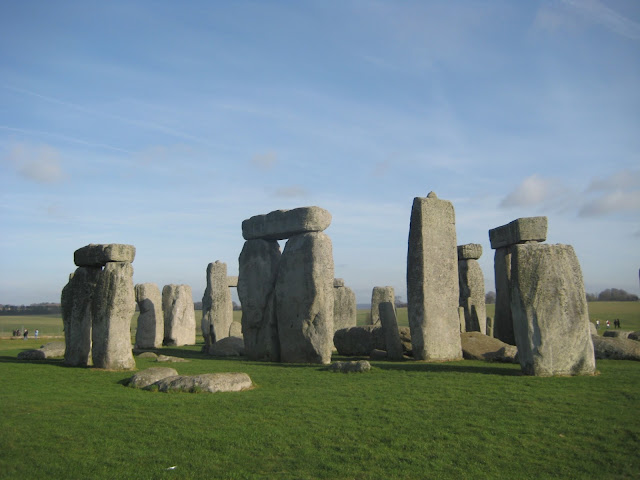
Say Cheese! Feeding Stonehenge
Image
The beginning of the semester at Newcastle is just flying by. So many exciting opportunities for the future - but right now a little something from the past. Back in 2010 I started a postdoctoral position with the BioArCh group at the University of York, investigating food residues in pottery from Durrington Walls, thought to be the settlement that housed the builders of Stonehenge. I've blogged about the progress of the project on a number of occasions , and wrote about it for the Day of Archaeology back in 2012. This week the academic paper from all that hard work was  published in Antiquity journal, along with a university press release , and it's very satisfying to see the final results in print. Being related to Stonehenge, I suspected it may be of general interest, and I was quite excited to see whether the media would run the story. I spent yesterday evening watching with a combination of awe and horror at how this process unfolds - a carefully worded story of science...

New year, new Science

Image
Happy new year from Castles and Coprolites! The first news item of 2014 is a write-up by Michael Balter about the latest research on Stonehenge, featuring snippets about my work on pottery residues as part of the Feeding Stonehenge project , as well as summaries of work by the faunal team and other specialists. There's also a brief mention of our unpublished pilot study on pottery residues at the Ness of Brodgar, which we carried out as a comparison whilst working on the Durrington Walls assemblage. If you'd like to read it and don't have access to Science online, drop me an email and I can send you a pdf. http://www.sciencemag.org/content/343/6166/18

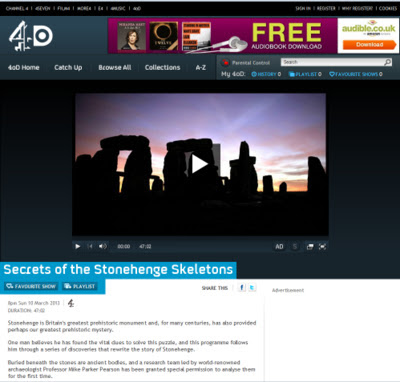
Secrets of the Stonehenge Skeletons

Image
My postdoc work on the pottery residues for the Feeding Stonehenge project was featured on the Channel 4 documentary last night Secrets of the Stonehenge Skeletons. The organic residues PI, Dr Oliver Craig did a great job of explaining the methods we have been using, with a few hints at our results - full details won't be available until we publish the research towards the end of the year (and complete our statistical analysis to confirm our interpretations!). The work is also featured as one of this week's main news stories on the University of York website here and the Department of Archaeology news page here . http://www.channel4.com/programmes/secrets-of-the-stonehenge-skeletons/4od As Ol explains, this is one of the largest studies of pottery residues from a single site (over 300 individual pots were analysed), and by designing a sampling strategy with GIS and other specialists, we have been able to investigate spatial differences in pottery use across the site, be...

Day of Archaeology - What happened next?

Image
A couple of weeks ago I wrote a blog post as part of the Day of Archaeology which aims to give people an insight into the variety of work that archaeoklogists around the world do. There are some really fascinating stories on there, and it was great to see a few posts from fellow Çatalhöyük types ( faunal team and human remains team ) on what they are up to this year. This is the first season in a long time that I won't be heading out this summer. We are just too busy finishing off all the lab work for Feeding Stonehenge. My post outlined a typical day in the bioarchaeology lab at the University of York, featuring more of those poetry inspiring pot sherds from Durrington Walls. This is just a little follow on to explain what happened next.... So, we got to the point of putting the extracted samples on the GC/MS which works something like this: Step 4 actually involves a lot of manual checking of the data to make sure what the computer thinks the lipids are is correct - it c...

To Potsherds

Image
I wandered lonely in the lab, Amongst the tubes, clearing the spills When all at once I saw a bag Of broken sherds amongst the drills Beside the bench, beneath the shelves I guess they won’t extract themselves.           Continuous as the gas that flows, And dries the samples in their vials, Wherefore these sherds appear who knows? It’s like a never-ending trial: Ten thousand Grooved Ware at a glance, Am I caught in a bad romance? From postholes, pits and avenue From middens, house floors, slots of beams, There’re always more postsherds to do: Grit tempered vessels haunt my dreams. I gazed - and gazed - with little thought What wealth the sherds to me had brought For now, whilst at the bench I stand, Clad in white coat, with pensive stare, It all makes sense, I understand! I like you lots, most Grooved of Ware And now my heart with pleasure fills The sherds my friends, my secret thrills. ...

Salisbury, Skulls and Steampunk

Image
To continue the alliterative theme of the blog, this sums up nicely in 3 words my sampling visit to the Salisbury and Wiltshire Museum yesterday. The museum houses the collection of pottery from the 1967 excavations at Durrington Walls by Wainwright, which we will be using for comparison with the pottery being analysed from the Stonehenge Riverside Project . I was pleasantly suprised to see how pretty the city is - a little bit like York with random medieval buildings and bits of medieval wall dotted around the centre, and also an impressive cathedral. Maybe not quite as pretty as York Minster, but not too bad :) The cathedral is right next the the museum, though alas I didn't get a chance to look around as I had a rather large box of pottery to carry around by that point. The museum itself was rather exciting. The collections of archive material are located in a very chilly old store room complete with strangely labelled Victorian draws containing Antiquarian curiosities. It wa...

Feeding Stonehenge - food residues in Neolithic pots

Image
Lab day today, finishing off the last batch (for now) of pottery samples from Durrington Walls . Bit of background - my main research project at the moment is to investigate patterns of food consumption at Durrington Walls, the Neolithic settlement associated with Stonehenge. This involves selecting pottery from different parts of the site, extracting food remains, and seeing if there are differences across the site. Fatty food residues survive suprisingly well in prehistoric pottery (well, some of it, depending on the preservation conditions and other factors). They can be extracted quite easily in the lab by grinding up a small portion of the pottery and shaking it with solvent. The fatty residues dissolve into the solvent, and can then be identified by injecting the solvent into a GC/MS. In basic terms, the GC/MS seperates out all of the different parts of the food residue so we can identify the different components, and the result is something like this. Each of the peaks is a diff...