Posts

Showing posts with the label ash

Micrograph of the Month: Mixed fuels
Image
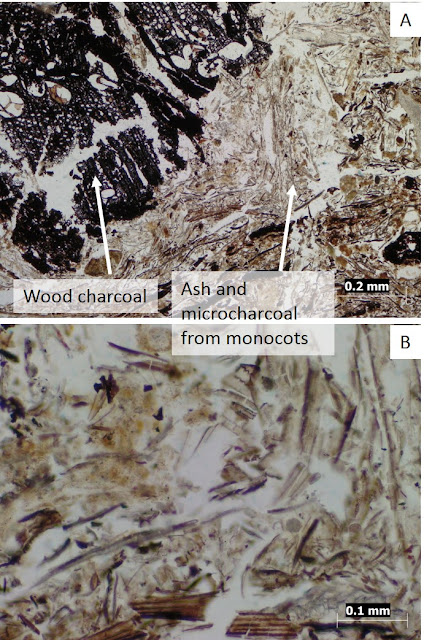
It's been too long since I've looked at any new thin section samples, but today I had the chance to look at some new stuff from Catalhoyuk . Here are some lovely mixed fuel deposits from an external area, showing A. wood charcoal (Quercus?), with microcharcoal and phytoliths from grasses and sedges. B. is a close up of the ash to try and show some of the phytoliths but it is hard to get a good photo in focus even though the slide is only 30 microns thick. Probably redeposited given the random orientation of the phytoliths.
Microfossil of the Month: Fragile phytoliths

Image
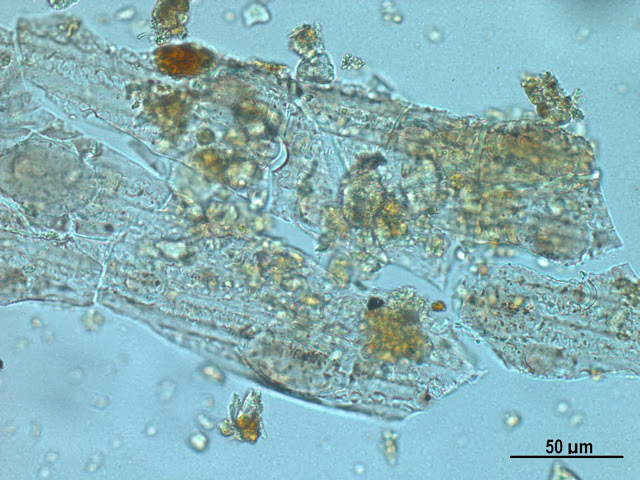
I promise brand new images will be coming soon, but for now here is a micrograph from my old files, this time from my work with the Central Zagros Archaeological Project back in 2010, and is from ashy deposits in an external area at the Neolithic site of Sheik e Abad in Iran. This is a great example of a conjoined phytolith that is not particularly well silicified and/or has suffered erosion. The pattern of the cells is not very distinct, and quite 'faint', though you can just about make out the wave pattern of the long cells in places. For comparison, see this example of well-silicifed wheat phytoliths from Catalhoyuk, and this reference specimen of Setaria italica , both of which have very distinctive and well defined cell morphologies. The reason I chose this micrograph is that it is a very good example of how fragile phytoliths are. Despite being composed of silica, which is pretty resistant to decay, phytoliths are physically quite fragile. Think of it like glass - it i...

Ladies of the Midden Kiln

Image
Back in March I mentioned that I was involved in a sciart collaboration, where artists and scientists come together to work on collaborative art projects, inspired by scientific research. I love this idea. I was always really into both art and science growing up (and took Art as an A Level subject!), and although I choose to go down the 'science' route for my career, I have maintained a keen interest in art, and particularly how we can use artistic expression to communicate scientific research. The artist I have been working with is Molly McEwan , an Edinburgh based artist and graduate of Duncan of Jordanstone College of Art and talented ceramicist.  The photos to the left are a sneak preview from Molly's exhibition at Wednesday's Girl, a free exhibition showcasing the work of female artists from Scotland, held at Space Club and supported by Somewhere To , an organisation provides spaces and venues for young people across the UK. Molly's solo exhibition , ...

Microfossil of the Month: Plant Stomata

Image
For 2015 I have decided to replace my Micrograph of the Month feature with Microfossil of the Month. I will likely return to the thin section micrographs at some point, but as I am going to be working on phytolith and ash samples for most of this year, I figured it would make sense to feature some of these on the blog! Who knows how long I will be able to keep it up - from past experience of the sites I am working on, I may be limited in the range of examples that I will find! As a refresher (and for those of you new to the blog), microfossils are any fossil remains that are too small to see easily with the naked eye, but can be identified under the microscope. I work on plant microfossils, specifically silica phytoliths, which are 3D 'impressions' of plant cells and tissue. When the plant is alive, it takes up silica from the ground, which is then deposited inside and between the cells, forming 3D replicas of the cells that preserve when the organic part of the plant decays. T...

Micrograph of the Month: Krotovinas at Çatalhöyük

Image
Did you know that there is a word for an animal burrow that becomes backfilled with soil/sediment? That word is krotovina! At Catalhoyuk , burrowing by small mammals is probably one of the most destructive forms of bioturbation on site. Ground squirrels, or suslik as they are known in Turkey, have a great time digging their way through the nice soft archaeological sediments, mixing up the deposits as they go. When marking out locations for micromorphology sampling we try and avoid these burrows, as we want to look at intact stratigraphy. Every once in a while however, what looks to be undisturbed deposits turns out to have a hidden burrow when the slide is made. It makes the sample almost useless it terms of analysis, but in this case has given a nice example of bioturbated deposits for my teaching reference collection of slides! I have included pictures of the midden section that these micrographs come from, as it is much easier to understand what a krotovina is at the macroscale. The...

Return to the Ness! Day 1

Image
Layers of ashy midden deposits sitting on glacial till A dizzying view of excavations in Trench T After a small adventure involving delayed flights, gale force winds and navigating with no GPS signal (how did we ever cope before smart phones with Google Maps?), I finally arrived in Orkney yesterday. This is actually the last week of excavation before the trenches are covered over until next year, so it’s all very quiet on site. Most of the students have left, and the remaining teams are working to complete recording by the end of the week. I have had a quick tour around to get a feel for what’s happened since I was here last year, and have spent today planning my sampling strategy. As usual so much is going on and there’s plenty for a micromorphologist to do. This year I am focusing on collecting samples from middens in Trench T. Regular blog readers will have seen the snippets I’ve posted about my analysis of middens in the central excavation areain 2013 . Although analysis o...

Micrograph of the Month: Different views of dung ash

Image
I seem to post quite a lot about ash. As an archaeological ecofact, it is often overlooked, but can provide a wealth of information on fuel use, both through the shape and form of the ash crystals, and the microscopic materials contained within it. This month's set of micrographs shows different views of another ashy deposit from Catalhoyuk (from a midden in the 4040 Area), this time we have a pseudomorph of an animal dung pellet that has been transformed into ash from burning. In photo C you can see the pellet (labelled 1) overlying another mixed dark brown ashy deposit (labelled 2). Photo A shows a magnified area of the pellet, with the arrows pointing to phytolith inclusions embedded within the pellet. Photo B shows the same photo under cross polarised light, where you can see the calcaerous spherulites that are distinctive of certain animal dung deposits. In photo D you can see a well preserved conjoined phytolith that was extracted from the dung pellet. This series of photos d...

Micrograph of the Month: Melted Silica Bubbles

Image
Melted silica in ashy deposits at Neolithic Boncuklu (Turkey) above, and Kamiltepe (Azerbaijan) below. Silica is one of the most common components of plant ash, and is often seen in the form of phytoliths. In the case studies I have worked on, phytoliths in ash can have >50% abundance in thin section, and there may be millions of them per gram of sediment. Less common are these features, also composed of silica but with a very different appearance. These are 'bubbles' of melted silica, and they occur when silica is present in conjunction with alkali salts. Heating under these conditions causes the silica to melt and form what has been termed a 'glassy slag' or vesicular glass (e.g. see Canti 2003). The word vesicular refers to the gas bubbles you can see within the larger silica mass (also bubble shaped!). I prefer to call it melted silica rather than use the word 'glass' as it can be confusing in an archaeological context. The two examples here are from...