Posts

Showing posts with the label residue analysis

New year, new Science

Image
Happy new year from Castles and Coprolites! The first news item of 2014 is a write-up by Michael Balter about the latest research on Stonehenge, featuring snippets about my work on pottery residues as part of the Feeding Stonehenge project , as well as summaries of work by the faunal team and other specialists. There's also a brief mention of our unpublished pilot study on pottery residues at the Ness of Brodgar, which we carried out as a comparison whilst working on the Durrington Walls assemblage. If you'd like to read it and don't have access to Science online, drop me an email and I can send you a pdf. http://www.sciencemag.org/content/343/6166/18
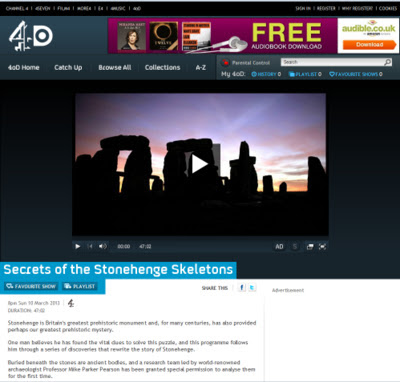
Secrets of the Stonehenge Skeletons

Image
My postdoc work on the pottery residues for the Feeding Stonehenge project was featured on the Channel 4 documentary last night Secrets of the Stonehenge Skeletons. The organic residues PI, Dr Oliver Craig did a great job of explaining the methods we have been using, with a few hints at our results - full details won't be available until we publish the research towards the end of the year (and complete our statistical analysis to confirm our interpretations!). The work is also featured as one of this week's main news stories on the University of York website here and the Department of Archaeology news page here . http://www.channel4.com/programmes/secrets-of-the-stonehenge-skeletons/4od As Ol explains, this is one of the largest studies of pottery residues from a single site (over 300 individual pots were analysed), and by designing a sampling strategy with GIS and other specialists, we have been able to investigate spatial differences in pottery use across the site, be...

War of the Lipids

Image
Different ways of representing lipid structures Chemistry has always been one of my favourite subjects, I like how logical mechanisms are, and the structures have a certain beauty - once you know what the symbols mean. I was asked to contribute some lectures on lipid analysis for the Honours Scientific Methods in Bioarchaeology course this semester. Having taught this subject previously I thought this wouldn't be a problem, and dug out my 2 hour session on lipid chemistry and nomenclature ( Octadeca- cis -6- cis -9- cis -12-trienoic acid anyone?).  It's a shame I can't just start with the archaeology - Feeding Stonehenge! The Earliest Humans in North America! Mummification! There is such an exciting range of applications of the technique. It isn't until the latter part of the session however that I usually get into the archaeological aspects, as I think it's important to understand the background chemistry in order to understand how you can apply it to ...

Salisbury, Skulls and Steampunk

Image
To continue the alliterative theme of the blog, this sums up nicely in 3 words my sampling visit to the Salisbury and Wiltshire Museum yesterday. The museum houses the collection of pottery from the 1967 excavations at Durrington Walls by Wainwright, which we will be using for comparison with the pottery being analysed from the Stonehenge Riverside Project . I was pleasantly suprised to see how pretty the city is - a little bit like York with random medieval buildings and bits of medieval wall dotted around the centre, and also an impressive cathedral. Maybe not quite as pretty as York Minster, but not too bad :) The cathedral is right next the the museum, though alas I didn't get a chance to look around as I had a rather large box of pottery to carry around by that point. The museum itself was rather exciting. The collections of archive material are located in a very chilly old store room complete with strangely labelled Victorian draws containing Antiquarian curiosities. It wa...

Feeding Stonehenge - food residues in Neolithic pots

Image
Lab day today, finishing off the last batch (for now) of pottery samples from Durrington Walls . Bit of background - my main research project at the moment is to investigate patterns of food consumption at Durrington Walls, the Neolithic settlement associated with Stonehenge. This involves selecting pottery from different parts of the site, extracting food remains, and seeing if there are differences across the site. Fatty food residues survive suprisingly well in prehistoric pottery (well, some of it, depending on the preservation conditions and other factors). They can be extracted quite easily in the lab by grinding up a small portion of the pottery and shaking it with solvent. The fatty residues dissolve into the solvent, and can then be identified by injecting the solvent into a GC/MS. In basic terms, the GC/MS seperates out all of the different parts of the food residue so we can identify the different components, and the result is something like this. Each of the peaks is a diff...