Posts

Showing posts with the label kamiltepe

Micrograph: Unusual archaeobotany

Image
As a micromorphologist something that you begin to notice quite quickly is that plant remains come in a huge variety of forms. Whilst at the macroscale we usually think about charred remains - wood charcoal, burnt seeds and grains - at the microscale there is a whole world of other plant remains. Phytoliths and other microfossils are something I talk about quite a lot in this blog, and these are becoming a standard form of 'plant evidence' alongside plant macros. More unusual are pseudomorphic voids, plant remains that are no longer there! I have talked about these a lot in previous posts , basically they are 'impressions' of plants that have since decayed. The micrographs below show something a bit in between. The plants haven't fully decayed, as they were partially desiccated. The orange colour you can see is where the organic matter from the plant has stained the calcareous aggregate (probably some sort of architectural material). In the voids you can see remains...
Micrograph of the Month: Varieties of Gypsum 1

Image
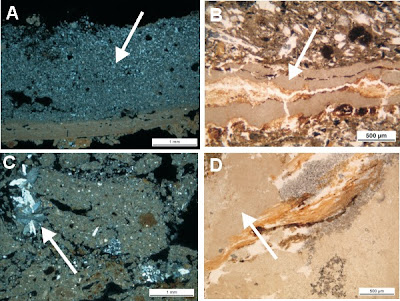
A: gypsum plaster (Tell Brak, building) B. microcrystalline gypsum (Catalhoyuk, midden) C. gypsum rosette (Kamiltepe, building) D. microcrystalline gypsum (Kamiltepe, external area) This month we have some micrographs showing examples of some different ways you might encounter gypsum in archaeological thin sections, part 1 as there are a few other forms that I don't have photos of yet but will aquire at some point. Gypsum (aka calcium sulphate) often occurs in Near Eastern samples as a post-depositional feature, where the calcium sulphate salt, dissolved in water, precipitates as the water evaporates. The growth of the crystals can often cause a lot of damage to intact deposits, as the growth of the crystals pushes apart the material. The crystals can have a widely variable morphology, as a result of different formation mechanisms. As well as precipitation from water evaporation, the salts can precipitate due to the solution becoming saturated (i.e. there is so much present no ...

Micrograph of the Month: Fabulous Floors

Image
Floors at Kamiltepe, Azerbaijan. 1. shows the constructed floors, 2. is a layer of ashy debris with 3. is a fragment of bone and 4. shows more debris, this time with single crystals of gypsum. This month's micrograph shows more deposits from the site of Kamiltepe in Azerbaijan. I have mentioned the site in a few previous blog posts , where you can find a link to an article which has a bit more detail on the preliminary micromorphology results from other parts of the site. Analysis of the deposits is still in progress, but already there are some great examples of prehistoric floors. Floors like these have been extensively studied from sites like Catalhoyuk, largely by Dr Wendy Matthews of the University of Reading. The floors at Kamiltepe are a lot dirtier than those at Catalhoyuk - the latter which are notable for their cleanliness and lack of activity residues. In the micrographs here we can see fragments of bone, microcharcoal and organic debris. In the micrograph on the left...

Micrograph of the Month: Melted Silica Bubbles

Image
Melted silica in ashy deposits at Neolithic Boncuklu (Turkey) above, and Kamiltepe (Azerbaijan) below. Silica is one of the most common components of plant ash, and is often seen in the form of phytoliths. In the case studies I have worked on, phytoliths in ash can have >50% abundance in thin section, and there may be millions of them per gram of sediment. Less common are these features, also composed of silica but with a very different appearance. These are 'bubbles' of melted silica, and they occur when silica is present in conjunction with alkali salts. Heating under these conditions causes the silica to melt and form what has been termed a 'glassy slag' or vesicular glass (e.g. see Canti 2003). The word vesicular refers to the gas bubbles you can see within the larger silica mass (also bubble shaped!). I prefer to call it melted silica rather than use the word 'glass' as it can be confusing in an archaeological context. The two examples here are from...

Micrograph of the Month - Microdebitage

Image
Following on from my post last week about the Neolithic site of Kamiltepe in Azerbaijan , I thought I would share some of the images from the preliminary micromorphology report I did for the 2010 monograph. I loved working on these samples - it's the first time I've worked on a building myself. All of my work at Catalhoyuk has focused on middens, and all of the work on buildings is done by Dr Wendy Matthews (University of Reading), who supervised my PhD. Wendy's work at Catalhoyuk and many other Near Eastern sites is fantastic, and is the starting reference point for my own work in this area! So it was nice to see variety in deposit types - with the middens there is a lot of redeposited material, ashes, charcoal etc, but I have seen suprisingly little of the type of thing you can see here in these images. These show bits of microdebitage embedded in the floor of the building - that's tiny bits of waste chips from the production of stone tools. What is exciting about th...

New year, new job, new news

Image
One of the trenches I worked in at Kamiltepe 2010 I'm almost at the end of my second week in my new position at the School of History, Classics and Archaeology at the University of Edinburgh and it's already been full of busy! The first week I spent gathering quotes for equipment to set up the new microfossil and microscope laboratories, so fingers crossed we can get ordering soon! I also made sure the library was well stocked in all the books and journals that I will need for teaching towards the end of the year, and was really pleased to see how extensive the collections are here. I've already started discussing potential collaborations with other staff members here, and as it turns out there are already several connections with my old BioArCh research group at York, which is very useful! I anticipate I will maintain my involvement with York, and was made a Visiting Research Associate at the beginning of the new year so that I can carry on using the facilities there ...