Posts

Showing posts with the label Latvia

Digitized thin section slides!

Image
I can't remember if I posted about this earlier in the year, but I was lucky enough to be awarded two student work experience placements as part of the  Newcastle NWE programme , where students complete flexible paid projects within the university. Two of my Environmental Archaeology students have been working for the past few months, digitizing my entire collection of thin section slides. At some point I hope to make these available online as an open access resource for teaching and research. They did a brilliant job! I've only just had a chance to go through all the scans, having been away on fieldwork, busy with exams, then graduation. Here is one of the scans of a thin section from medieval Riga, that I have been working on as part of the Ecology of Crusading project . Combined with the fact I have just moved the lovely Leica DM750P research microscope into my office (kindly purchased by History, Classics and Archaeology ), I can now get working on my mounting backlog of sa...
Microfossil of the Month: Which Wood?

Image
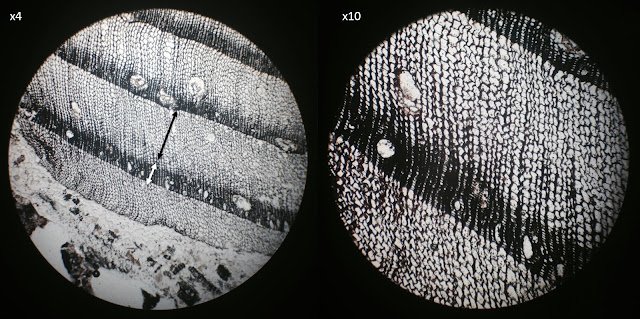
Something a little bit different for October. This fits in nicely with what I've been up to this week, preparing teaching materials on wood charcoal analysis in archaeology. Although I am not technically a wood specialist, I am wondering if I should pick up a new skill set, as it would actually be very useful as a thin section micromorphologist. This image shows a cross section through an unidentified fragment of wood charcoal in a thin section of sediments from the tower at Cesis Castle, Latvia . There are layers within the sediment that are full of tiny wood charcoal fragments, and actually we see bits of wood a lot when looking at thin sections of ash samples, unsurprisingly. You can see the annual rings quite clearly in this fragment, and it can be identified as a soft wood species (coniferous) due to the lack of pores. Soft woods are a bit more difficult to identify than hard woods (from deciduous trees), as their structure is more simple and less distinctive. In this example ...

More vivianite!

Image
I couldn't resist posting about this lovely micrograph, even though I blogged about this mineral quite recently . This is the same floor sample from medieval Riga, it's absolutely chock full of these iron phosphate crystals (vivianite) in various forms. The last image I posted showed the typical blue amorphous mass, here is another view, this time of a collection of smaller 'rosette' crystals, showing the monoclinic form. You can see that there is a mix of blue and yellowish/grey crystals in these rosettes. Vivianite turns blue on exposure to air, suggesting that this part of the deposit remained waterlogged whilst other parts were partially exposed. Curious that these little crystals appear to be clustering around that white area - a 'crack' in the floor.

Christmas Parcels

Image
What excitement is this? Parcels in the post over Xmas! Perhaps more exciting than all the Xmas chocolates and treats? It's the long awaited box of micromorphology slides from Medieval Riga, Latvia! Ok, so maybe not quite as exciting as chocolate, but still pretty fab. I've been waiting for these to be ready since September so it's quite a nice suprise to see them all finished and coverslipped, just in time to get back to work after the holidays. Excuse the camera flash, I will scan them in properly at some point. Waterlogged and charred plant remains, and also (I suspect) animal dung Occupation debris accumulated on a medieval floor from the city of Riga I also got sent a copy of The Archaeology of the Prussian Crusade by Aleks Pluskowski , PI on the Ecology of Crusading project. Parcels of excitement This is something else I have been looking forward to - I did a lot of the line drawings for it and it has been very exciting seeing it come together ...

A curious incident

Image
Corroding sample! Yesterday's ICP samples are coming along nicely. I'm happy to say nothing had exploded when I went to check on them this afternoon. Today I also started boxing up the last few samples from medieval Riga, and came across this oddity ---->. All of the samples from Riga were waterlogged, and something strange has happened to this one; you can see all that orange spreading across the bottom of the sample? It is some sort of iron staining, and is very clearly seeping from the sides of the tin into the fine grained clay floor part of the sample. There were also lots of little salt crystals all over the surface, and you can see to the centre right a small area at the top of the metal tin has corroded! I'm wondering if there is a metal object in the block somewhere that is degrading? A few of the other samples had unfortunately started growing mould. In future I will learn to wear a mask when unwrapping waterlogged samples! Hopefully this was just on th...

Elementary, said he

Image
80s-tastic plasma lamp (Wikipedia) Today I was mostly preparing lake sediment core samples for ICP. ICP stands for Inductively Coupled Plasma, and comes either in the MS (mass spectrometry) or OES (optical emission spectrometry) variety. Both are methods for measuring the different elements present in a sample. The ICP bit is a 'torch' containing a gas, typically argon, that is ionised by heating it via electromagnetic induction (remember those weird glowing globe plasma lamps?). Still confused? This means there is a coil wrapped around the torch, which produces a very strong electromagnetic field when turned on. The argon gas is ''lit' by an electrostatic spark, and the gas becomes ionised. The sample (dissolved in liquid) is sprayed into the argon flame, and also becomes ionised. As different components in the sample become ionised they gave off a characteristic energy. The MS and OES parts is the bit that detects the elements present. MS does this by measur...

Riga slides in progress

Image
Riga town samples set in resin, ready for cutting into slides Another week of lab work in Reading this week for the Ecology of Crusading project. The samples I boxed up in September for resin impregnation are now ready for cutting, and hopefully some of them will be finished into slides by the end of the week. They look like they've set really well; I was a little worried there would be problems as some of them were quite damp with lots of 'manure' layers, which can sometimes distort when dried or interfere with resin curing. I boxed up a few more samples from medieval Riga (Latvia), and 3 from Święta góra (Poland) today. It's going to be a tremendous amount of microscope work to get them all analysed, but I'm looking forward to it! I also started preparing some lake core samples for ICP analysis today, which was delayed due to some minor hiccups which will hopefully be corrected tomorrow. That should take the rest of the week, with the Association for Envir...

Quo vadis? Cesis!

Image
Back in the lab after a week in the field in Latvia, taking micromorphology samples for the Ecology of Crusading project at Cesis Castle . As I was only there for the week I missed all the fun of actually excavating the trench and uncovering exciting stuff like the fully articulated horse skeleton (hence the nickname 'horse trench'!), and horse related paraphernalia including bridle bosses, spurs and stirrups. Wet muddy trench of doom This did mean that I had a nice fully exposed section to work with, which makes it much easier to work out the best locations for taking micromorphology blocks - in this case to identify the surface residues on the floor and test the hypothesis that this was stable. The benefit of this however was perhaps outweighed by the fact the trench was filling up with water as I collected the samples, and the presence of a huge waterlogged beam conveniently located right where I needed to stand, making it a rather muddy business with some preca...