Posts

Showing posts with the label Ecology of Crusading

Digitized thin section slides!

Image
I can't remember if I posted about this earlier in the year, but I was lucky enough to be awarded two student work experience placements as part of the  Newcastle NWE programme , where students complete flexible paid projects within the university. Two of my Environmental Archaeology students have been working for the past few months, digitizing my entire collection of thin section slides. At some point I hope to make these available online as an open access resource for teaching and research. They did a brilliant job! I've only just had a chance to go through all the scans, having been away on fieldwork, busy with exams, then graduation. Here is one of the scans of a thin section from medieval Riga, that I have been working on as part of the Ecology of Crusading project . Combined with the fact I have just moved the lovely Leica DM750P research microscope into my office (kindly purchased by History, Classics and Archaeology ), I can now get working on my mounting backlog of sa...
Microfossil of the Month: Which Wood?

Image
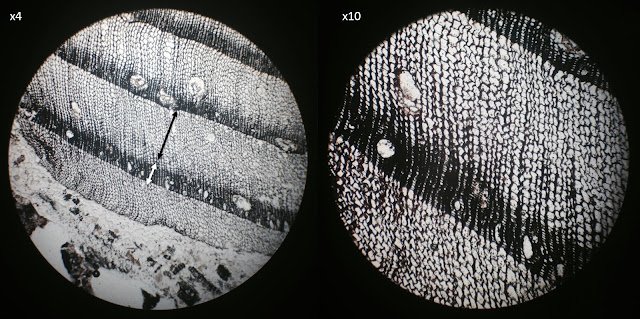
Something a little bit different for October. This fits in nicely with what I've been up to this week, preparing teaching materials on wood charcoal analysis in archaeology. Although I am not technically a wood specialist, I am wondering if I should pick up a new skill set, as it would actually be very useful as a thin section micromorphologist. This image shows a cross section through an unidentified fragment of wood charcoal in a thin section of sediments from the tower at Cesis Castle, Latvia . There are layers within the sediment that are full of tiny wood charcoal fragments, and actually we see bits of wood a lot when looking at thin sections of ash samples, unsurprisingly. You can see the annual rings quite clearly in this fragment, and it can be identified as a soft wood species (coniferous) due to the lack of pores. Soft woods are a bit more difficult to identify than hard woods (from deciduous trees), as their structure is more simple and less distinctive. In this example ...

Archaeology versus History

Image
I was alerted to a blog post a few weeks ago with the (deliberately I'm sure) provocative title Archaeology is just an expensive way of finding out what historians already know... Of course I immediately felt the need to...actually I didn't. The post does have a point. Archaeology is indeed usually more expensive than historical research. I don't think the central criticism of the article is specific to archaeology. What is actually being complained about here is poorly designed research, without a clear objective. Though it is not clear whether this is because the actual excavation being discussed (a battle field) does not have clear objectives, or that the main source linked to is a Telegraph article. Saying that archaeology just shows what historians already know is a narrow view of the aims of both history and archaeology. Whilst the contribution of archaeology to (in this case) a 200 year old battle that is extensively documented, may be more limited, there are alway...

Analysing lipid residues in archaeological soil and faeces at the NERC LSMSF

Image
It's been a while since I've been in the lab, but last week I got to spend the entire week working in the NERC LSMSF (Life Sciences Mass Spectrometry Facility) in the Organic Geochemistry Unit at the University of Bristol. I have worked with Bristol for many years now as they have arguably the best set up in the world for archaeological and environmental geochemistry. For this visit I was working mostly on samples from the Ecology of Crusading project , with a few extra coprolite samples thrown in from Catalhoyuk and Durrington Walls (more on those at a later date!). The EoC samples are part of a larger programme of geochemical analysis, designed to look at human impacts on the landscape associated with colonisation in the medieval period. We are looking for evidence of increased faecal inputs (lovely!) associated with clearance of land for pasture, and maybe even human 'sewage' inputs from intensification of activity. Although I have developed the facilities for pot...

Integrating archaeological science at medieval Riga

Image
Team palynology and zooarchaeology Team archaeobotany and geoarchaeology Lovely weather here in London today, though mostly being experienced inside a meeting room at the Warburg Institute ! I'm away from Edinburgh this week, firstly for a project meeting for the Ecology of Crusading project and then for a week of lab work in Bristol - more on that to come! This weekend I am here with fellow team members Rowena Banerjea , Alex Brown , Monica Badura and PI Aleks Pluskowski , discussing our  analyses of deposits from medieval Riga. This is the first time we've all got together to integrate our data, and to get updates on the dating of the deposits. So far  we have potentially the earliest known building in Riga, on the basis of dendrochronological dates, and some great archaeobotanical data on the types of plant materials that were being used - along with the micromorphology it looks like a lot of the plant material is associated with construction, such as wood chipping...

Micrograph of the Month: the woods decay and fall

Image
Close-ups of decaying waterlogged wood. Upper left showing 1. latewood with secondary cell wall intact 2. earlywood with loss of secondary cell wall. Upper right showing loss of birefringence in areas subject to decay Another fab example of the sorts of things that go on in medieval waterlogged deposits. I posted some pictures of this waterlogged wood a couple of months ago, as well as a nice example of the formation of vivianite in the same deposits . Here we have another example of waterlogged wood, but I've added some close-ups in cross polarised light (XPL). For the non geoarchaeologists in the audience, this is a technique in microscopy where you change the type of light you use to look at a sample, by inserting polarisers on the microscope. Polarised light vibrates only in one direction. On the geological microscope, the lower polariser causes the light to vibrate in an E-W direction, whilst the upper polariser/analyser filters light that is not vibrating in the N-S d...

Micrograph of the Month: Ferrous phosphate (vivianite)

Image
This month we have a lovely image of a particularly colourful mineral feature called vivianite. Vivianite is an amorphous hydrated ferrous (iron) phosphate, which is blue when oxidised. It has been linked to the decomposition of bone and/or human and animal waste in wet sediments, which fits with what we know about this context. Yes, we are still looking at those waterlogged deposits from medieval Riga ! This is just one example of the many occurrences of vivianite in this layer. The small fragment of wood is also interesting. Unlike the waterlogged wood we looked at a couple of months ago , this fragment has been completely mineralised due to the presence of phosphate in the waterlogged sediment - at first glance I thought it was a bit of bone! You can also see that the pores spaces within the wood have been completely filled with fine sediments, which also indicates waterlogged conditions - the infilling of the voids occurs as fine sediments suspended in water are deposited within...

Micrograph of the Month: Medieval floors

Image
This is the second floor themed micrograph post, you can see examples of Neolithic floors in a post from last year here . You'll notice the same horizontal surface and distinct boundaries, and even a similar type of charred plant, ash and bone debris, however the construction of the floors themselves is quite different. Whereas the prehistoric floors are made from packed mud/earth, these Medieval floors from the town of Riga are made from a calcareous material with a very high quantity of sand grains. It looks very similar to a lime mortar, though I want to do a bit more work on it before saying that for definite. Another difference here, whereas the Neolithic floors were showing signs of post-depositional processes in the form of gypsum crystals, the debris on this floor is remarkably well-preserved. I have put together two photos here, the bottom image showing an earlier floor, overlain by mixed debris, containing tiny bone fragments, wood charcoal and ash. The upper photo show...

Micrograph of the Month - Waterlogged Wood

Image
Here are two examples of waterlogged wood, in deposits from Medieval Riga, currently being analysed as part of the Ecology of Crusading project. It's been almost a year since I started on these slides, which were prepared in December last year - there are so many of them it is taking me quite a while to get through. It's a fascinating set of samples, such a mix of materials with some interesting post-depostional processes going on. In the upper image you can see a fragment of wood preserved entirely through waterlogging, within a mixed deposit containing charred material. This little fragment of wood has been stained orange, which is typical of waterlogging and mineralisation. In the lower image you can see a fragment of wood which has been preserved through a mix of partial burning (as seen by the black colour in the lower part of the wood), whilst the non-charred part has been preserved through waterlogging. Waterlogged deposits are relatively rare - most plant material ...

Micrograph of the Month - Glauconite Grains

Image
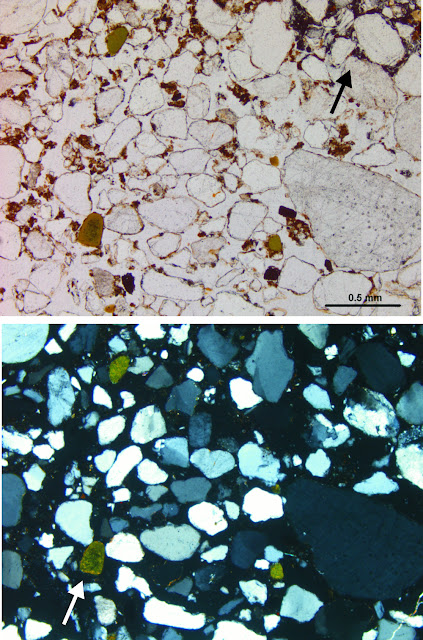
I've been working on and off on these samples from BiaÅ‚a Góra (Poland) as part of the Ecology of Crusading project . We collected them back in June 2011 along with a coring transect survey to assess the nature and extent of the 'cultural layer' at the site. It's a very shallow deposit containing lots of broken ceramics and animal bones etc. The sediment itself looks similar to 'dark earth' deposits in the field, of which there have been many micromorphology studies, largely led in the UK by Dr Richard MacPhail .  The micrograph shows the lowermost 'natural' deposits (upper in PPL and lower in XPL), which consist of a silty sand deposit which becomes coarser further down the profile. The pretty greenish grains are glauconite, an iron potassium silicate mineral, which is thought to be indicative of a marine depositional environment. They can be seen especially clearly in XPL in the lower image.  The geology is this part of Poland (as I found out a...

Crusader Castles of the Baltic

Image
I wrote a feature article for Current World Archaeology Magazine on the Ecology of Crusading project, which has just been published in issue 57. It's a brief overview for a general audience, so there's lots of basic info on the environmental and lab methods we are using as well as some of the preliminary results. And of course lots of fab photos of castles, fieldwork and whatnot. I like writing more general articles like this - it's something I can show the parents and they get all excited about. Pages of technical jargon in J. Arch. Sci. and the like never get quite the same reaction. http://www.world-archaeology.com/features/crusader-castles/ It's exactly 10 issues since the last piece I wrote for them in issue 47, 2011, on Catalhoyuk under the Microscope, which you can read an excerpt from here: http://www.world-archaeology.com/features/turkey-neolithic-life-at-catalhoyuk/

Fun with phytoliths, part 1

Image
Weighing out: the container is zeroed and the exact weight of the sample recorded New year, new samples! Well, newish, they were collected in the summer of 2012 but only made their way to me a few weeks ago . Today is my first day on site at the University of Edinburgh, where I am hoping to set up laboratory facilities for microfossil processing. In the meantime I managed to speedily process this last batch at York. Following drying the samples out in the oven, the next few stages involve removal of different fractions of the soil/sediment. Soil is made up of a range of organic and inorganic components - so to get at the phytoliths, we have to remove any non-phytolith material. It is actually quite an easy lab method, but rather time consuming as there is lots of drying and transferring into different sized containers! As with all sample preparation, the samples are weighed after drying so we can quantify how much material has been processed. The amount of sample that we choose to...

Christmas Parcels

Image
What excitement is this? Parcels in the post over Xmas! Perhaps more exciting than all the Xmas chocolates and treats? It's the long awaited box of micromorphology slides from Medieval Riga, Latvia! Ok, so maybe not quite as exciting as chocolate, but still pretty fab. I've been waiting for these to be ready since September so it's quite a nice suprise to see them all finished and coverslipped, just in time to get back to work after the holidays. Excuse the camera flash, I will scan them in properly at some point. Waterlogged and charred plant remains, and also (I suspect) animal dung Occupation debris accumulated on a medieval floor from the city of Riga I also got sent a copy of The Archaeology of the Prussian Crusade by Aleks Pluskowski , PI on the Ecology of Crusading project. Parcels of excitement This is something else I have been looking forward to - I did a lot of the line drawings for it and it has been very exciting seeing it come together ...