Posts

Showing posts with the label neolithic

Archaeology of death, grief and remembering

It’s not an exaggeration to say that 2021 and  2022, have been the most difficult period of my life. In addition to all the general crap from the pandemic, I have lost four people who meant a lot to me. Earlier in 2021, Great Grandma Ann passed away at the age of 99. She was my great grandmother in law, but I’d always felt a connection to her since we first met eight years ago. She was a remarkable women with a fascinating life story, not mine to share here. But I admired her, and found her easy to talk to, which is a rare thing for me. Her passing was sad, but she was ready to go. I just wish we’d been able to travel and see her one last time. In September 2021 my dad died, at the age of 69. He wasn’t ready, and neither were we. My dad’s story was that of a working class lad from the north east. He lived and died where he was born, a life that to many might seem unnoteworthy but the epitome of life of his class and generation, the last years of the shipyards, with many funny stori...
Getting ready for fieldwork

Image
It feels like this year has gone by even quicker than usual, and it is a bit surreal that I'm gearing up to head back out on fieldwork already. I had actually told myself that I would not do any fieldwork this year, and spend more time in the lab instead, but plans change and a couple of opportunities came up than I couldn't refuse! Last year blog readers will remember I went to Olynthos in Greece to collect some pilot samples for a new project, looking at use of space within this ancient Greek settlement. It was the first time I had been to Greece, and the project itself is fascinating - lots of mudbricks to excite the geoarchaeologists among you. Earlier this year I was delighted that we successfully applied for funding for a PhD studentship from the AHRC Northern Bridge consortium , and Mara Lou Schumacher will be joining Newcastle later this year to work on the Olynthos material, co-supervised by Prof. Lisa Nevett at Michigan . So I'll be heading back to Olynthos later...

Microfossil of the Month: Fragile phytoliths

Image
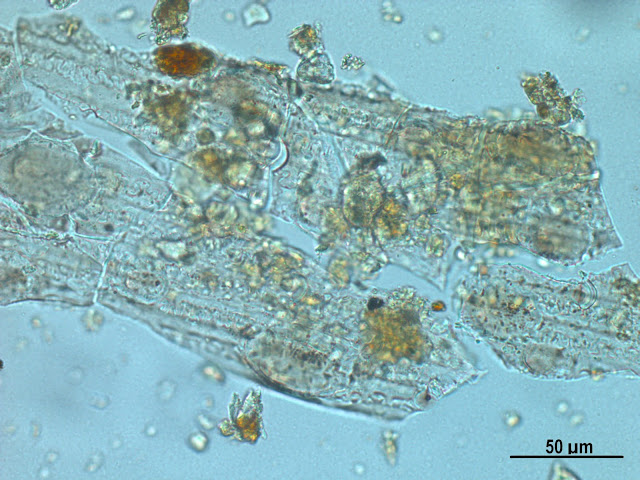
I promise brand new images will be coming soon, but for now here is a micrograph from my old files, this time from my work with the Central Zagros Archaeological Project back in 2010, and is from ashy deposits in an external area at the Neolithic site of Sheik e Abad in Iran. This is a great example of a conjoined phytolith that is not particularly well silicified and/or has suffered erosion. The pattern of the cells is not very distinct, and quite 'faint', though you can just about make out the wave pattern of the long cells in places. For comparison, see this example of well-silicifed wheat phytoliths from Catalhoyuk, and this reference specimen of Setaria italica , both of which have very distinctive and well defined cell morphologies. The reason I chose this micrograph is that it is a very good example of how fragile phytoliths are. Despite being composed of silica, which is pretty resistant to decay, phytoliths are physically quite fragile. Think of it like glass - it i...

Ness of Brodgar: Latest from the Lab

Image
Some exciting news for my research at the Ness of Brodgar! I just heard from Earthslides.com that the 2014 samples are well under way being set in resin. I thought readers might be interested in a quick post on the process of creating archaeological thin sections, and I do recommend that you go check out the Facebook page, Hidden Worlds , if you want to investigate this further. Below you can see block of sediment, as collected in the field. These were posted direct from Orkney to Cambridge, wrapped up tight in tissue, tape and bubble wrap, to avoid disturbance during transport. These are carefully unwrapped and air dried over a few weeks, before being transferred into large desiccators. These are the big glass domes you can see below, and they have tight sealing lids that create an air tight seal. Resin is added to the plastic boxes containing the samples, and the whole thing is put under vacuum, using a pump. This removes all the air and draws the resin up into all the little spaces...

Microfossil of the Month: Multi-celled Sedges

Image
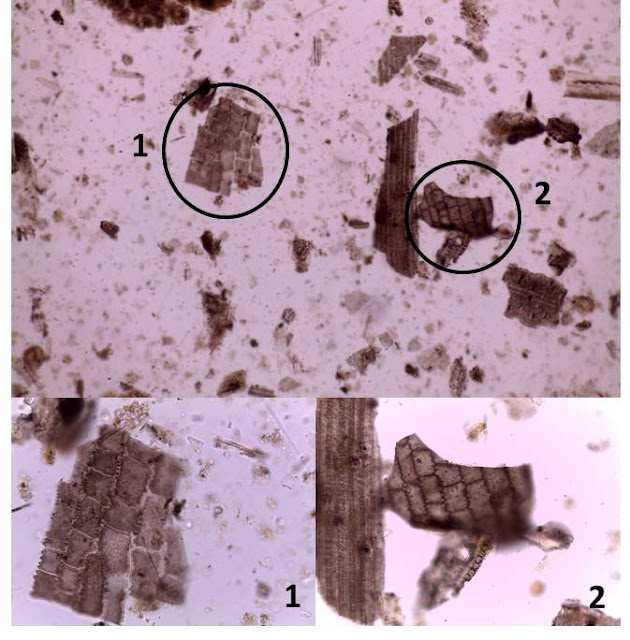
Yikes, I can't believe it's already June, and time for a new microfossil! This month we have firstly a general view of a phytolith slide from the site of Boncuklu in Turkey , at x100. This just gives you a taste of how chock full of microfossils these slides are! I have highlighted two particular phytoliths here shown at x400, both are conjoined phytoliths from sedge. Sedges, or Cyperaceae, are monocots which are similar to reeds, and are associated with wetlands. Though significantly, it should be noted that they can be found in other types of environment as well. At Boncuklu we know from other environmental work that a local wetland habitat was quite likely, and we also see a lot of reed phytoliths in these samples. The blocky square pattern is typical of sedge phytoliths, though it is difficult to say anything about which species they might be from. This sample is from an ashy layer in a midden deposit, and it could be that the sedges were burnt alongside reeds, either delib...

Microfossil of the Month: Jigsaw phytoliths

Image
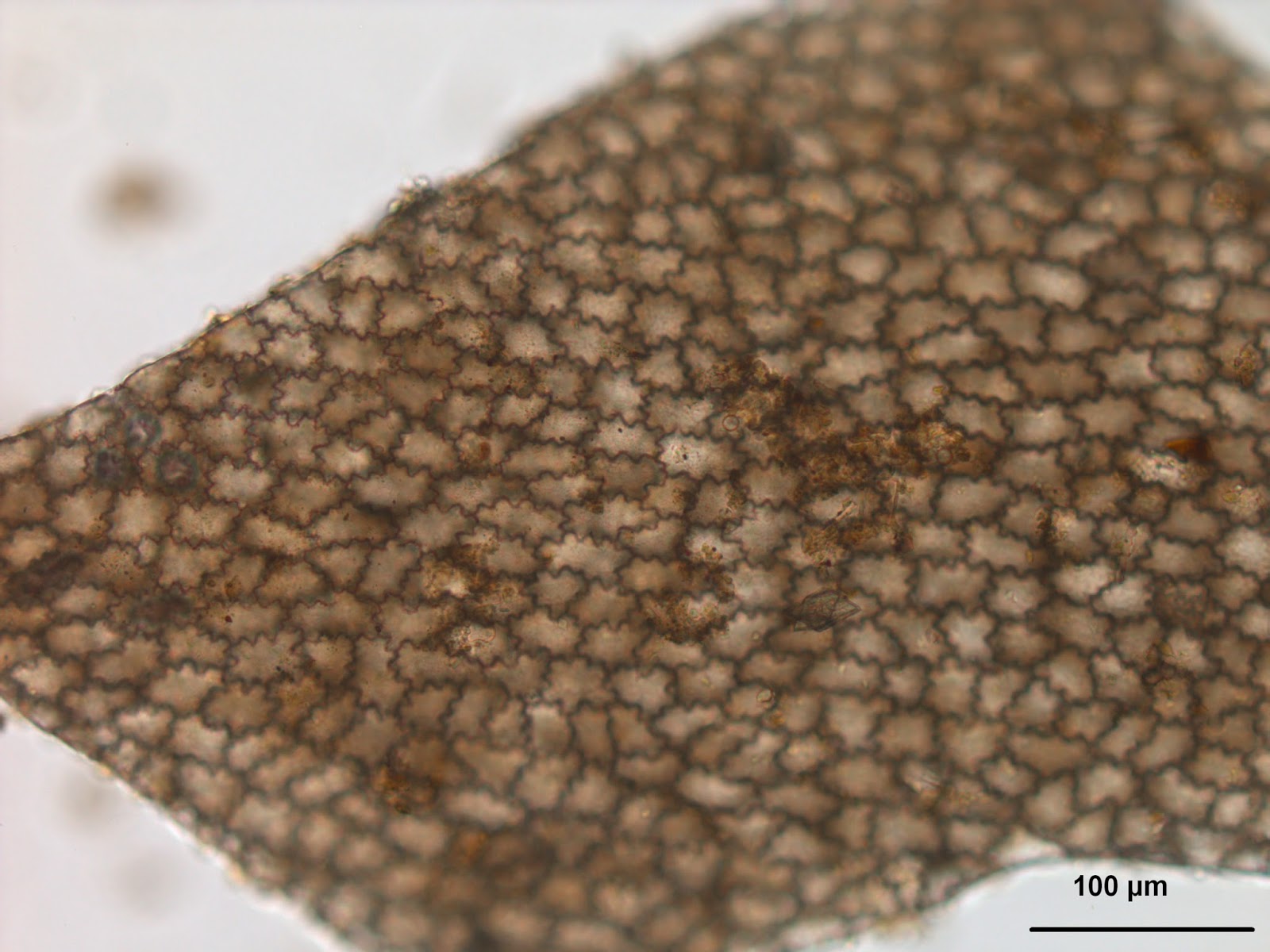
This month's microfossil is a 'jigsaw' phytolith, or rather phytoliths, as it is actually a tissue fragment consisting of multiple conjoined silicified cells. These jigsaw types are associated with the epidermis of woody dicotyledonous plants, though they are also found in herbaceous plants. The two images show the same phytolith in two different focal planes. The uppermost image being the upper epidermis, and the lowermost image showing the underlying layer of 'regular' shaped cells, or the palisade mesophyll layer. The sample this was extracted from is from Sheik e-Abad in Iran, an early pre-pottery Neolithic site, though in terms of food, the plant remains suggest the people were relying to a large extent on non-domestic resources. What makes this sample particularly interesting is the context, within a layer of dark grey calcitic ash, as identified through thin section micromorphology. Dicot phytoliths account for 10% of whole assemblage, which is a lot conside...

Science, Art and the Construction of Reality in Archaeology

Image
I found out this weekend that my application to take part in an exciting art/science collaborative project was successful! It was only by chance that I found out about the project, through some random browsing around Twitter. Joining Twitter was one of the best things I ever did, so many opportunities and connections to be made that I would never get the chance to see otherwise. The project I am joining is ASCUS/TNS Engage project. ASCUS is a non-profit organisation that supports collaboration between arts and sciences, and builds connections between different organisations, institutions, individuals and the public. TNS is The Number Shop , an art studio and gallery. Artists from the studio will be developing new work based on dialogues with scientists, as part of the Edinburgh International Science Festival . Some of the work will actually be produced during Open Studios during the festival, so that the public can come and experience the work being produced. The idea is to bring the ...

Microfossil of the Month: Awn phytoliths

Image
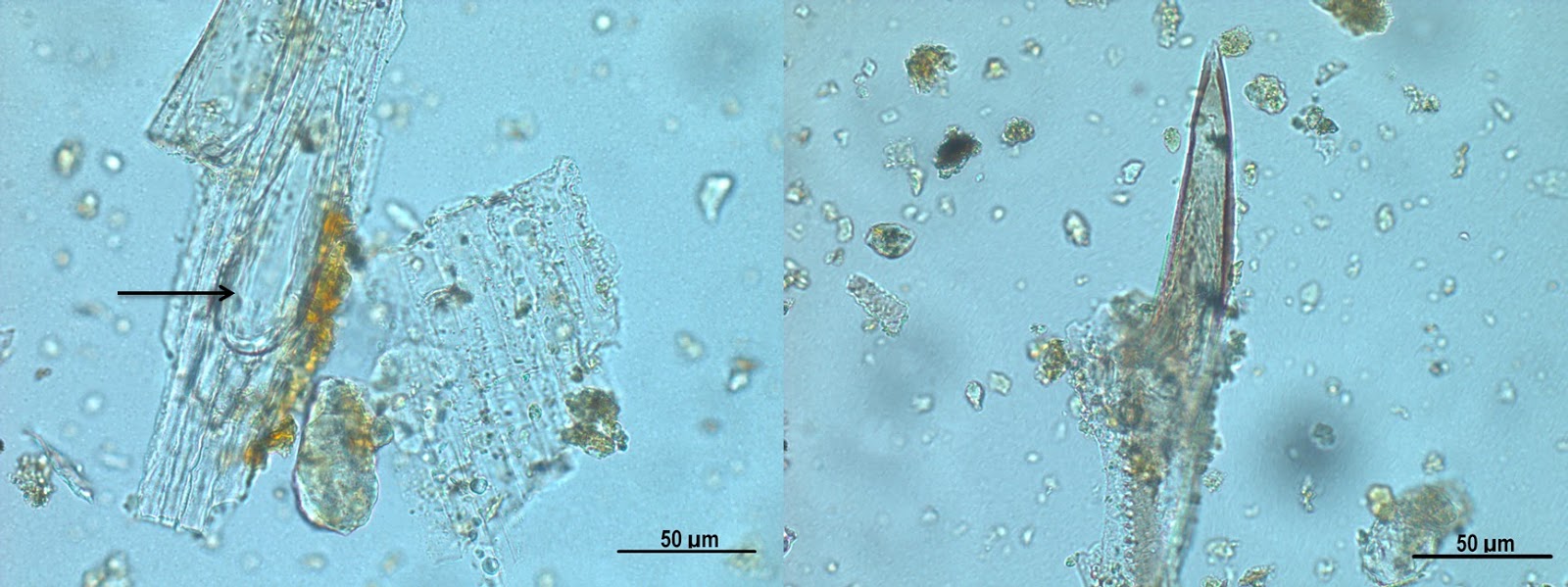
These micrographs show grass awn phytoliths, on the left the spiky hair part is still attached to the rest of the awn, the one on the right shows a hair that has become detached. Awns are hair or bristle type structure which are particularly common on grasses. In some species, such as emmer wheat, the awns contribute to seed dispersal, by hooking into the soil. Changes in humidity cause the awns to expand and contract, acting like a ratchet to propel the seed into the ground. Not to be confused with trichomes, which are another 'hair-like' structure, but a much finer growth of hairs on the surface of the epidermis, and can also produce distinctive phytoliths. Both of these examples are from the same sample, extracted from ashy deposits in an external area at Sheik-e Abad, an early pre-pottery Neolithic site in Iran. The site was excavated as part of the Central Zagros Archaeological Project . I worked there for 2 months after submitting my PhD in 2008, one of the most fascinat...

Microfossil of the Month: Sponge Spicule

Image
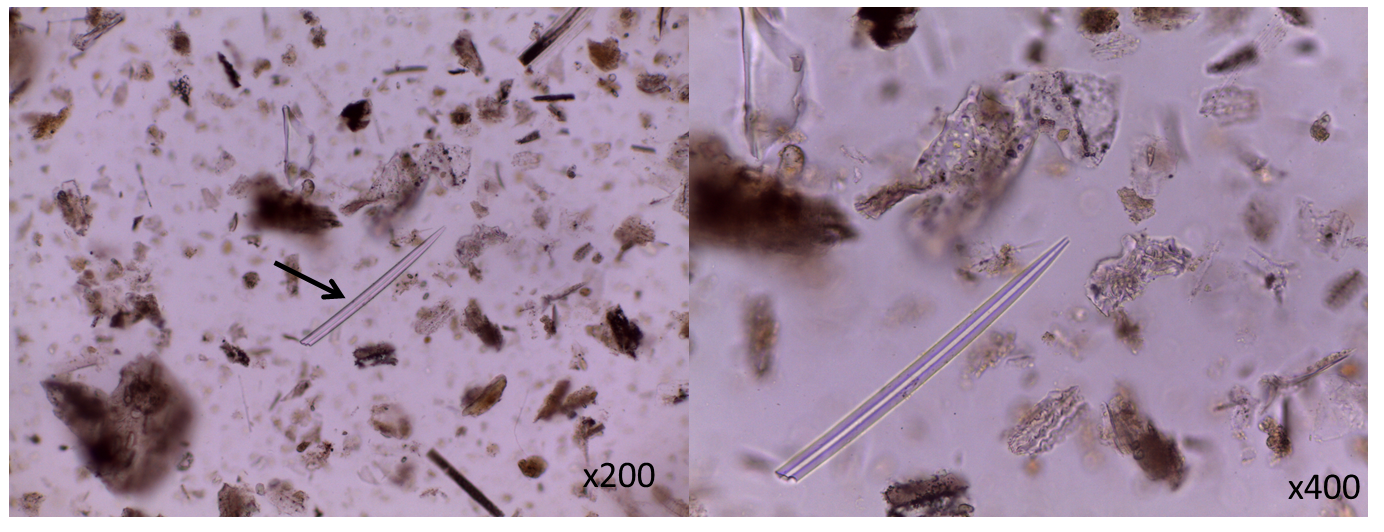
Something a little bit different - this month I have an image of a siliceous sponge spicule! This show up occasionally in my phytolith slides, and are very distinctive. Sponges, or poriferans to give them their scientific name, are characterised by an unusual feeding system that involves drawing water in through little pores in the outer walls, and filtering food from the water as it moves around their bodies, before being pumped back out again. This flow of water occurs in one direction and is driven by beating flagella. Sponge spicules provide structural support and protection from predators. They come in all sorts of shapes each with a different name - the single spike shape that you can see looks like a monaxon, though it is also possible that is has broken off a larger 'polyaxon' type. The formation of spicules seems to be better understand than that of my other favourite siliceous microfossil, the phytolith, and is controlled largely genetically, but with environmental c...

Microfossil of the Month: Plant Stomata

Image
For 2015 I have decided to replace my Micrograph of the Month feature with Microfossil of the Month. I will likely return to the thin section micrographs at some point, but as I am going to be working on phytolith and ash samples for most of this year, I figured it would make sense to feature some of these on the blog! Who knows how long I will be able to keep it up - from past experience of the sites I am working on, I may be limited in the range of examples that I will find! As a refresher (and for those of you new to the blog), microfossils are any fossil remains that are too small to see easily with the naked eye, but can be identified under the microscope. I work on plant microfossils, specifically silica phytoliths, which are 3D 'impressions' of plant cells and tissue. When the plant is alive, it takes up silica from the ground, which is then deposited inside and between the cells, forming 3D replicas of the cells that preserve when the organic part of the plant decays. T...

Goats and reeds in the Neolithic

Image
Bulliform cells in modern Zea mays tissue (source: Visuals Unlimited, Inc) Fellow animal dung enthusiast Sarah Elliot at the University of Bournemouth shared this fab little article describing the use of 'Eco goats' to manage invasive plants in the US . It is especially interesting that they note the use of goats as a pesticide-free way to manage Phragmites reeds. These reeds have distinctive phytoliths which archaeologists call 'keystone' bulliforms, which are relatively large single cell phytoliths that are named as they are said to resemble a Roman keystone arch in cross section.  In transverse section they look a bit sausage shaped, and within a plant these cells are 'stacked' next to each other as part of the upper epidermis (the plant 'skin'), and are related to water storage. If you're a botanist you might also call these motor cells, because during times of water stress, they shrink and cause leaves to fold or curl up. Phragmites phytoli...

World Toilet Day - attitudes to poop in the past

Image
I found out that today is World Toilet Day ! What better chance then to have a think about toilets and the disposal of human waste in the past. Regular readers will know (and the blog title perhaps suggests...) that coprolites, or fossilised faeces, are a regular feature of my work. A big part of World Toilet Day is about education and the problems of sanitation that many people face on a daily basis. The campaign highlights the fact that excrement is a bit of a taboo topic for many people, it's something we don't feel comfortable talking about. It's a 'hidden' activity. Has this always been the case in the past? The answer from the archaeological record is no - from prehistory to the famous public latrines of the Romans , there are many examples of a more open or communal approach to defecation. The study of human waste in archaeology, particularly faecal waste, is however a neglected topic. Coprolites don't really fit neatly into any of the major existing s...

Micrograph of the Month: Bits of Bones

Image
For the past few weeks I have been revisiting some old slides from the TP excavation area at Catalhoyuk . I collected these samples  in 2004, and they were some of the first that I worked on for my PhD. At the time I found them a bit disappointing, as there is a lot of bioturbation and erosion  going on in this part of the site, which means that trying to reconstruct activities using microstratigraphic analysis is difficult. The TP area is located very close to the surface of the mound, so despite the fact that these are the youngest deposits, the preservation is nowhere near as good as the earlier, deeply buried deposits. In the end I focused more on the South and 4040 areas, with the TP samples being used as a brief comparison of how different the taphonomic processes are in different parts of the site. Which brings me on to this month's photos! I was contacted by Kamilla  PawÅ‚owska who is conducting zooarchaeological analysis in the TP area, and is...

Closing down - Ness of Brodgar final day

Image
Not too much to report, aside from the fact I've had a productive and successful, albeit short, field trip this year. I managed to collect 20 large block samples during the week I've been here, which is more than enough to keep me occupied for the foreseeable future. The midden deposits I sampled in Trench T cover the early to late sequence, and hopefully we will be able to distinguish differences in activities and resource use between these phases. Will we see similar things going on here as we see in the main excavation area? Or will there be differences between these two parts of the site? Just some of the many questions we are hoping to answer! For now I will leave you with these fine images of the site being covered over until next year! More tyres than archaeologists

Ness of Innsmouth, Day 2

Image
Dig house in the distance, Stones of Stenness to the right. Ominous rain clouds overhead. Day 2 at the Ness. I had some things to sort out in Kirkwall this morning so took the local bus to site. It only takes about 30 minutes but it drops off on the main road, and then you have to walk all the way along the peninsula to get to the excavation. Lovely view, but increasingly rainy and windy the further you get towards site, almost as if it’s in its own little otherworldly wet dimension. Glad I invested in an all-weather notebook. On site I’ve been getting on with taking micromorphology samples out of the midden section in Trench T. The excavation in this part of the site is being supervised by Dr Ben Chan, who I previously worked with on the Feeding Stonehenge project. There are other familiar faces from York too – Prof Mark Edmonds and Alison McQuilkin, who recently completed her dissertation on phytoliths from the famous Mesolithic site of Star Carr. The Ness is like a magnet for ...

Return to the Ness! Day 1

Image
Layers of ashy midden deposits sitting on glacial till A dizzying view of excavations in Trench T After a small adventure involving delayed flights, gale force winds and navigating with no GPS signal (how did we ever cope before smart phones with Google Maps?), I finally arrived in Orkney yesterday. This is actually the last week of excavation before the trenches are covered over until next year, so it’s all very quiet on site. Most of the students have left, and the remaining teams are working to complete recording by the end of the week. I have had a quick tour around to get a feel for what’s happened since I was here last year, and have spent today planning my sampling strategy. As usual so much is going on and there’s plenty for a micromorphologist to do. This year I am focusing on collecting samples from middens in Trench T. Regular blog readers will have seen the snippets I’ve posted about my analysis of middens in the central excavation areain 2013 . Although analysis o...

Animal dung and the beginnings of sheep domestication in the Near East?

There's an exciting paper out today in PNAS on Aşıklı Höyük , an early sedentary pre-pottery Neolithic site in central Anatolia, occupied a millennia earlier than that site oft discussed on this blog, Çatalhöyük . This paper by Stiner et al. is a great example of research that brings together work from different archaeological specialists to produce a coherent story, supported by multiple lines of evidence. The argument is based around the zooarchaeological analysis of animal remains, which demonstrates a shift over the occupation of the site from a broad spectrum of wild species, to a dominance of sheep by 8200 cal BC. However it is the geoarchaeological analysis that arguably provides direct evidence of deliberate animal management, and as a micromorphologist with a special interest in all things coprolite and dung related , I am very happy to see that this technique is one of the highlights of the paper! (Phytoliths also get a mention!). The researchers identify accumulation...