Posts

Showing posts with the label catalhoyuk

Micrograph of the Month: Mixed fuels
Image
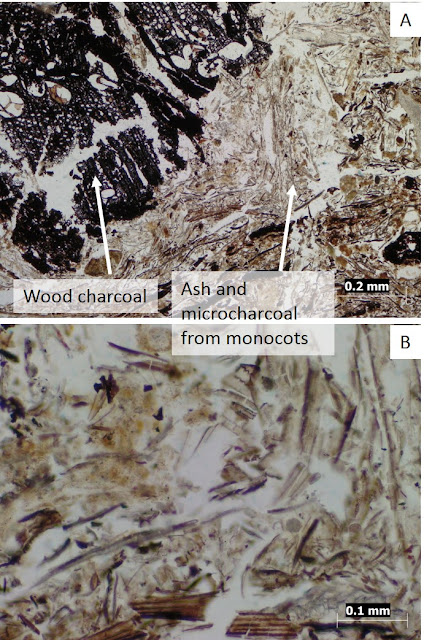
It's been too long since I've looked at any new thin section samples, but today I had the chance to look at some new stuff from Catalhoyuk . Here are some lovely mixed fuel deposits from an external area, showing A. wood charcoal (Quercus?), with microcharcoal and phytoliths from grasses and sedges. B. is a close up of the ash to try and show some of the phytoliths but it is hard to get a good photo in focus even though the slide is only 30 microns thick. Probably redeposited given the random orientation of the phytoliths.

Experiential experiments

Image
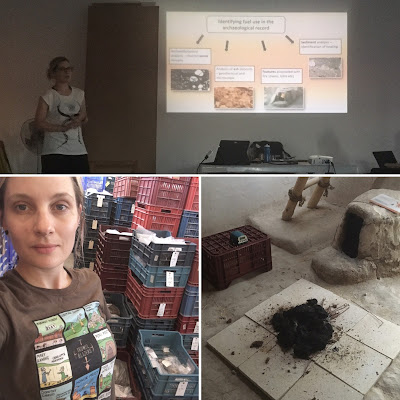
We've spent the past couple of days doing burning experiments in the reconstructed mudbrick house at Catalhoyuk, as part of our Wellcome Trust project. The aim of the experiments is to collect some pilot data relating to smoke emissions when ovens and hearths are in use. We don't have time in the pilot study to conduct a detailed series of controlled experiments - there are a lot of different variables that could be adjusted to test different scenarios - but we do hope to get some basic comparisons of different fuel types and how emissions change over a few hours of burning. I think the most useful part of doing this pilot work has been the practical side of things, the experience of having to find the materials for fuel, finding out how much fuel works best (and at what point there's too much fuel and you get smoked out of the house), observing how different people react differently to smoke levels. We tried using animal dung but it smouldered really badly, which we reali...

Catalhoyuk - Wellcome project

Image
After yesterday's musings I figured I should post about some of the fun archaeological stuff I've been up to at Catalhoyuk this week. The reason we are here this year (we being myself and project postdoc Helen Mackay ), is that we were lucky enough to be awarded a grant from the Wellcome Trust. We are collecting archive samples to export for analysis, doing some burning experiments in the reconstructed mudbrick house, and general networking and scouting for collaborators for when we (hopefully!) do the full sale research project. The focus of the Wellcome project is to investigate the potential relationships between 'biofuel' use and respiratory health in the archaeological record. The materials that people used for fuel in the Neolithic (wood, dung, reeds etc) are being promoted today as sustainable alternatives to fossil fuels, however there has been a lot of research showing that these fuels are actually just as bad for respiratory health as fossil fuels. Biomass ...

25 years of Catalhoyuk

Image
Day 2 at Catalhoyuk. This blog post was supposed to be full of excitement at all the cool samples we've collected and the experiments we have been doing in the reconstructed mudbrick house, but instead I find myself contemplating the institution that is Catalhoyuk. Not Catalhoyuk the Neolithic settlement, but Catalhoyuk the archaeological dig, the community of archaeologists, locals and all the other people who are or have been involved with the project. I don't think I ever fully appreciated what Prof Ian Hodder has achieved here, not until I got my job at Newcastle and realised the time and effort that goes into organising fieldwork, and generating funding for projects. Field seasons that last 2 months, with up to 100 people on site at a time. A dig house with labs and storage. Catering, accommodation, the politics, and of course the archaeology itself. I always felt like I never quite belonged here; my visits were always timed as the excavation was well underway, and ev...

Off to Catalhoyuk, via Olynthos

Image
It seems like I only just got back from Oregon and I'm off again, this time to Catalhoyuk in Turkey, via Olynthos in Greece. I am really excited about the Olynthos project . Although I am no expert in ancient Greece, I was always fascinated by the mythology as a child, and it will be great to finally visit Greece. I was invited to join the project as a geoarchaeologist, specifically looking at the micromorphology of floor deposits in collaboration with the archaeobotany and geochemsitry experts. The excavations are co-directed by Lisa Nevett  at the University of Michigan in collaboration with the Greek Ministry of Culture & Sports and the British School at Athens . One focus is the excavation of house Bix6 on the North Hill. New data on artefacts and their distribution as well as geochemical testing by fellow geoarchaeologist  Carla Lancelotti have indicated broad spatial differences in uses between rooms in the building. I will be applying sediment micromorphology to ...

A day in London

Image
I was hoping to post this whilst on the train but the not so great free wifi scuppered my plans. I arrived in London yesterday evening following a day of exam board meetings. The exam board is where we go through all the marks and see who has passed, what grades they have, and who gets prizes. The whole process is anonymised until final marks are confirmed, then we get to see who got which prizes. I was really happy to see some of the first students I taught when I joined Newcastle finish their degrees and do so well! No names though as I'm not sure the details have been released to students yet. So, I'm in London for two reasons - firstly to go to an appointment at the Turkish consulate to collect visas for myself and other team members for fieldwork at Catalhoyuk in July, and secondly for University Archaeology Day . I think the last time I went to Turkey was 2013 - how time goes by so quickly! Up until then I had been pretty much every year since 2004! University Archaeol...

Field season is about to begin

Field season is beginning a bit earlier than usual for me this year. 2015 - 16 was wonderfully successful in terms of project development and grants, which in turn means that there is a lot going on in 2017. The first round will start at the end of next week, when I will be heading off to Oregon for the main period of fieldwork for the NERC project at Paisley Caves, which I've been blogging about a fair bit. I can't wait to be back in central Oregon getting my hands dirty, literally. It is such a beautiful landscape, very quiet and we'll be a small team, which I prefer. We'll be camping near the site, and taking showers at Summer Lake Hot Springs.  So the stress of sampling at such an important site will be rewarded with a bit of relaxation at the end of the day! When I get back from Oregon I'll be making frantic arrangements to get my research visa for Turkey. This involves leaving your passport on the consulate in London for 1-2 weeks, which is a bit difficult w...

Did the people of Çatalhöyük build boats?

Image
Two posts crossed my Twitter feed last week that got me thinking. Both are related to experimental archaeology and use of wetland resources. If you are a regular reader of my blog (or indeed my academic papers) you will have noticed that I talk a lot about the environment of Çatalhöyük, and how this may have influenced human activity in the Neolithic. You will also notice that I have criticised some of the early interpretations which, to me, present a simplistic interpretation of evidence that doesn’t consider the complexity of the environment, or people. Çatalhöyük was situated in a wetland environment, and there have been debates over the influence this had on agriculture. Where were people growing their crops if the local area was not suitable for agriculture?  One theory suggests people travelled to fields that were located many km away from the site, which in turn has implications for social organisation. This always bothered me, firstly because of the limitations of the ...

EAA conference, Vilnius 2016

Image
Last week was very busy. I was away in Vilnius, Lithuania for the European Association of Archaeologists annual meeting . The last one I went to was Pilsen in 2013  so it was good to go back and catch up with the latest research. I think I probably overdid it, giving a paper and a poster presentation, and also running the Newcastle University exhibition stand. I wasn't really able to do either effectively, having to jump in and out of sessions to sit at the desk. I ended up missing quite a few talks that I wanted to see. However, my paper presentation did go well, and I got some good questions and discussion. I was talking about Catalhoyuk, and assessing the past 25 years of 'multi-proxy' archaeology and approaches to use of space. Although some aspects were critical, the aim was to try and see what has worked and what hasn't worked, and some of the reasons why this might be. There is such a rich and unique record of the history of  excavation and methodology at Catalh...

I love middens

Image
We are in the process of updating the School website for History, Classics and Archaeology at Newcastl e. I've been asked to provide some high resolution photos for various sections, and so have been digitally digging through my image archive. I came across this amsuing photo from 2004 - my first ever visit to Catalhoyuk . It was either during my MSc or just after I finished. So long ago that I still dyed my hair black! I remember this midden - I think it was Unit 1668, and probably isn't there anymore. The first midden I worked on, looking at archived micromorphology slides at the University of Reading, and trying to compare the phytolith data from the same units. Although the Masters project had a lot of limitations (working with archive samples is very difficult when trying to compare microstratigraphic data), the lessons I learned formed the basis of the project I went on to do for my PhD. So I still have a soft spot for this particular midden! These were taken using one of...

Fieldwork in Sicily - Abandoned buildings

Image
Back in the office today after a safe return from Sicily yesterday. I've just about cleared the two week email backlog and am going through all the fieldwork photos. As well as taking lots of photos of the actual excavation , I also took quite a few around the town where we were staying, Villarosa. It's a very small town, with a population of around 6000. A few decades ago it was almost twice this, but the population declined rapidly after the last of the local sulphur mine s was closed in the 1980s. A huge number of people moved to Belgium to take up work in the coal mines, leaving a large number of unoccupied buildings in the town. The photos show an example of an abandoned building overgrown with vegetation, located in between two occupied flats. It is such a strange thing to see; we would never get this in the UK, where property (or land to build new property) is so sought after. It got me thinking about the prehistoric urban landscape of places like Catalhoyuk. The popul...

Micrograph: Layers within layers

Image
I love this image. It's another one from Catalhoyuk , a nice midden in the South Area (unit 17739). I published a paper on these deposits in Antiquity which included this image , so I'll let you read the paper to find out more about this area and its significance. Here I wanted to show a close up of this image and the beautiful but daunting complexity of archaeological deposits under the microscope. What we are looking at is a tiny fragment of wall plaster mixed in with ashy debris and charcoal. A few years ago I did a post about these plaster deposits, as they are found within buildings at Catalhoyuk , on floors and walls. By counting the layers we can see the frequency with which the inhabitants were re-plastering and 'repainting' their houses - regular cycles of maintenance on an annual and seasonal basis. This layer in the midden shows a fragment which has fallen off a wall, and somehow made its way into the midden, probably through sweeping and dumping of debris, ...

Micrograph: Partially burnt sediment with plant voids

Image
I've been preparing for teaching a micromorphology lab class tomorrow, on the topic of architectural materials. Having recently dug out my old laptop ( to look at old job applications... ), I came across my huge archive of micromorphology images. I really need to figure a way of making these available online. I have so many and they are such fantastic references. I found this nice example of a partially burnt aggregate; it is perfect for showing how pseudomorphic plant voids appear in a plant-tempered clay. On the right hand side of the image, the plant temper (grasses) has been burnt, and so has preserved in the form of microcharcoal. On the left hand side, where the aggregate escaped the burning, the plants have totally decayed, leaving only the voids in the shape of the grasses. It also shows how the colour of the sediment change as they are heated, becoming a distinctly darker brown. This sample is from the Deep Sounding midden at Catalhoyuk, some of the earliest deposits that...

Ladies of the Midden Kiln

Image
Back in March I mentioned that I was involved in a sciart collaboration, where artists and scientists come together to work on collaborative art projects, inspired by scientific research. I love this idea. I was always really into both art and science growing up (and took Art as an A Level subject!), and although I choose to go down the 'science' route for my career, I have maintained a keen interest in art, and particularly how we can use artistic expression to communicate scientific research. The artist I have been working with is Molly McEwan , an Edinburgh based artist and graduate of Duncan of Jordanstone College of Art and talented ceramicist.  The photos to the left are a sneak preview from Molly's exhibition at Wednesday's Girl, a free exhibition showcasing the work of female artists from Scotland, held at Space Club and supported by Somewhere To , an organisation provides spaces and venues for young people across the UK. Molly's solo exhibition , ...

Microfossil of the Month: Wheat husk phytoliths

Image
This month's microfossil is a classic, at least within near eastern archaeology. The beautiful little structure you are looking at here is a phytolith from the husk of wheat. A huge area of research in phytolith studies is focused on cereals, and whether cereal phytoliths can be used to identify the genus or even species of cereals, and whether we can distinguish cultivated cereals from wild grasses. This obviously has very significant potentials in studying the origins and development of agriculture. This particular phytolith is from the middle Neolithic levels at Catalhoyuk , Turkey. At this point we have definitive evidence for agriculture from other lines of evidence, such as charred cereal grain stores within buildings. This phytolith was recovered from a midden, and is interesting because of its size. There is a positive correlation between the size of conjoined phytoliths and the availability of water during the growth of the plant. you can see that this phytolith is very la...

Science, Art and the Construction of Reality in Archaeology

Image
I found out this weekend that my application to take part in an exciting art/science collaborative project was successful! It was only by chance that I found out about the project, through some random browsing around Twitter. Joining Twitter was one of the best things I ever did, so many opportunities and connections to be made that I would never get the chance to see otherwise. The project I am joining is ASCUS/TNS Engage project. ASCUS is a non-profit organisation that supports collaboration between arts and sciences, and builds connections between different organisations, institutions, individuals and the public. TNS is The Number Shop , an art studio and gallery. Artists from the studio will be developing new work based on dialogues with scientists, as part of the Edinburgh International Science Festival . Some of the work will actually be produced during Open Studios during the festival, so that the public can come and experience the work being produced. The idea is to bring the ...

Goats and reeds in the Neolithic

Image
Bulliform cells in modern Zea mays tissue (source: Visuals Unlimited, Inc) Fellow animal dung enthusiast Sarah Elliot at the University of Bournemouth shared this fab little article describing the use of 'Eco goats' to manage invasive plants in the US . It is especially interesting that they note the use of goats as a pesticide-free way to manage Phragmites reeds. These reeds have distinctive phytoliths which archaeologists call 'keystone' bulliforms, which are relatively large single cell phytoliths that are named as they are said to resemble a Roman keystone arch in cross section.  In transverse section they look a bit sausage shaped, and within a plant these cells are 'stacked' next to each other as part of the upper epidermis (the plant 'skin'), and are related to water storage. If you're a botanist you might also call these motor cells, because during times of water stress, they shrink and cause leaves to fold or curl up. Phragmites phytoli...

Micrograph of the Month: Krotovinas at Çatalhöyük

Image
Did you know that there is a word for an animal burrow that becomes backfilled with soil/sediment? That word is krotovina! At Catalhoyuk , burrowing by small mammals is probably one of the most destructive forms of bioturbation on site. Ground squirrels, or suslik as they are known in Turkey, have a great time digging their way through the nice soft archaeological sediments, mixing up the deposits as they go. When marking out locations for micromorphology sampling we try and avoid these burrows, as we want to look at intact stratigraphy. Every once in a while however, what looks to be undisturbed deposits turns out to have a hidden burrow when the slide is made. It makes the sample almost useless it terms of analysis, but in this case has given a nice example of bioturbated deposits for my teaching reference collection of slides! I have included pictures of the midden section that these micrographs come from, as it is much easier to understand what a krotovina is at the macroscale. The...

World Toilet Day - attitudes to poop in the past

Image
I found out that today is World Toilet Day ! What better chance then to have a think about toilets and the disposal of human waste in the past. Regular readers will know (and the blog title perhaps suggests...) that coprolites, or fossilised faeces, are a regular feature of my work. A big part of World Toilet Day is about education and the problems of sanitation that many people face on a daily basis. The campaign highlights the fact that excrement is a bit of a taboo topic for many people, it's something we don't feel comfortable talking about. It's a 'hidden' activity. Has this always been the case in the past? The answer from the archaeological record is no - from prehistory to the famous public latrines of the Romans , there are many examples of a more open or communal approach to defecation. The study of human waste in archaeology, particularly faecal waste, is however a neglected topic. Coprolites don't really fit neatly into any of the major existing s...

Micrograph of the Month: Bits of Bones

Image
For the past few weeks I have been revisiting some old slides from the TP excavation area at Catalhoyuk . I collected these samples  in 2004, and they were some of the first that I worked on for my PhD. At the time I found them a bit disappointing, as there is a lot of bioturbation and erosion  going on in this part of the site, which means that trying to reconstruct activities using microstratigraphic analysis is difficult. The TP area is located very close to the surface of the mound, so despite the fact that these are the youngest deposits, the preservation is nowhere near as good as the earlier, deeply buried deposits. In the end I focused more on the South and 4040 areas, with the TP samples being used as a brief comparison of how different the taphonomic processes are in different parts of the site. Which brings me on to this month's photos! I was contacted by Kamilla  PawÅ‚owska who is conducting zooarchaeological analysis in the TP area, and is...