Posts

Microfossil of the Month: Which Wood?
Image
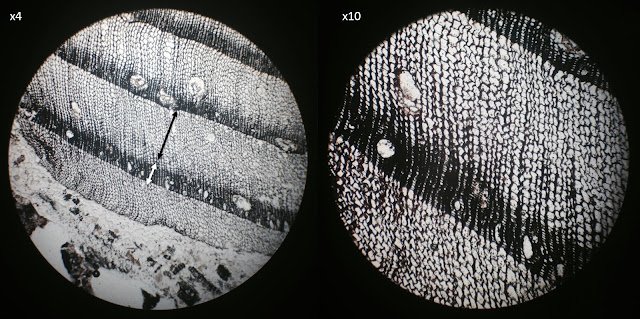
Something a little bit different for October. This fits in nicely with what I've been up to this week, preparing teaching materials on wood charcoal analysis in archaeology. Although I am not technically a wood specialist, I am wondering if I should pick up a new skill set, as it would actually be very useful as a thin section micromorphologist. This image shows a cross section through an unidentified fragment of wood charcoal in a thin section of sediments from the tower at Cesis Castle, Latvia . There are layers within the sediment that are full of tiny wood charcoal fragments, and actually we see bits of wood a lot when looking at thin sections of ash samples, unsurprisingly. You can see the annual rings quite clearly in this fragment, and it can be identified as a soft wood species (coniferous) due to the lack of pores. Soft woods are a bit more difficult to identify than hard woods (from deciduous trees), as their structure is more simple and less distinctive. In this example ...
Say Cheese! Feeding Stonehenge

Image
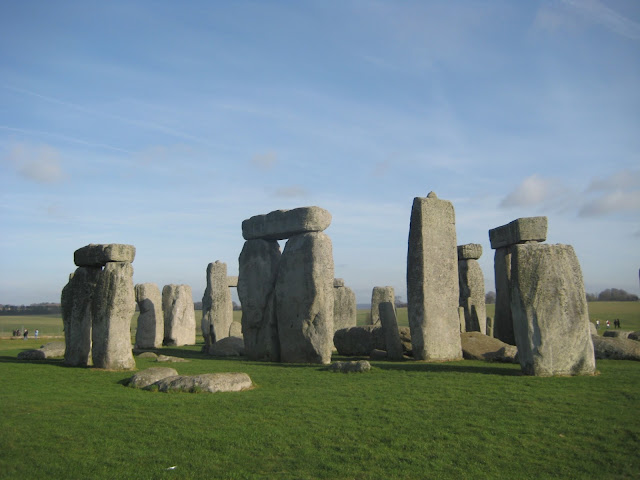
The beginning of the semester at Newcastle is just flying by. So many exciting opportunities for the future - but right now a little something from the past. Back in 2010 I started a postdoctoral position with the BioArCh group at the University of York, investigating food residues in pottery from Durrington Walls, thought to be the settlement that housed the builders of Stonehenge. I've blogged about the progress of the project on a number of occasions , and wrote about it for the Day of Archaeology back in 2012. This week the academic paper from all that hard work was  published in Antiquity journal, along with a university press release , and it's very satisfying to see the final results in print. Being related to Stonehenge, I suspected it may be of general interest, and I was quite excited to see whether the media would run the story. I spent yesterday evening watching with a combination of awe and horror at how this process unfolds - a carefully worded story of science...

Microfossil of the Month - Globigerina Ooze

Image
A bit of a geoscience themed iPhone micrograph for September (I am getting quite good at this iPhone down the eyepiece photo taking thing). Yes, there really is a sediment called ooze... Globigerina  ooze! Archaeologists are probably aware that much of our global scale climate reconstructions come from the isotopic analysis of deep sea sediment cores, and  Globigerina ooze is one of these sediments. Huge areas of the ocean floor are covered in this stuff, which consists largely of the shells of various foraminifera, of which the species Globigerina bulloides is the most common. The shells of these little creatures are composed of calcium carbonate (CaCO 3 ) and it is the oxygen component of this that is used for oxygen isotope analysis in the  reconstruction of  temperature in the past. The name  Globigerina  ooze was first used to describe the sediment during planning and construction of the earliest transatlantic telegraph cables. They are ve...