Posts

Showing posts with the label teaching

New BSc Archaeology programme at Newcastle!

Exciting news from Newcastle today - the proposal I have been working on for over a year, for a new BSc Archaeology degree, was approved today (pending some minor paperwork tweaks). I am really excited about this - it is something I have wanted to do since I started at Newcastle, and it's been hard work getting all the paperwork in place, but it has paid off, and fingers crossed is the first step in broadening our archaeological science teaching at both undergraduate and postgraduate level, in line with our expanding research profile in this area. Newcastle is actually quite unusual, being one of the only Russell Group universities not to offer  both a BA and BSc in Archaeology. Archaeology is one of those truly interdisciplinary subjects that places emphasis on both science and humanities, and students usually have the option to focus their skills in either area. Since I joined Newcastle I have developed a number of new 'science' based modules in environmental and geoarcha...

Teaching archaeological sediment micromorphology part 2

This semester I've been teaching archaeological sediment micromorphology, as part of a third year module in geoarchaeology. I mentioned a few weeks ago how hard it was to teach a subject this complex in only 2 hours per week, and that in future I was thinking of removing it from Geoarchaeology and turning it into a stand alone module. I still haven't decided whether to do this, as I think it's important to have some teaching of it at UG level, but a module focusing entirely on micromorphology is probably more suitable for Masters level. Related to my frustrations, I made an offhand comment on Facebook that despite it being one of my specialist subjects, sediment micromorphology is very boring to teach. More than any other method I have studied, micromorphology is definitely the one filled with the most jargon. Don't get me wrong, I think jargon is important. We need the specialist language to describe the many complex features and processes that we see in thin sectio...

Teaching geoarchaeology and sediment micromorphology

Image
Today I am doing three hours of teaching for PG students on soil. This follows two hours yesterday of teaching 3rd year students sediment micromorphology. My 3rd year Geoarchaeology module is challenging this year, as the class is 75% geography students, so I have had to modify the content a bit to make sure we go over the archaeological concepts. Having non archaeologists in the audience makes you really just how jargon filled the subject is! At the moment the module is set up so that the practical classes are about 25% bulk soil analysis and 75% thin section analysis, but I am tempted to switch this next year and focus on the bulk sediments. As much as I love micromorphology, it is a very challenging subject to teach as it is so time intensive, and I think it would work better as a stand alone module. This will give the students more time to work on materials, and to focus the seminars specifically on micromorphology. At the moment the Geoarchaeology module seminars are focused on br...

Teaching Geoarchaeology Field Skills

Image
As part of a postgraduate module I am co-convening, Landscape Archaeology: Theory and Practice, I will be taking a group of Masters students into the field in a few weeks time to teach them the joys of soil transect surveys. We've even bought a brand new shiny hand auger kit. I am quite pleased with how the handbook and plan have turned out. We're lucky to have the amazing landscape of Northumberland to work with, and the area we are looking at, Milfield Basin, has had extensive archaeological and geoarchaeological analysis so there is plenty of background material for the students to refer to. Preparing this exercise has been strange in some ways and almost nostalgic, as this was one of my first experiences as a geoarchaeologist. As part of my MSc Geoarchaeology, we were tasked with doing a borehole survey and writing it up like a professional commercial report. I remember distinctly the terror of being sent out with a hand auger, and being left to get on with it. There is not...

Adventures in fish bone preparation

Image
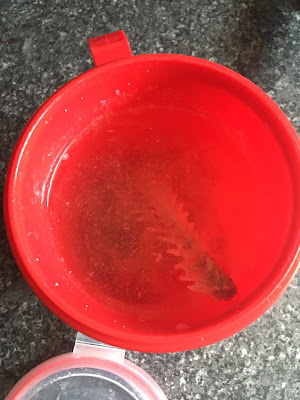
Cold water maceration If you follow my Twitter feed you may have noticed a string of posts discussing the best methods for preparing specimens for animal bone reference collections. This all started a while back when I decided to take the Sheffield Zooarchaeology short course . Having had little training in bones I thought it would be a good idea to get some basic skills, as I am responsible for the reference collections at Newcastle. However the majority of our existing collection is large domesticates, and being an environmental archaeologist, I figured we needed some microfauna. I already have a lecture in my Environmental Archaeology module that covers animal remains as environmental indicators, and wanted to expand this to include a practical. Being a second year undergraduate module this is very much an introduction to the subject, and the learning outcomes focus more on understanding the implications of recovery and taphonomic issues, rather than developing expertise in spec...

Zooarchaeology short course at Sheffield

Image
For the past three days I've been doing a short course in Zooarchaeology at Sheffield . The Sheffield lab is one of the best places in the UK, and probably Europe, for animal bone research, and I was amazed at the extent of their reference collections. An absolutely fantastic resource. Although I have spent many years working with zooarchaeologists, and have a basic understanding of the subject, I've never worked directly with this material myself. As I am now responsible for the Wolfson Laboratory at Newcastle , and therefore our animal bone reference collection, I figured I should learn a bit more about them! It was very interesting to hear about a lot of research themes that I am interested in from the perspective another specialism. Taphonomy for example is something that I deal with myself a lot in the analysis of environmental samples, and it was very informative to hear how other people approach this topic. Whilst a lot of zooarchaeology focuses on the relationships be...

Pollen for Archaeologists

Image
The past few weeks have been pollen themed. Teaching pollen for Environmental Archaeology, and a new paper out on pollen analysis (and geoarchaeology) at RadzyÅ„ CheÅ‚minski in Poland . The latter is from my time working on the Ecology of Crusading project , and is a nice case study in using multi-proxy approaches, including historical documentary sources, to investigate landscape change. Pollen analysis is not my area of research expertise, but I have spent a long time working with pollen data. As a geography undergraduate I had several pollen classes for modules in  Quaternary   Environments  and Biogeography, and it also featured heavily in my MSc Geoarchaeology. Pollen analysis does what it says on the tin - we extract pollen grains from sequential layers in sediment cores, and count them to see how vegetation has changed over time. If we have a sediment layer dated to 1000 years ago that is full of oak pollen for example, we can reasonably assume that there was an oa...

War of the Lipids

Image
Different ways of representing lipid structures Chemistry has always been one of my favourite subjects, I like how logical mechanisms are, and the structures have a certain beauty - once you know what the symbols mean. I was asked to contribute some lectures on lipid analysis for the Honours Scientific Methods in Bioarchaeology course this semester. Having taught this subject previously I thought this wouldn't be a problem, and dug out my 2 hour session on lipid chemistry and nomenclature ( Octadeca- cis -6- cis -9- cis -12-trienoic acid anyone?).  It's a shame I can't just start with the archaeology - Feeding Stonehenge! The Earliest Humans in North America! Mummification! There is such an exciting range of applications of the technique. It isn't until the latter part of the session however that I usually get into the archaeological aspects, as I think it's important to understand the background chemistry in order to understand how you can apply it to ...