Posts

Showing posts with the label fungus

Digitized thin section slides!

Image
I can't remember if I posted about this earlier in the year, but I was lucky enough to be awarded two student work experience placements as part of the  Newcastle NWE programme , where students complete flexible paid projects within the university. Two of my Environmental Archaeology students have been working for the past few months, digitizing my entire collection of thin section slides. At some point I hope to make these available online as an open access resource for teaching and research. They did a brilliant job! I've only just had a chance to go through all the scans, having been away on fieldwork, busy with exams, then graduation. Here is one of the scans of a thin section from medieval Riga, that I have been working on as part of the Ecology of Crusading project . Combined with the fact I have just moved the lovely Leica DM750P research microscope into my office (kindly purchased by History, Classics and Archaeology ), I can now get working on my mounting backlog of sa...

Faecal lipids and fungal spores as proxies for ancient pastoralism

Image
I was recently alerted to this interesting new paper (open access!) through Google Scholar citation alerts, which is a very useful service for finding out when your papers are cited by other authors (in this case my 2011 paper on faecal lipid residues at Catalhoyuk ). The authors studied a sequence of lake sediments from Lake Igaliku in SW Greenland, looking at changes in the quantity of DOC and fungal spores. DOC is a bile acid (deoxycholic acid), and is found in both human and ruminant faeces, but at a higher concentration in ruminants. Humans have higher amounts of LC (another bile acid, lithocholic acid). Interestingly no LC was found, suggesting that the DOC comes entirely from herbivores (and that the runoff 'polluting' the lake is largely agricultural, rather than coming from settlement sewage waste). The fungal spores that were found are from coprophilous fungi - i.e. fungi that grow on faeces! The amount of DOC present correlated with the number of fungal spores, wi...

Micrograph of the Month: Fabulous Fungi

Image
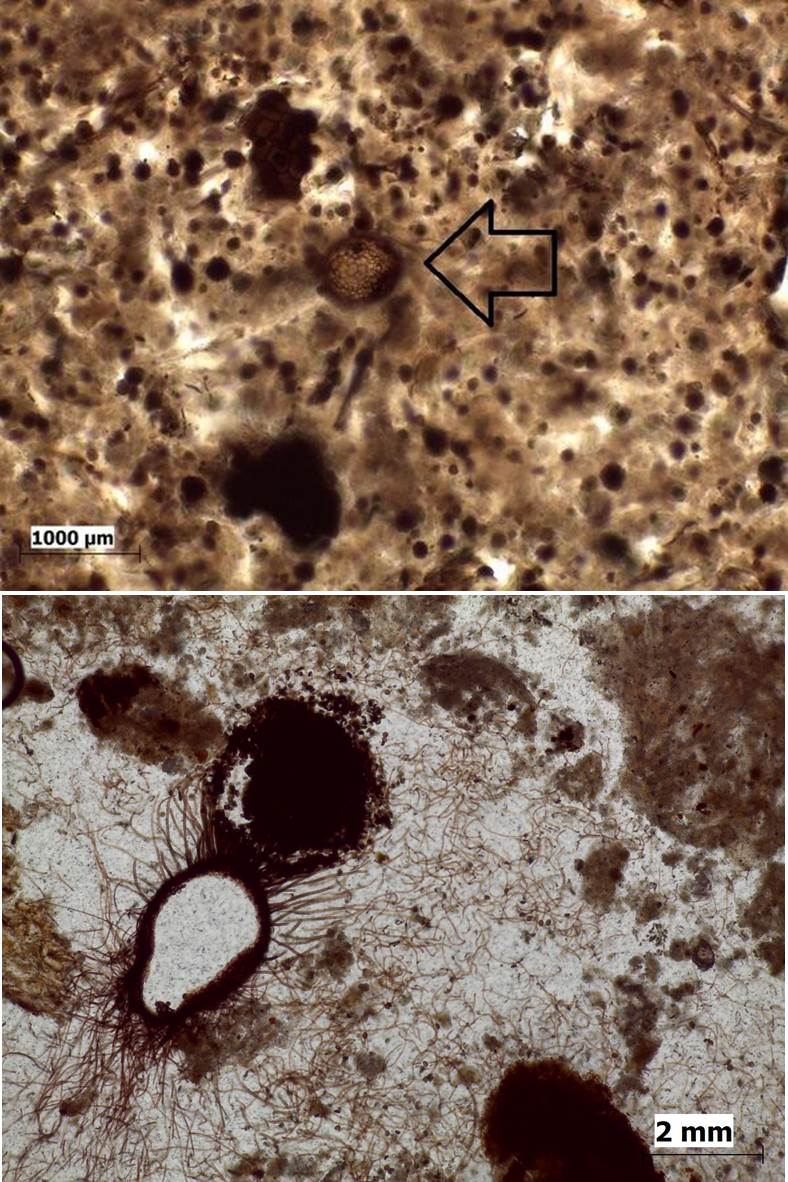
Followers of my Twitter account may recognise these little creatures! I posted the pics separately a while ago to see if anyone could help with identification. So far no response, if anyone has any clues or reference suggestions do let me know. Both are from medieval floor deposits that have undergone significant post-depositional bioturbation. The lower image is one of my favourites. The hyphae are like little tentacles that spread all the way through the sediment. That is the little string like projections that you can see extending from the sporongium. Which is the spherical bit containing all the little spores, and in this particular view is nice and ripe with little spores bursting forth. It is quite creepy to come across all of a sudden when you are looking down a microscope and not expecting it! The one at the bottom has a clear area in the middle, because the top has been abraded away during the thin section preparation process. Basically we are looking at an 'aerial' v...