Posts

Bricks

Image
As promised, a new post that is actually on geoarchaeology. I never used to be into industrial archaeology. Having grown up in the north east, I always thought the buildings were ugly. The skyline from our house was filled with the cranes of Swan Hunters shipyards, and I remember the siren that used to go off to call people to work. My dad would grab his bait box and walk there, down the path into what is now Segedunum Roman Fort. He likes to tell me the story of how the end of the wall was right outside the cabin where he would sit with his mates on a break. This was all just whatever at the time. I prefered nature - beaches, rocks and trees - to being in the urban landscape. After my dad was made redundant when the Shipyards was closing down for good, the industrial landscape became associated with decline, poverty instead of pride. A reminder that we were poor and lived in an ugly place with ugly old buildings. I was so happy to move away from that at age 18 when I went to univers...

The ethics of archaeological coprolite analysis?

Image
Some personal good news amongst the Covid19 chaos - I have a new paper currently in press in Earth Science Reviews  (currently pre-proof so check in at a later date for definitive version with updated figures etc). This is a substantial review my team and I have been working on for a couple of years now, chipping away at it in the background as part of our NERC research project , and I'm really pleased with how it turned out. We posted it as a pre-print a few months ago on EarthArkiv , the first time I've used a pre-print server. I was hoping to engage in an open peer review process, but we didn't get any comments (do pre-prints really get peer reviewed...? A discussion for another blog post). On the plus side we did get 264 downloads before the paper made it through peer review with Earth Science Reviews. One of the points we make (albeit briefly) in this paper is that coprolites should be subject to the same strict protocols for access and analysis that have been propos...

New project: TerraSAgE: Terraces as Sustainable Agricultural Environments.

Image
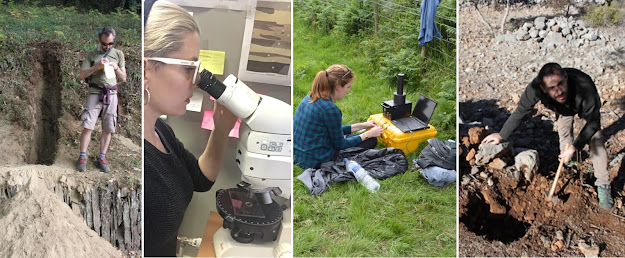
I am excited to announce a new AHRC research project starting at Newcastle  in January,   TerraSAgE: Terraces as Sustainable Agricultural Environments .The project is led by PI Prof. Sam Turner, and I am one of the project coIs, overseeing the geoarchaeological aspects of the project. Sam and his team have been doing pilot studies for this project for a while now, developing a new OSL dating method to understand the chronology and formation of agricultural terraces from prehistory to historic periods. I became involved in the project last year to advise on geoarchaeological and soil science approaches to the analysis of archaeological and historic terraces. The major aims of the project are to understand how and when terraces were constructed and how they were maintained and managed, and how this varies in different geographic regions, and in different time periods. We also want to understand why terracing developed, and conversely, why it was abandoned in some places but not...